



"We will lead the VR/AR market with VRIGHT's immersive media services"
 Published2018.02.21 09:34
We will provide new customer experiences and form a VR/AR ecosystem through corporate collaboration.
KT conducted strategies and experiences for immersive media services (VR/AR), which are core technologies of the 5G era.
KT showcased immersive media services using the 28GHz frequency at the PyeongChang Winter Olympics. In 2017, it established a 5G pilot network at the Jeonju/Suwon World Cup Stadium, where the U-20 World Cup was held, enabling features such as "360-degree virtual reality live" and "interactive time-slice." Moving forward, including at the Olympics and events, users will be able to watch sports matches realistically through KT's immersive media services, such as Sync View and Omni Point View.
Immersive media, which is attracting attention as a next-generation business, is content based on information and communication technology (ICT) that maximizes the five human senses to provide experiences similar to reality. For example, information such as the scent of food or flowers, touch, and motion recognition can be accessed through the sensory organs. It is expected to provide users with new experiences and create new business models.
Ko Yun-jeon, Head of KT’s Future Business Development Group, emphasized, “We will leverage the ultra-high speed and ultra-low latency characteristics of 5G to enhance the immersion, realism, and real-time interaction of VR/AR.” He added, “The global market for immersive media services was valued at 8 trillion won in 2017 and is projected to grow to 91 trillion won by 2021,” stating that the market is expected to expand into the media, sports, and commerce industries, centered on games.
However, the immersive media industry cannot be viewed optimistically based solely on prospects. First, domestic content distribution is facing difficulties due to low investment in content. Furthermore, device adoption is not proceeding smoothly as sales are concentrated overseas, centered around device manufacturers. Problems also include a vicious cycle of shrinking investment caused by a lack of core technology and ambiguous legal regulations.
Due to difficulties in distributing content and devices caused by a lack of technology, legal regulations, and cost issues, Korea’s technology level was 79% of that of the United States as of 2017, with a technology gap of 2.2 years, indicating a gap in business and technology.
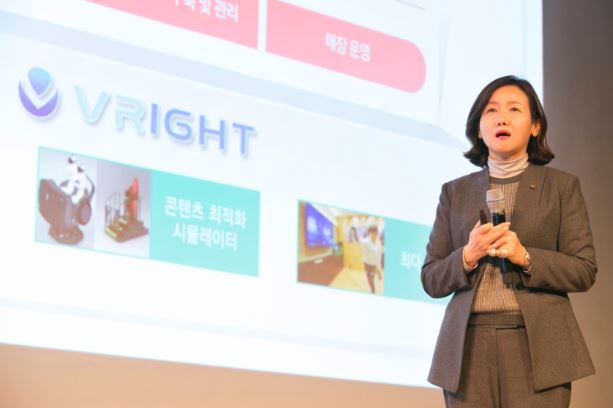
Accordingly, KT began the 'VRIGHT Project Collaboration' with retail company GS Retail last year to create revenue-generating content and platform infrastructure. The VRIGHT Project is an accessible VR theme park that offers FPS games, exclusive domestic AR sports, and content-optimized simulators.
KT aims to promote B2B business and generate revenue models through experiential spaces like Bright. The company announced plans to secure core competencies for content dissemination and copyrights by establishing a dedicated VR/AR fund for enterprises and engaging in continuous collaboration with business partners, while also striving to resolve national regulatory and censorship issues.
Bright, an urban theme park where a pilot service for immersive media was conducted on this day, will officially open in early March. Currently, it features about 13 types of VR content, including 'Special Force VR: UNIVERSAL WAR', a VR version of the first-person shooter game 'Special Force', and 'Flying Jet', and is expected to increase to around 50 types. Each piece of content provides a new VR/AR customer experience through HMD (Head Mounted Display) devices, which are worn on the head to enjoy large-screen images.
'Special Force VR: UNIVERSAL WAR' has become a win-win model that goes beyond content supply to incorporate IP. A representative from Special Force, participating as a leading small and medium-sized arcade company, stated, "It seems people are unable to experience VR/AR due to expensive devices," adding, "Collaboration between companies is necessary through the expansion of experiential businesses like Bright, which utilize the content and services of SMEs."
KT has set a goal to expand the market size to 1 trillion won by 2020, raise its technology level to 95%, and narrow the technology gap to less than one year. It indicated that it would develop video recognition, hologram technology, and big data-based AI content using its network infrastructure, and launch them for individual consumers within the year.
To handle the massive data traffic of immersive content that conveys information from the five senses, 5G implementation must serve as the foundation. Currently, we are in a 4.5G (pre-5G) situation where no standard for 5G has been established. In response to a question regarding whether there would be any issues with implementing KT's VR/AR technology, Director Ko stated, "There are no problems implementing the current level, but we are currently in the development stage to ensure that it can be utilized even after the standard is finalized."
KT’s Head of Future Convergence Business Promotion Office, Yoon Kyung-rim, stated, “We will provide cloud-edge-based services to offer opportunities to content developers and designers and lead the industrial ecosystem through mutual growth,” and emphasized, “We will lead the future next-generation immersive media service market by utilizing 5G for VR/AR that cannot be realized in 4G.”
Comments
Related news
K-live X VR Park, where you can experience realistic media, unveiled
KT will open the Sangam 'K-live X VR PARK' at the Nuridream Square Digital Pavilion in Sangam, Seoul, applying various immersive media technologies including hologram, AR, and VR. The Sangam 'K-live X VR PARK' (hereinafter Sangam K-live X) is an immersive media complex experience space built and operated by KT, VR content specialist Bareunson, and Holotive Global, which has operational experience with K-live Centosa, receiving spatial support within the 'Korea VR/AR Complex (KoVAC)' established by the Ministry of Science and ICT/National IT Industry Promotion Agency (NIPA) to foster the VR/AR industry ecosystem.
2017.12.26by 김지혜 기자
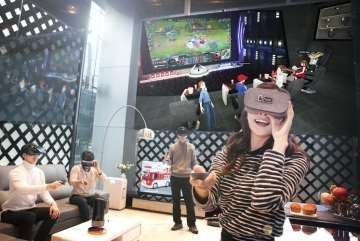
SK Telecom unveils 'Oksusu Social VR' for performances and conversations in virtual space
SK Telecom will showcase a service resembling the virtual space from the film 'The Matrix' at MWC 2018. Users can don VR devices, enter virtual space as their own avatar, and communicate with other participants while viewing the same video content through 'Oksusu Social VR(oksusu Social VR)'. 'Oksusu Social VR' combines virtual reality with the media platform service 'Oksusu' and 'Social Community' functionality, enabling users to enjoy video content together with friends worldwide in virtual space and communicate through avatars.
2018.02.19by 김지혜 기자
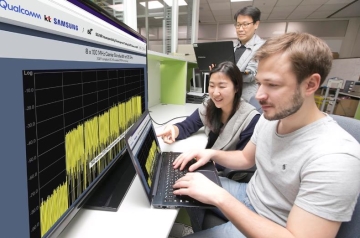
KT, Samsung Electronics, and Qualcomm Successfully Launch 5G Data Communications Based on International Standards
KT announced that it has successfully achieved data communication based on the 5G NR (New Radio) specification, which is the 3GPP international standard for 5G, together with Samsung Electronics and Qualcomm at Samsung Electronics Digital City in Suwon, Gyeonggi Province. The demonstration content from the collaboration of the three companies is scheduled to be exhibited at the three companies' booths at MWC2018, which will be held in Barcelona, Spain from February 26th. In this demonstration, ultra-high-speed 5G data communication and ultra-low latency of approximately 1ms were verified. These performance characteristics are essential for future 5G services that require large-capacity data transmission and fast response speeds, such as VR/AR, real-time gaming, smart factories, and autonomous vehicles.
2018.02.20by 김지혜 기자
ESP32 Development Environment Selection and GPS Application Implementation
The ESP32 is a microcontroller that integrates Wi-Fi, Bluetooth, 12-bit ADC, capacitive touch, PWM, DAC, and UART in a single SoC. However, the abundance of features does not by itself solve the designer's problems. The real challenges lie in selecting the appropriate development environment, determining which pins can be used and which must be avoided, and converting raw data from modules into usable information. This document addresses ESP32 peripheral constraints (ADC2 and Wi-Fi coexistence limitation, UART1 occupancy, ADC non-linear regions), the trade-offs between Arduino IDE and ESP-IDF, and the process from connecting NEO-6M/NEO-M8N GPS modules to UART2, parsing NMEA sentences, and visualizing routes in Google Earth, all organized based on documented references.
2026.10.12by 편집부
MIPI CSI-2, DSI-2, C-PHY, D-PHY Test Solution Technical White Paper
The MIPI interface adopts a burst mode that transitions between low-power (LP) and high-speed (HS) states for low-power consumption, and in return, strict timing rules are imposed on state transitions. Additionally, the high-speed section operates as a packet-based protocol with headers, ECC, and CRC, so verification engineers must handle waveforms and protocols simultaneously. Traditional configurations combining general-purpose oscilloscopes and AWGs reveal limitations in setup complexity, measurement uncertainty, and lack of reproducibility when faced with these requirements. This white paper, based on webinar materials, organizes the structure of this problem and describes how the SV5C-DPTXCPTX generator for receiver testing and SV5C-DPRXCPRX analyzer for transmitter testing integrate state transition testing, stressed eye testing, and protocol analysis into a single bench, along with their application boundaries.
2026.10.12by 편집부











