


To expand 3D printing, know-how and technical capabilities, not just simple financial support, are needed.
 Published2018.03.02 10:40
Ministry of Trade, Industry and Energy Announces Four Key Strategies to Lead the 3D Printing Market
The "Iron Man" helmet worn by Yun Sung-bin, who won the gold medal in skeleton at the recently concluded PyeongChang Winter Olympics, has become a hot topic. This product was prototyped by HCJ using a Stratasys 3D printer. Additionally, 3D printing was applied to the sleds of the U.S. Olympic luge team to produce personalized equipment while saving time and costs. 3D printing is now expanding from sports into the industrial sector.
3D printers offer greater cost and time savings compared to conventional printers when product defects are detected, and can produce prototypes immediately. By integrating the concepts of product production and disassembly, consumers can directly manufacture the items they need according to their preferences; as long as they have an idea, there is no need to equip special facilities or outsource production. For these reasons, 3D printing has been introduced as one of the top 10 promising technologies at various forums and has been hailed as an innovation in manufacturing.
Contrary to expectations that it would be utilized in many fields during the early stages of the industry, it is currently specialized in high-value-added industries that use specific equipment for extended periods, such as industrial machinery, space and aviation, and defense. In such cases, predictive maintenance and repair are crucial. By utilizing 3D printers, replacement parts can be produced immediately without the need to manufacture expensive molds. For example, GE presented a business model utilizing maintenance and repair, and in Korea, the restoration of discontinued and procurement-difficult items was carried out using 3D printing technology for five months starting July 1, 2016. Through this, water jet propulsion systems for patrol boats and pumps for destroyers were manufactured and replaced.
The Korea Printing Association projected that the U.S. 3D printing manufacturing market would see revenue increase to $4.3 billion by 2023, starting with 17% growth in 2018 and maintaining an annual growth rate of 7.8%. As such, 3D printing is demonstrating growth in the global market by realizing eco-friendliness, speed, and smartification in manufacturing processes.
However, despite the optimistic outlook and various advantages of 3D printing, the actual utilization of 3D printing in Korea is difficult to perceive due to the burden of equipment costs, technical outsourcing costs, shortage of skilled personnel, high level of usage methods, and lack of technical capabilities.
According to NIPA, domestic technology levels are at 60% of those of the United States, lagging behind by 2.9 years, and the country has recently been overtaken by China. Furthermore, it announced that in terms of market share by country, the U.S. recorded 37.9%, Germany 11.1%, and Japan 7.8%, while South Korea stood at only 4.0%.
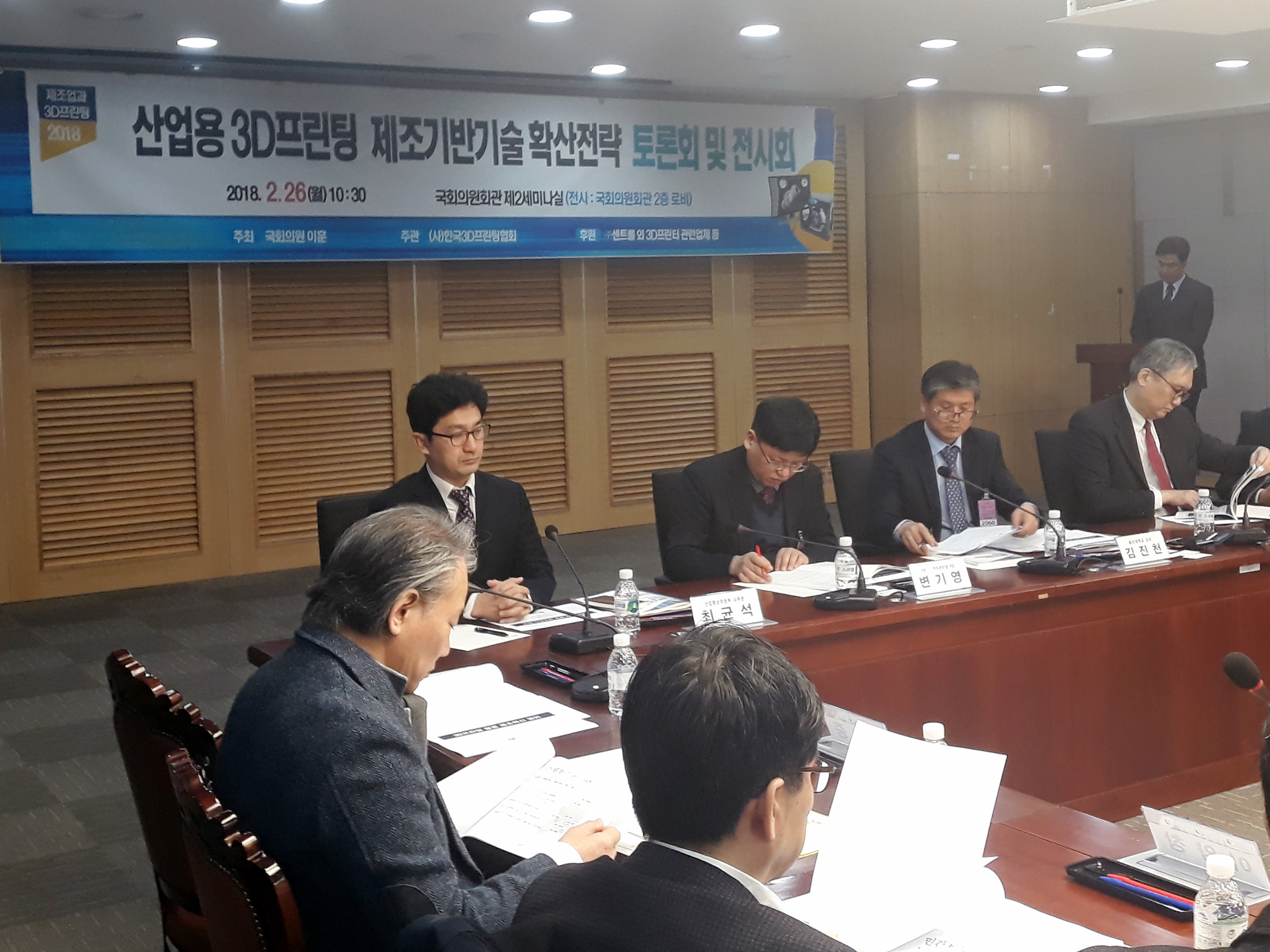
Choi Gyun-seok, an official at the Ministry of Trade, Industry and Energy, said, “3D printers will be applied in various fields, including industrial machinery, aerospace, consumer goods, electronics, automobiles, and the medical industry.” He continued by suggesting the topic of "Trends and Problems in the 3D Printer Market," stating, "I hope this serves as an opportunity to diagnose issues for widespread adoption and apply solutions during the planning process."
Regarding the issues with distribution, Lee Seok-mo, a senior researcher at Hyundai Heavy Industries, pointed out problems, stating, “Since all production research and equipment secured domestically through funding utilize foreign equipment, prototype production is costly, and there is a lack of technical capability and know-how to handle it effectively.” He further emphasized, “It is time to provide simultaneous support for equipment and powder costs, as well as workforce training, know-how, and technical capabilities within the 3D printing industry.”
For example, the Korean figure market relies on Chinese technology for production rather than domestic technology. The input process in China takes an average of over 120 days, and physical distance and communication gaps during the mold manufacturing process have a negative impact on the production process. If we secure our own technology and increase the utilization of printers, the manufacturing period can be shortened by approximately 30 to 40 days, resulting in cost reduction.
Kwon Soon-hyo, a team leader at Materialise, cited the reason for companies' reluctance to adopt 3D printers as “the low level of understanding and trust in 3D among domestic manufacturers.” He stated, “There is a need to secure the trust of small and medium-sized enterprises by increasing the use of 3D printing in visible sectors such as semiconductor and medical supply companies, as well as large corporations.”
Lee Yong-woo, a director at the Korea 3D Printing Association, argued, “It is necessary to approach 3D printing in conjunction with the Fourth Industrial Revolution or smart factories.” Pointing out that essential elements of smart factories can only be introduced by large corporations and that it is difficult for small and medium-sized enterprises (SMEs) to adopt them due to realistic conditions, he expressed the opinion that “if we increase the utilization of 3D printing for SMEs, the diffusion effect will be greater.”
The government announced that it would achieve the goals of "fostering global leading companies," "increasing global market share from the current 4% to 6% by 2019," and "securing independent technological capabilities, such as domestic and international patent applications," by reflecting the opinions of experts from various fields and implementing four major strategies: supporting market growth through demand creation, strengthening technological competitiveness, strengthening the foundation for the diffusion of the 3D printing industry, and strengthening the institutional foundation for industrial development.
There was a shared consensus among those in the field that it is necessary to diagnose the 3D printing industry from a macroscopic perspective and foster technological capabilities by establishing short-term, medium-to-long-term plans in addition to financial investment. Furthermore, they unanimously agreed that field experts must be involved in policy formulation to ensure policies are effective in the industrial field.
Representative Lee Hoon of the Democratic Party of Korea said, “I hope this serves as an opportunity to examine the current state of South Korea’s manufacturing competitiveness and to establish systems that can support strategies for the diffusion of new manufacturing base technologies by presenting 3D printing technology and related cases that strengthen domestic manufacturing.”
Comments
Related news
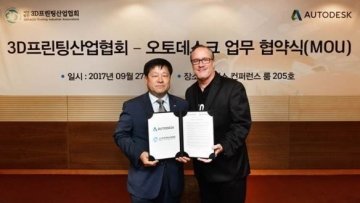
Autodesk and the 3D Printing Industry Association will collaborate on talent development and product development.
Autodesk and the 3D Printing Industry Association, a representative non-profit organization in Korea's 3D printing industry, signed a Memorandum of Understanding (MOU) to promote the dissemination and strengthen the technical capabilities of Korea's 3D printing technology at the 'Autodesk University Korea' held at the COEX Convention Center on the 27th. The memorandum of understanding includes the adoption of Autodesk Fusion 360 as the standard tool for the education and certification programs of the 3D Printing Industry Association, and encompasses the collaborative efforts of both parties to ultimately advance the domestic 3D printing industry through cooperation in fostering specialized 3D printing experts, job creation, and technology transfer. The 3D Printing Industry Association has produced approximately 10,000 trained graduates through its 3D printing expert training program over the past three years. Through this collaboration, the two organizations plan to adopt Fusion 360 as the standard educational tool for 300 member companies and 30 educational facilities belonging to the 3D Printing Industry Association, and will continue to provide support for the dissemination of 3D printing technology and the enhancement of technical capabilities.
2017.09.27by 김자영 기자

Stratasys Strengthens Smart Manufacturing in Domestic Industries Through 3D Printing Adoption
Stratasys introduced additive manufacturing solutions while announcing its business expansion strategy for the domestic market. Hwang Hye-young, Branch Manager of Stratasys Korea, introduced various additive manufacturing solutions recently unveiled and shared insights on diverse innovations led by 3D printing technology in the future manufacturing sector.
2017.12.14by 김지혜 기자

Stratasys Utilizes 3D Printing Additive Manufacturing Technology in Luge Sleds
Stratasys announced that the U.S. Luge National Team utilized Stratasys FDM (Fused Deposition Modeling) 3D printing technology at the 2018 PyeongChang Winter Olympics to manufacture and test competition sleds customized for individual athletes in a faster and more cost-effective manner. The U.S. National Team utilized various high-performance materials from Stratasys when 3D printing key layup and sacrificial tool components used in carbon fiber composite sled manufacturing. The advanced FDM technology provided by Stratasys enables a level of personalization impossible with conventional composite processing methods, and such customization capabilities are considered an important success factor in the manufacturing of competition sleds that descend at speeds up to 87 mph (approximately 140 km/h).
2018.02.22by 김지혜 기자

ESP32 Development Environment Selection and GPS Application Implementation
The ESP32 is a microcontroller that integrates Wi-Fi, Bluetooth, 12-bit ADC, capacitive touch, PWM, DAC, and UART in a single SoC. However, the abundance of features does not by itself solve the designer's problems. The real challenges lie in selecting the appropriate development environment, determining which pins can be used and which must be avoided, and converting raw data from modules into usable information. This document addresses ESP32 peripheral constraints (ADC2 and Wi-Fi coexistence limitation, UART1 occupancy, ADC non-linear regions), the trade-offs between Arduino IDE and ESP-IDF, and the process from connecting NEO-6M/NEO-M8N GPS modules to UART2, parsing NMEA sentences, and visualizing routes in Google Earth, all organized based on documented references.
2026.10.12by 편집부

MIPI CSI-2, DSI-2, C-PHY, D-PHY Test Solution Technical White Paper
The MIPI interface adopts a burst mode that transitions between low-power (LP) and high-speed (HS) states for low-power consumption, and in return, strict timing rules are imposed on state transitions. Additionally, the high-speed section operates as a packet-based protocol with headers, ECC, and CRC, so verification engineers must handle waveforms and protocols simultaneously. Traditional configurations combining general-purpose oscilloscopes and AWGs reveal limitations in setup complexity, measurement uncertainty, and lack of reproducibility when faced with these requirements. This white paper, based on webinar materials, organizes the structure of this problem and describes how the SV5C-DPTXCPTX generator for receiver testing and SV5C-DPRXCPRX analyzer for transmitter testing integrate state transition testing, stressed eye testing, and protocol analysis into a single bench, along with their application boundaries.
2026.10.12by 편집부











