



KT and Seoul Metropolitan Government Develop 'Living Population Statistical Indicators' Through Big Data Analysis
 Published2018.03.05 15:30
Demographic experts participate in the advisory group to ensure the accuracy of living population estimates.
KT announced that it has completed the development of the 'Seoul Living Population Statistics Indicator' service, utilizing big data analysis in collaboration with the Seoul Metropolitan Government, and will make it available to the general public through the Seoul Open Data Plaza.
KT held a discussion on the opening and utilization of data under the theme of "The Role of Data in the Era of the Fourth Industrial Revolution" at the "Open Data Day" event hosted by the civic group OK Korea, taking the opportunity of the public release of "Seoul Living Population" data.
KT and the Seoul Metropolitan Government conducted a joint study over a period of 10 months starting in May 2017, as the need arose to shift the paradigm of population policy to revise the target of Seoul's administrative services from the resident population to the population actually living there, as the registered resident population, which is the standard for Seoul's administrative services, has been on a continuous downward trend since peaking in 2010, while the 'economically active population' and 'daytime population,' which indicate productivity and urban vitality, have been on an upward trend.
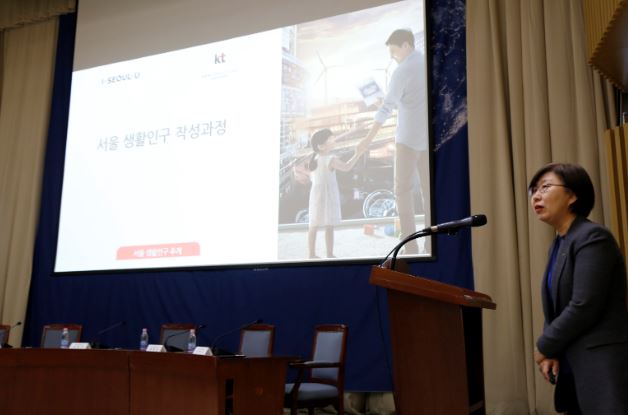
"Seoul Living Population" is an estimate based on public big data owned by the Seoul Metropolitan Government and telecommunications data from KT. It refers to the "current resident population" staying in Seoul at the time of the survey, encompassing not only those with a registered address in Seoul but also the population that temporarily visits the city for business, tourism, medical care, education, etc., thereby generating administrative demand.
'Seoul Living Population' is KT LTE signal information This is an example of population estimation using [method]. It is significant that the population movement status was aggregated at the district level, which is more detailed than the administrative dong level, and that the data was aggregated based on a D+5 data production cycle (e.g., when KT provides information to the Seoul Metropolitan Government on February 28, it provides data dated February 23).
Looking at the findings regarding Seoul's living population (analysis period: October–December 2017), the average living population in Seoul was 11.51 million, with a maximum of 12.25 million (12/20 (Wed) 14:00) and a minimum of 8.96 million (10/2 (Mon) 7:00), confirming a difference of up to 2.12 million compared to the registered resident population (10.13 million, based on the registered resident population at the end of 2017).
The top three areas by registered resident population were Songpa (670,000) > Gangseo (610,000) > Gangnam (560,000), while the top three areas by living population were Gangnam (850,000) > Songpa (770,000) > Seocho (620,000), showing a difference.
The population living in Seoul for reasons such as commuting to work or school, even though they do not reside in Seoul, is up to 1.65 million, with Gyeonggi (78.6%) and Incheon (10.5%) accounting for 89.2% of the total. By city and county, the figures are as follows: Goyang (154,000), Seongnam (143,000), Bucheon (119,000), Namyangju (110,000), and Yongin (93,000).
Regarding the resident population, it was confirmed that long-term foreign residents are concentrated in Yeongdeungpo-gu, Guro-gu, and Gwangjin-gu, while short-term foreign visitors for reasons such as tourism are concentrated in Jung-gu, Gangnam-gu, and Mapo-gu. For reference, long-term residents are foreigners who have signed up for KT with an Alien Registration Card, and short-term residents are classified as roaming service users.
In particular, the population living in Seoul during the Chuseok holiday period, which is expected to have the highest population movement of the year, was found to temporarily decrease by 2.55 million people compared to the average (11.51 million people).
Kim Hyung-wook, Head of KT’s Platform Business Planning Office, stated, “The development of the Seoul living population indicator is an excellent example of public-private cooperation creating significant results in line with the era of the Fourth Industrial Revolution, and we hope that this outcome will play an important role in the realization of smart cities by local governments.”
'Seoul Living Population' conducted joint research through business cooperation with KT in April 2017 to supplement population statistics information for the formulation of administrative policies of the Seoul Metropolitan Government, and nine experts in the field of population statistics from domestic academia, the private sector, and public institutions participated as an advisory group to improve the accuracy of living population estimation.
Comments
Related news
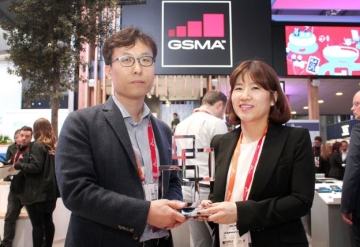
SKT Wins "Enterprise Mobile Service Innovation Award," the Telecom Industry's Oscar
SK Telecom announced that its 'LiveCare' service won the 'Enterprise Mobile Service Innovation Award' at the MWC 2018 GSMA Global Mobile Awards. This category honors companies that showcase services and products capable of contributing to enterprise productivity improvements in areas such as data management, service innovation, and security. 'LiveCare' is an IoT livestock management system developed through collaboration between SK Telecom and Youlike Korea, enabling farm owners to monitor cattle conditions in real-time. The service deploys a biocapsule equipped with an IoT communication module in the first stomach (rumen) of cattle to check body temperature and pH levels, thereby providing various information including disease and calving sign detection and optimal breeding timing prediction.
2018.02.27by 김학준 기자
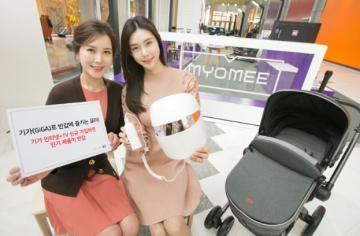
KT sets out to capture women's hearts with 'MYOMEE'
KT announced that it is running "Half Price Choice: 2539 Women's Special Event" which offers popular products from Lotte Rental's lifestyle rental platform 'MYOMEE' at discounted prices. 'KT Half Price Choice' is a program that allows customers to purchase home appliances such as TVs and notebooks at affordable prices when signing up for new KT Internet and IPTV services in conjunction with home appliances. In the "Half Price Choice: 2539 Women's Special Event," the product lineup has been expanded to include home appliances and lifestyle products through partnership with Lotte Rental's 'MYOMEE.' The event features a total of 18 products including childcare and beauty products such as LG Pra:el masks and strollers that are highly preferred by women aged 25 to 39 (2539 generation) who are trend-sensitive and value themselves as well as their families.
2018.03.02by 김학준 기자
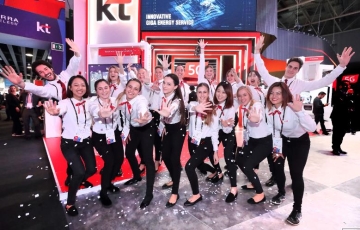
KT Showcases Advanced 5G Technology in Barcelona
KT solidified its 5G leadership through world-class ICT technology at the 'Mobile World Congress 2018 (MWC 2018)'. MWC 2018 became an opportunity for people around the world to experience 5G-based services that KT had been preparing and to understand the process. Under the theme of 'Experience the World's First 5G, KT', KT showcased various technologies that allow visitors to experience the upcoming 5G era in advance. In particular, the '5G Broadcasting Relay Service' garnered significant attention from many visitors by demonstrating 5G broadcast relay that synthesizes and transmits video footage captured by multiple drones in real-time. It was evaluated as demonstrating at a glance the characteristics of 5G: ultra-high speed, ultra-low latency, and hyper-connectivity.
2018.03.02by 김지혜 기자

Nvidia invests $5 billion in Intel
NVIDIA and Intel, leaders in global AI computing technology, are now forging ahead in providing cutting-edge solutions through NVLink-based architecture integration. NVIDIA and Intel have officially announced a strategic partnership and stated that they will jointly develop customized data center and personal computing products to accelerate diverse applications and workloads ranging from hyperscale to enterprise and consumer markets, thereby laying the foundation for the next generation computing era.
2025.09.22by 배종인 기자
.jpg)
Applied Materials Launches Environmental Protection Campaign to Mark World Cleanup Day
Applied Materials Korea (CEO Park Kwang-seon) is carrying out environmental cleanup activities with employees and their families around the Dongtan Sinricheon area on the occasion of World Cleanup Day, evolving into a company that engages with the local community beyond technological innovation.
2025.09.22by 명세환 기자











