



NI Technology Successfully Reduces Subaru's Electric Vehicle Test Development Time by 90%
 Published2018.03.21 14:56
National Instruments (NI) announced that major automakers, such as Japan's Subaru, have adopted NI Hardware-in-the-Loop (HIL) technology for simulating real-world road environments required for electric vehicle testing, thereby eliminating environmental factors and reducing test time and costs.
Generally, vehicle performance and safety response tests are conducted using finished vehicles on test tracks or public roads. However, it is difficult to perform reproducible tests in a timely manner due to constraints such as weather or unpredictable road surface conditions. Furthermore, electric vehicles are significantly more complex than conventional vehicles due to their numerous interdependent subsystems. This complex testing environment exacerbates the workload for automotive test engineers, who already face challenges due to short development cycles and limited budgets.
To address these issues, Subaru applied NI HIL simulation solutions based on NI PXI products and LabVIEW software to verification tests instead of actual roads. By introducing the HIL system, we were able to eliminate environmental factors before actual vehicle diagnosis and efficiently and thoroughly test vehicle embedded controllers in a virtual environment.
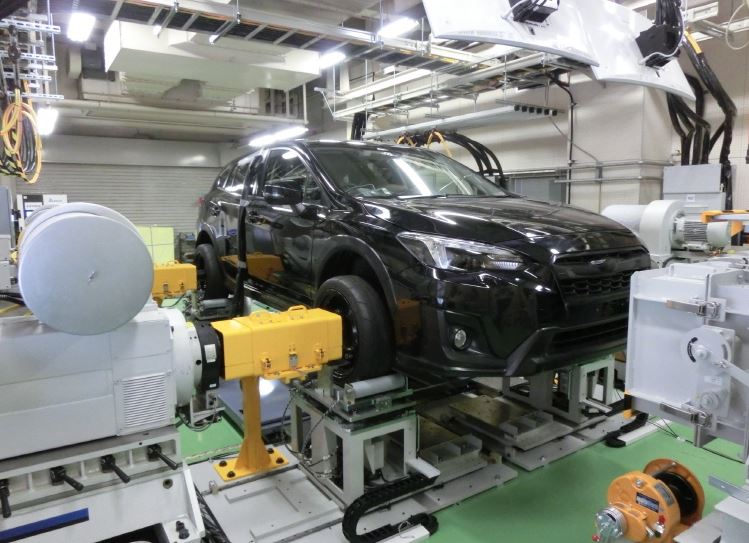
Daisuke Umiguchi, head of Subaru’s electric power unit research and experiment department, stated, “We were able to fully implement a customized HIL system and develop our own software in just one to two weeks using NI PXI products and LabVIEW,” adding, “We were able to reduce purchasing costs to about one-third of the level compared to other companies’ products, and because we were familiar with the LabVIEW environment, we were able to develop our own software at one-sixth the level of outsourcing costs.”
Subaru additionally equipped the system with a controller-driven dynamometer from HORIBA and CarSim vehicle dynamics simulation software from Virtual Mechanics to generate load conditions identical to actual road conditions. This drive system transmits the calculated values to the NI HIL system in real time, creating closed-loop control between the model on the HIL system and the drive system model. Consequently, the HIL interaction system enables the application of appropriate loads to the vehicle throughout the entire testing process.
Subaru plans to use this NI test system for final quality inspection during the final stage of electric vehicle development, and intends to expand its application to all models in the future. Furthermore, by adopting this NI system, it is expected that test time will be reduced by half compared to the existing method.
Comments
Related news
NI Launches Sub-6 GHz 5G NR Test Solution
National Instruments (hereafter NI) has announced a Sub-6GHz 5G test reference solution compliant with the 3GPP Release 15 5G NR (New Radio) specification. As the feasibility of commercial 5G NR implementation below 6GHz increases, engineers are actively developing Sub-6GHz 5G RF components and devices. Using NI's newly launched Sub-6GHz 5G NR reference solution enables testing that guarantees both cost-effectiveness and high performance. This allows engineers to quickly finalize designs and seamlessly transition from the R&D phase to the production test environment. NI's latest reference test solution is suitable for testing new wideband RFICs, particularly operating models in the 3.3-4.2GHz and 4.4-5.0GHz bands. Engineers can use the PXIe-5840 vector signal transceiver (VST), a 4.5G/5G test solution that supports 1GHz instantaneous signal generation and up to 6GHz analysis bandwidth, to test devices operating at continuous signal bandwidths of 400MHz or higher. When using NI VST, improved measurement speed and EVM performance of 0.32% (-50dB) or better for 100MHz NR signals can be expected.
2018.03.07by 김학준 기자
NI Showcases Sensor Fusion Test Technology for Autonomous Vehicles at Automotive Testing Expo
National Instruments announced that it will participate in the 'Automotive Testing Expo 2018' to be held at KINTEX in Ilsan for four days from March 13 to 15, and will showcase the latest solutions and demonstrations including sensor fusion test technology for autonomous vehicle testing and vehicle simulators. At this exhibition, NI will publicly disclose a variety of solutions that can reduce the cost and time of automotive testing and secure industry-leading measurement accuracy. As vehicle systems become increasingly sophisticated, NI continuously develops technologies that meet more stringent test requirements to ensure system safety and quality. NI's platform-based approach provides flexible and future-oriented systems with timing and synchronization capabilities across the entire system, thereby meeting complex automotive test requirements such as ADAS, V2X, infotainment, powertrain, body and chassis.
2018.03.12by 김지혜 기자
NI Showcases ADAS Testing with Virtual Environment Software and Actual Hardware Integration
To implement virtual environment simulation, Inno Simulation and IPG Korea constructed a 3 km area around Sangam-dong, and this virtual environment was configured to include an actual vehicle environment where real drivers can operate. Germany-based Konrad demonstrated VRTS (Vehicle Radar Test Simulation) using NI's VST (vector signal transfer) and VDG (Vector delay generator) hardware along with an mmWave head, enabling Continental's radar sensor to work in conjunction with the simulation and detect targets as an actual radar would. This enables ADAS testing in various scenarios.
2018.03.20by 명세환 기자

[e4ds Tech Day 2026 ⑨] Sim Sang-gyu, Autocrypt CTO: "In the Physical AI Era, Automotive Security Must Extend Beyond the Vehicle"
At e4ds Tech Day 2026, Sim Sang-gyu, CTO of Autocrypt, explained automotive cybersecurity strategies in the era of Physical AI and SDV (Software-Defined Vehicle). Automobiles are evolving as part of an ecosystem connected to AI, cloud, chargers, IoT, and robots, and he emphasized that the scope of security must expand beyond the vehicle interior to the entire connected environment. In particular, AI model tampering, adversarial attacks, OTA updates, and EV charger hacking were identified as major threats. He explained that response measures require zero trust, AI model integrity protection, intrusion detection, Security by Design and Default, and full lifecycle security management, and that proactive security system establishment beyond regulatory compliance is critical for securing future mobility competitiveness.
2026.10.12by 배종인 기자

Practical HIL Construction Strategy for Automotive and Off-Highway Controller Validation
As vehicle E/E architecture transitions to zonal structures and shifts to software-defined vehicles (SDV), the number of controllers (ECUs) requiring validation and software complexity are surging dramatically. Meanwhile, real vehicle testing cannot provide repeated verification under identical conditions and entails lead time and safety concerns. This white paper explains the principles of HIL (Hardware-in-the-Loop) validation and the structure of the NI platform composed of PXI, SLSC, and VeriStand, and through two actual implementation cases—Camera Record & Replay HIL for In-Cabin Monitoring Controller (ICMU) and Forklift Controller (VCU) HILS—describes how controller-level regression testing becomes possible. Additionally, it explicitly states application boundaries and limitations, such as lack of A2B support.
2026.10.12by 편집부











