



What is KT's faster-than-anyone 5G commercialization strategy?
 Published2018.03.22 16:16
Planned for commercialization in March next year with five core technologies including 5G integrated slot structure and 5G-LTE interworking architecture
KT held a 5G achievement presentation and commercialization strategy press briefing to announce the 5G technologies used during the 2018 PyeongChang Winter Olympics and Paralympics, as well as future strategies.
Oh Seong-mok, head of KT's Network Division, stated, "After announcing at the Mobile World Congress (MWC) that KT would showcase the world's first 5G trial service at the 2018 Olympics, KT made efforts in developing various technologies and services for early 5G commercialization."
During this Olympics, KT applied 5G-based technologies such as SyncView, Time Slice, and OmniView to events including figure skating, short track speed skating, and skiing. Through these technologies, KT delivered three-dimensional images capturing key moments such as aerial jumps and championship goals, as well as competition scenes from 360-degree angles to spectators and viewers. For bobsleigh, SyncView equipped on the top 10 teams was also used by US-based NBC. Additionally, approximately 3,000 people, including government officials, media executives, and telecommunications company CEOs, boarded KT's 5G Connected Bus.
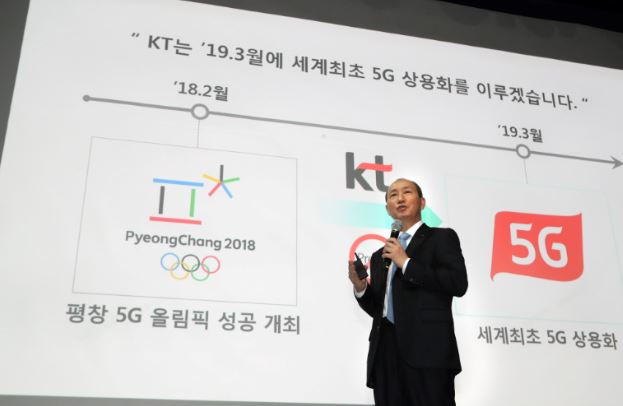
These technological capabilities led to requests for KT's 5G bus at the Jakarta Asian Games and SyncView and Time Slice at the Bobsleigh and Short Track Speed Skating World Championships. In the Olympic White Paper compiled by the IOC, KT is recorded as the world's first to implement 5G. Experts believed that Tokyo Olympics would be the first to utilize 5G, but KT advanced this by two years. KT established itself as an ICT Olympics. This required development of standards, equipment, and terminals.
KT completed a common standard based on 'SIG'. This reflects 85% of the international 5G standard '3GPP NSA', contributing to shortening the global standardization schedule. In this process, a total of 386 papers were submitted, of which 79 were adopted, at a level ready for immediate commercialization. The 3GPP NSA 5G standard allows cross-use of currently used LTE and 5G networks.
Additionally, KT is developing and strengthening technological capabilities with five solutions: ▲5G integrated slot structure, ▲5G-LTE interworking structure, ▲intelligent multi-beam tracking solution, ▲in-building solution, and ▲artificial intelligence-based network optimization.
The 5G integrated slot structure improves traffic structure using TDD (time division duplex) method to overcome the transmission delay that occurs after 4ms in 4G, implementing ultra-low latency. The 5G-LTE interworking structure secures coverage by automatically switching to LTE network when outside 5G coverage, reducing disconnection issues.
The intelligent multi-beam tracking solution addresses a key challenge: 5G's mm-Wave operates in high-frequency bands, resulting in significant shadowing due to obstacles such as buildings and vehicles. By capturing signals from both primary and secondary base stations, service continuity will be ensured. The in-building solution is a repeater solution that reduces signal loss to secure 5G quality, as 5G experiences greater transmission loss through glass and similar materials compared to LTE.
Particularly, development of an artificial intelligence-based optimization solution has been completed, enabling remote and automatic base station output adjustment. Through this, the company plans to secure real-time quality including antenna direction and angle optimization without requiring field visits.
Oh Seong-mok, head of KT's Network Division, stated that true 5G commercialization means "not only technology but also service development," and added, "In the 5G field where a market size of 850 trillion won is expected to form by 2025, KT will launch services centered on immersive media, 5G factory, drones, and connected vehicles."
For immersive media, KT is already operating 'Bright' by combining 5G with VR games. Issues such as dizziness caused by content transmission delays in gigabit Wi-Fi will be resolved by connecting to 5G networks. Through E2E orchestrator, the company plans to implement work management, efficiency, and safety for 5G factory. Company P is monitoring work processes through UHD-grade CCTV, Company H is improving test efficiency through real-time data transmission analysis, and Company S is improving work environments by measuring harmful gases and temperatures through IoT sensors.
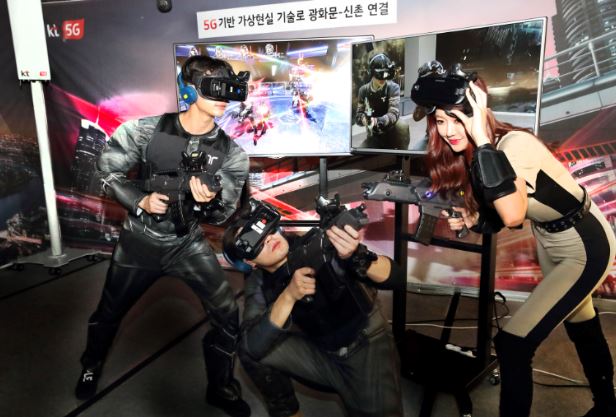
KT is expected to evolve beyond a simple network into an integrated platform. KT has established OpenLab, an R&D space for collaboration with SMEs to promote early activation of the 5G ecosystem and mutual growth. The facility consists of a 5G experience zone, service development zone, and technology zone. This has already been showcased through collaborations such as SyncView and connected vehicles at the PyeongChang Olympics.
Unlike 4.5G, which is a fixed service, 5G must guarantee mobility and coverage. KT ensured mobility through SIG-based connected vehicles in Gangneung, PyeongChang and other areas. At the briefing, KT stated, "To secure coverage, mobile terminals, 5G service, cloud and virtualization, and services must all be in place," and emphasized, "This is true commercialization, and since KT's standard reflects 85% of global standards, KT will be the first to build true 5G, not 4.5G." KT's current 5G commercialization timeline is March next year.
The technologies reflected in standardization include over 100 core patents with substantial competitive advantages. At the time of commercialization in March next year, nationwide 5G coverage will not be immediately possible, but the company plans to apply services in some major cities first, cover the remaining areas with LTE networks, and gradually expand coverage.
Regarding security, another critical aspect of 5G, Jeon Hong-bum, director of the Infrastructure Research Institute at KT's Convergence Technology Institute, stated, "We have established a joint research center with KIST (Korea Institute of Science and Technology) and are conducting research and development, which has resulted in the development of one-to-many quantum cryptography communication." He continued, "If this is realized, it is expected to become an economically viable technology. Currently it is wired, but we will continue developing how to apply it to 5G."
Comments
Related news
Stop worrying about accidents and emergencies with 5G autonomous vehicles!
SK Telecom (hereinafter SKT) Park Jin-hyo, Head of ICT Technology, said at a 5G autonomous vehicle demonstration conducted by SKT and the Korea Road Traffic Authority, "I am pleased to be able to showcase 5G technology," and "Through autonomous driving, we will prevent traffic accidents and create a world without accidents, improving quality of life." For safe and convenient autonomous vehicle operation, which SKT emphasized on this day, 5G implementation is essential. At CES 2017, Intel announced a 5G modem, signaling innovation in various fields such as wireless broadband and the Internet of Things. 5G, which is a concern for mobile carriers, the automotive industry, and various companies, has the following characteristics in autonomous vehicle operation.
2018.02.08by 김학준 기자
Xilinx CEO Ahn Heung-sik: "We will prepare for 5G commercialization with RFSoCs."
The 2018 PyeongChang Winter Olympics opened on the 9th, and 5G trial service began simultaneously. Xilinx is expected to continue growing with 5G as a springboard. With KT and Samsung Electronics implementing 5G, Xilinx, which is collaborating with Samsung Electronics, has also established a trial service system through repeaters and terminals. Xilinx Korea Branch Manager Ahn Heung-sik stated, "This Olympic Games, which has the nature of pre-5G, will focus on demonstrating Xilinx's technological capabilities rather than on sales." He continued, "If Xilinx's all-programmable products are incorporated into the initial 5G infrastructure and demonstrate our technological prowess, they can be utilized in major system deployments as well."
2018.02.20by 김학준 기자
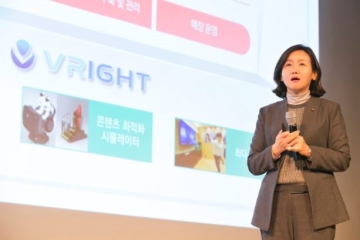
"We will lead the VR/AR market with VRIGHT's immersive media services"
KT held a business strategy discussion and new VR/AR service experience session on immersive media services (VR/AR), a key technology in the 5G era. KT showcased immersive media services using 28GHz frequency at the PyeongChang Winter Olympics. In 2017, KT constructed a 5G trial network at the 'Jeonju/Suwon World Cup Stadium' where the U-20 World Cup was held, implementing '360-degree virtual reality live' and 'interactive time slice' services. Going forward, users will be able to watch sports games realistically through KT's immersive media services such as Skny View and OmniPointView, in addition to Olympics and various events.
2018.02.21by 김학준 기자
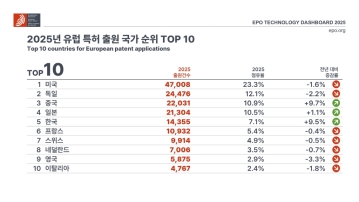
European Patent Applications Surpass 200,000 for the First Time… South Korea Maintains 5th Place, Led by Batteries and Telecommunications
According to the European Patent Office (EPO)'s 'Technology Dashboard 2025', European patent applications last year reached 201,974, surpassing 200,000 for the first time. Korean companies and inventors filed 14,355 applications, representing a 9.5% increase from the previous year and maintaining 5th place by country. Battery, digital communication, and semiconductor technologies led the growth, with Samsung ranking as the top EPO applicant for the second consecutive year and LG reaching 3rd place. The presence of major domestic cities such as Seoul, Suwon, and Yongin was also confirmed. It was also revealed that Korea's European patent strategy is expanding beyond individual technologies to span the entire industry.
2026.03.24by 명세환 기자
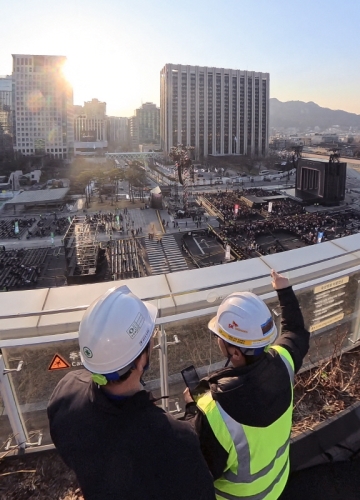
SK Telecom First Applies AI-Based Network Operations at Gwanghwamun K-Pop Concert
SK Telecom announced that it applied an AI-based network operation system for the first time at a large-scale K-pop concert held in the Gwanghwamun area of Seoul on March 21st, managing communication quality throughout the event. Mobile data usage during the three hours before and after the concert reached 12.15TB, approximately doubling compared to the same time slot the previous weekend. SK Telecom monitored traffic using the AI system 'A-One' in five-minute and 50-meter units to respond to potential overload situations, while also operating temporary communication facilities and on-site personnel in parallel. This case is interpreted as confirmation of the practical applicability of AI-based autonomous network operation in an environment where demand from dense events and foreign users increases simultaneously.
2026.03.23by 명세환 기자











