


Samsung Electronics Announces 'Exynos 7 (9610)' with Enhanced Deep Learning and Image Processing Capabilities
 Published2018.03.22 16:52
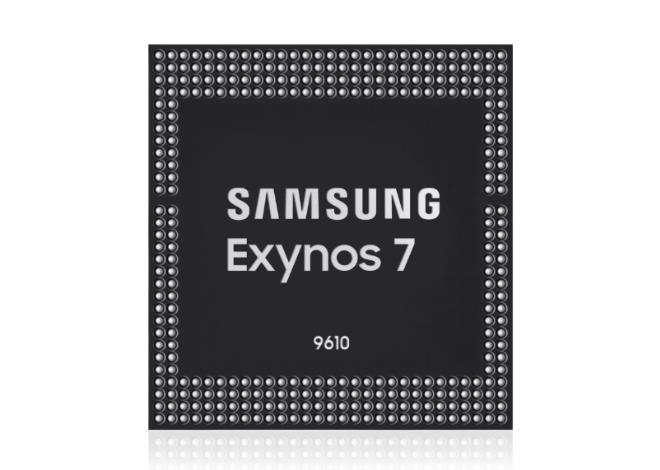
Samsung Electronics announced a new Exynos 7 series product (Exynos 7 9610) with enhanced deep learning and image processing capabilities.
Samsung Electronics has strengthened its competitiveness and expanded customer choices by applying the same 10nm FinFET process as the premium AP Exynos 9 series (9810) to the mid-range AP 'Exynos 7 (9610)' and equipping it with cutting-edge technologies such as deep learning-based image processing capabilities.
In particular, it is characterized by significantly enhanced image processing capabilities to align with recent smartphone trends that focus on camera functions and multimedia utilization.
Equipped with deep learning technology and built-in hardware optimized for it, it enables fast facial recognition even when the subject is not looking straight ahead or their face is obscured by hair, a hat, etc., during photo shooting. Additionally, through more accurate depth sensing, it allows for enhanced out-of-focus effects (an effect that blurs the background to make the subject stand out) using only a single camera.
'Exynos 7 (9610)' supports a premium multimedia codec capable of 4K 120fps. In addition, the speed of the built-in ISP (Image Signal Processor) responsible for image signal processing has been improved by about 1.6 times compared to the previous product (Exynos 7 7885), and the speed of the interface (MIPI, Mobile Industry Processor Interface) connecting the processor and the image sensor has been improved by about 2 times.
Through this, even when using a standard two-stage stacked image sensor, it supports FHD (1920×1080) slow-motion video at 480 frames per second and enables long-duration shooting.
The 'Exynos 7 (9610)' is composed of an octa-core architecture combining four high-performance big cores (Cortex-A73) operating at up to 2.3GHz and four little cores (Cortex-A53) operating at up to 1.6GHz, and features a 2nd generation Bifrost-based ARM Mali-G72 GPU boasting excellent graphics performance, demonstrating powerful multimedia capabilities.
In addition, power efficiency was improved by embedding a 'sensor hub (Cortex-M4F)' for motion recognition and situation awareness into the processor without the need for a separate chip.
A stable communication connection is also a strength. It is equipped with a 6-mode modem that covers everything from 2G CDMA to 4G LTE, enabling data communication anywhere in the world. It supports speeds of 600Mbps (Cat.12 3CA) for downloads and 150Mbps (Cat.13 2CA) for uploads.
It also features 802.11ac 2x2 MIMO Wi-Fi, Bluetooth 5.0, FM radio, and a built-in GNSS navigation system.
"Exynos 7 (9610) is not only a product with enhanced performance but also specialized in camera and multimedia functions," said Heo Kuk, Senior Vice President and Marketing Team Leader of Samsung Electronics' System LSI Business Division. "It will provide a differentiated user experience through deep learning-based image processing technology and slow motion support."
Comments
Related news
u-blox Announces F9 Industrial and Automotive AP Positioning Solution
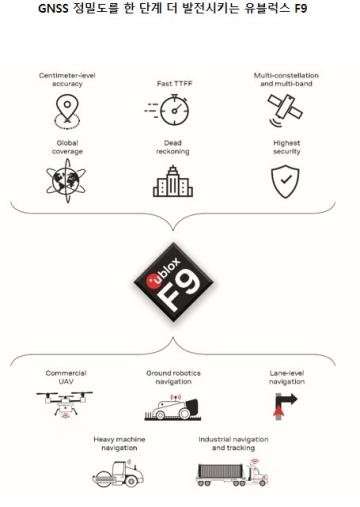
u-blox has announced the u-blox F9 technology platform, which provides high-precision positioning solutions for industrial and automotive mass-production applications. The platform combines multi-band GNSS technology, dead reckoning, high-precision algorithms, and compatibility with multiple GNSS correction data services to achieve centimeter-level positioning accuracy. Daniel Ammann, Director of Positioning Product Development at u-blox Product Center, stated, "High-precision technology will become the next frontier in positioning," and added, "u-blox F9 provides hardware and integrated software components to meet these market demands." The u-blox F9 platform will serve as the technological foundation for u-blox's positioning module products targeting mass-production markets in industrial and automotive sectors. The platform uses GNSS signals across multiple frequency bands (L1/L2/L5) to correct ionospheric interference errors and provides rapid Time To First Fix (TTFF). With the capability to receive signals from all GNSS satellites including GPS, GLONASS, Galileo, and Beidou, the F9 platform maximizes the number of visible satellites within a given timeframe to enhance performance.
2018.02.27by 김학준 기자

Mickey Mouse Follows Me Using 'AR Emoji'
Samsung Electronics is collaborating with Disney to provide 'Mickey Mouse' and 'Minnie Mouse' AR emoji to coincide with the launch of 'Galaxy S9' and 'S9+'. Users can download Disney character AR emoji from the camera on the 'Galaxy S9 and S9+'. Users can communicate with friends and family using 'Mickey Mouse' and 'Minnie Mouse' that imitate them by recognizing over 100 features such as eyes, nose, and mouth. Disney's John Rowe, Executive Vice President, said, "Through AR emoji on the Galaxy S9 and S9+, a new digital platform, consumers will be able to enjoy Disney characters in their daily lives and attract a new generation of fans."
2018.03.19by 김학준 기자

Samsung Electronics Expands New 8-Inch Foundry Solutions
Samsung Electronics is expanding its foundry solutions utilizing 8-inch (200mm) wafers to strengthen customer support. Samsung Electronics plans to expand its 8-inch foundry service product lineup from the existing 4 types to 6 types, and provide specialized fine process solutions ranging from 180 nanometers to 65 nanometers for each product to enhance customers' product completeness and convenience.
2018.03.21by 김지혜 기자

Intel Unveils Next-Generation 'Core Ultra Series 3' and vPro Platform for Enterprise PCs
Intel has officially unveiled the "Intel Core Ultra Series 3" for next-generation enterprise PCs and the latest vPro platform, addressing a wide range of demands from enterprise notebooks to high-performance workstations.
2026.03.26by 배종인 기자
ROHM Launches ESD Protection Diode Compatible with High-Speed Interfaces of 10Gbps or Higher
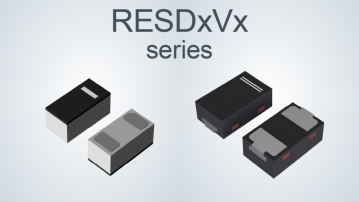
Semiconductor specialist ROHM has developed the 'RESDxVx series' of ESD (electrostatic discharge) protection diodes capable of responding to next-generation high-speed data communication environments exceeding 10Gbps, simultaneously enhancing both signal quality maintenance required in high-speed interfaces and IC protection performance.
2026.03.26by 배종인 기자











