



Samsung Electronics and Ewha Womans University Discover Reason for OLED Blue Pixel Lifespan Degradation
 Published2018.03.26 10:29
Researchers from Samsung Electronics' Advanced Institute of Technology and a research team led by Professor Yoo Young-min of the Department of Chemical and Materials Engineering at Ewha Womans University have for the first time demonstrated the degradation mechanism causing the lifespan reduction of OLED blue phosphorescent materials and proposed a material design method to improve this.
If this technology is commercialized, it will be possible to 혁신적으로 extend the lifespan and performance of OLEDs, which currently use fluorescent materials for only the blue light among the three primary colors of red, green, and blue emission, rather than phosphorescent materials.
OLEDs are self-emissive organic compounds that offer the advantages of a bright screen, excellent contrast ratio, and low power consumption. However, unlike red and green, where high-efficiency phosphorescent materials have already been commercialized, blue phosphorescence has not been commercialized due to its short lifespan, so fluorescent materials are currently used; consequently, it has been pointed out that they are not suitable for long-term use exceeding several years.
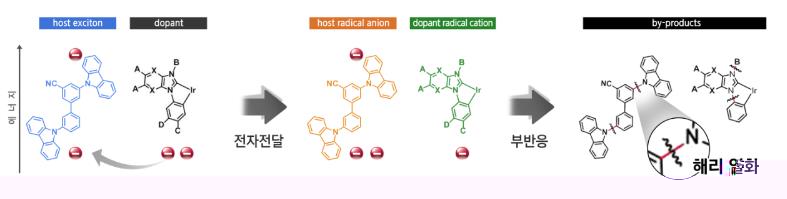
While analyzing the material degradation pathway of blue phosphorescence, the research team identified a mechanism in which charge-separating species formed during the electronic transfer process between phosphorescent components accelerate degradation. This is the first study to scientifically prove why the lifespan of blue phosphorescent materials shortens so much faster than that of red and green materials.
Furthermore, the research team confirmed that lifespan differences of up to tens of times occur depending on the extinction rate of charge separation species, and proposed a material combination structure capable of extending lifespan by eliminating charge separation species as quickly as possible.
"The ultimate goal is to find a blue phosphorescent material capable of minimizing degradation through further research and apply it to actual systems," said In Su-kang, a principal researcher at the Advanced Institute of Technology who participated in this joint study. "Professor Yoo Young-min of Ewha Womans University said, 'This study is significant in that it presents a new chemical mechanism explaining the cause of the short lifespan of blue OLED devices, and this mechanism could be usefully applied to understanding the lifespan of other electronic devices, such as organic transistors.'"
Comments
Related news
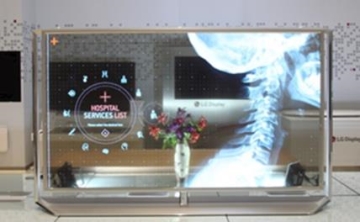
This is a 77-inch large transparent flexible display.
A 77-inch transparent flexible display has been unveiled. The Ministry of Trade, Industry and Energy held a "Transparent Flexible Display National Project Achievement Report Conference" on Thursday, the 22nd, at Seoul Olympic Parktel in collaboration with the Korea Institute for Advancement of Technology and LG Display. At the report conference, future convergence products such as smart desks utilizing large organic light-emitting diode (OLED) flexible displays and augmented reality (AR) aquariums were exhibited. The 77-inch transparent flexible display, publicly unveiled for the first time on this day, has significantly improved size and resolution compared to the 55-inch FHD-class model presented at CES.
2017.06.23by 김지혜 기자
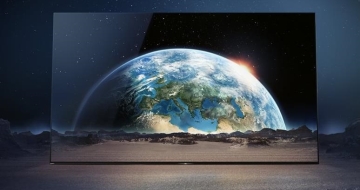
Will Flexible OLEDs and Next Year's Foldable Phones Become a New Growth Engine?
"Apple adopted OLED in iPhone 8 because of augmented reality (AR)" All smartphones from Samsung, LG, and Apple released in the second half of this year are equipped with OLED (organic light-emitting diode) displays. The Note 8 is no exception, and LG has adopted an OLED display in its V series for the first time. Apple is also applying OLED to the iPhone X, and it is expected that OLED adoption in smartphones will become mainstream. Seo Hyun-chul, Executive Director at Shinhan Financial Investment, stated, "iPhone 8 is scheduled to launch an AR-based shopping app through strategic collaboration with IKEA. OLED is essential to implement AR with this app." He forecasted that when 5G networks are commercialized, as AR smartphones become mainstream, the majority of 1.9 billion smartphones in 2024 will adopt OLED.
2017.10.06by 김지혜 기자

Samsung Electronics Launches Mixed Reality (MR) Headset with AMOLED Display
Samsung Electronics is launching the premium Mixed Reality headset 'Samsung HMD Odyssey' in Korea on the 21st. The 'Samsung HMD Odyssey,' a collaboration between Microsoft and Samsung Electronics, connects with PCs to link the virtual world and the real world, providing users with a new experience. It was first unveiled in the United States in early October. The 'Samsung HMD Odyssey' adopts a 3.5-inch dual AMOLED display, offering a maximum resolution of 2880x1600 and a field of view of 110 degrees. Additionally, it is equipped with a high-quality AKG headset, a premium audio brand from Harman, providing 360-degree spatial sound, and features a built-in microphone, enabling real-time voice chat even while using the device.
2017.11.15by 김지혜 기자
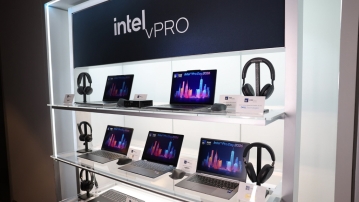
Intel Unveils Next-Generation 'Core Ultra Series 3' and vPro Platform for Enterprise PCs
Intel has officially unveiled the "Intel Core Ultra Series 3" for next-generation enterprise PCs and the latest vPro platform, addressing a wide range of demands from enterprise notebooks to high-performance workstations.
2026.03.26by 배종인 기자
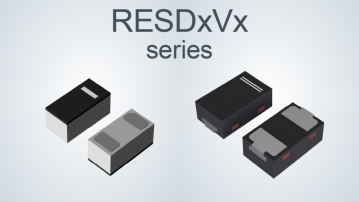
ROHM Launches ESD Protection Diode Compatible with High-Speed Interfaces of 10Gbps or Higher
Semiconductor specialist ROHM has developed the 'RESDxVx series' of ESD (electrostatic discharge) protection diodes capable of responding to next-generation high-speed data communication environments exceeding 10Gbps, simultaneously enhancing both signal quality maintenance required in high-speed interfaces and IC protection performance.
2026.03.26by 배종인 기자











