


'mmWave sensor' that remains unshaken even in adverse conditions
 Published2018.03.27 10:50
Features include 76~81GHz, minimum signal range of 3cm, and maximum output power of 12dBm.
The 2018 Pyeongchang Winter Olympics opening ceremony was not marked by the fluttering Olympic rings, but by 1,218 drones flying. Intel broke the Guinness World Record with its drone sensor and simultaneous control technology. The technology demonstrated through the drone performance is expected to be widely used in the future for entertainment and events, as well as drone delivery and monitoring, transportation, security, and industrial applications such as agriculture.
Our government has announced that it will raise our drone technology competitiveness to the world's top 5, and Texas Instruments (TI) has announced that the global unmanned aerial vehicle (UAV) market is expected to reach 21 billion dollars by 2022 and lead the global market economy with the goal of providing more than 127 billion dollars in business services.
The design and use of drones in industry will have a significant impact on our current lives, including increasing productivity and improving safety. However, there are technological challenges that need to be addressed to realize the use and deployment of drones in various fields.
Airborne devices utilizing communications technology are sensitive to weather and sunlight conditions, visibility issues due to smoke, fog, obstacles, and radio interference, which can quickly lead to safety and productivity issues. TI’s mmWave contactless sensors are suitable for indoor and outdoor operation, as they can be used in harsh environments such as lightning, rain, dust, and ice. And by calculating the distance, speed, and angle of objects around the equipment, it is possible to respond according to the situation.
TI mmWave sensor devices are single-chip devices that can be configured in a small size. They also implement high accuracy and resolution, and can be applied in various fields because they utilize internal MCUs and DSPs. They can be applied to radars for various applications using software-defined radios, and since they are designed as single-chip solutions, they consume less power.
Existing chips are configured by separating the digital blocks that process the radar signals received by RX and TX. As a result, the PCB size increases and the price also increases. In the process, there are noise generation and design difficulties. TI's mmWave sensor device is a single chip, so it can solve the above shortcomings and have the resolution and low power characteristics of mmWave.
TI's operating characteristics can obtain range, velocity, and angle through RAW ADC. The basic frequency band is 76~81GHz, the minimum range of the signal is 3cm, the minimum angle accuracy is 1 degree, and the maximum output power is 12dBm, so it can cover a wide range and high power of 30mW~2.7W.
This allows for a lightweight design. Reducing weight increases flight and drive time on a given battery, and makes deployment easier. The payload budget increases, allowing for onboard application-specific tools.
Additionally, because the margin of error is reduced, when a drone lands, the distance between the autonomous vehicle and another car can be accurately detected in centimeters, ensuring safety.
It is an object detection and avoidance platform that operates even in environments with physical obstacles. Accordingly, drones' ability to detect obstacles and take avoidance measures reduces damage to industrial equipment such as automobiles and drones and to the surrounding environment.
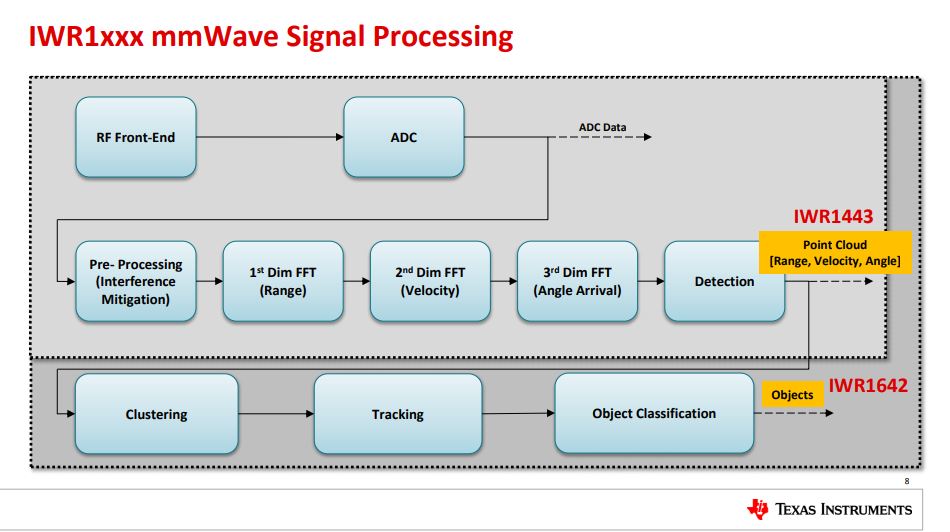
TI mmWave sensors that overcome the shortcomings of existing devices and have the above features are the IWR 1443 and IWR 1642. Both sensors have a frequency band of 76–81 GHz, and the difference is in the DSP and hardware accelerator.
IWR 1443 : It has a built-in hardware accelerator for radar signal processing. It is a solution that can make radar applications into a single chip through user programming for a simple MCU. Examples include entry-level, single-chip sensors. Through hardware blocks, you can obtain the final outputs of range, velocity, and angle through three stages of preprocessing, FFT, and detection.
IWR 1642 : Same architecture as IWR 1443, but with DSP instead of hardware accelerator, providing flexibility by adding user algorithms along with radar signal processing. An example is a user-oriented full-function single-chip radar. It provides more processed output through clustering, tracking, and object classification in the processing of IWR 1443.
When asked about RF regulations and whether it is possible to measure multiple devices, TI’s Kim Hyun-wook said, “First of all, the 77 GHz band is permitted for automotive applications, and future policy changes on frequency use should be monitored.” He added, “Measuring the speed of multiple devices requires tracking with a tracking algorithm for each, and post-processing of the received result data.” He continued, “We hope that the IWR mmWave series of millimeter wave radar sensors for industrial applications will be utilized in a wide range of industries, including level transmitters, drones, and transportation.”
Comments
Related news

TI Launches Multi-Standard MCUs to Meet Growing Connectivity Demands
Texas Instruments announced the launch of new SimpleLink wireless and wired microcontroller (MCU) products to meet increasing connectivity requirements for buildings, factories, and power grids. The product features industry-leading low power consumption and supports simultaneous multi-standard/multi-band connectivity including Thread, Zigbee, Bluetooth 5, and sub-1GHz. The new product expands the SimpleLink MCU platform with larger memory capacity and diverse connectivity options. With 100% code reusability among TI's ARM Cortex-M4 based MCUs, users can conveniently enhance sensor networks and connect to the cloud.
2018.03.05by 김지혜 기자
TI Unveils Power Management Chip for Higher Efficiency and Smaller Size
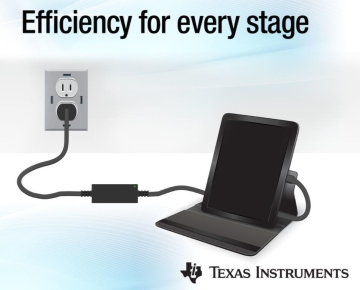
TI announced the launch of multiple new power management chip products that can reduce the size of power supplies and charging solutions for personal electronic devices and portable industrial equipment while improving efficiency. TI's new chipset product operating at up to 1MHz combines the UCC28780 active clamp flyback controller and UCC24612 synchronous rectifier controller, enabling power supply size reduction by half in AC/DC adapters and USB PD (Power Delivery) chargers. Additionally, the bq25910 6A 3-level buck battery charger is a suitable product for battery-powered electronic devices requiring maximum charging efficiency with minimal solution size, capable of reducing solution footprint by up to 60% in smartphones, tablets, and electronic POS devices.
2018.03.08by 김지혜 기자
.jpg)
TI Adds High-Speed GaN Driver to GaN Power Product Family
TI announced that it is adding two new high-speed GaN FET driver products to its industry-leading gallium nitride (GaN) power product portfolio. These new products enable more efficient and high-performance designs in speed-critical applications such as LIDAR and 5G RF envelope tracking. The LMG1020 and LMG1210 are capable of 50MHz switching frequency, improve efficiency, and achieve a solution size five times smaller than what was possible with silicon MOSFETs.
2018.03.12by 김지혜 기자
European Patent Applications Surpass 200,000 for the First Time… South Korea Maintains 5th Place, Led by Batteries and Telecommunications
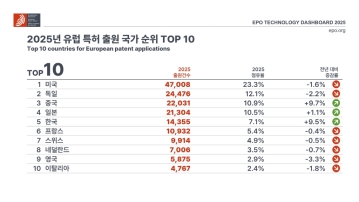
According to the European Patent Office (EPO)'s 'Technology Dashboard 2025', European patent applications last year reached 201,974, surpassing 200,000 for the first time. Korean companies and inventors filed 14,355 applications, representing a 9.5% increase from the previous year and maintaining 5th place by country. Battery, digital communication, and semiconductor technologies led the growth, with Samsung ranking as the top EPO applicant for the second consecutive year and LG reaching 3rd place. The presence of major domestic cities such as Seoul, Suwon, and Yongin was also confirmed. It was also revealed that Korea's European patent strategy is expanding beyond individual technologies to span the entire industry.
2026.03.24by 명세환 기자

SK Telecom First Applies AI-Based Network Operations at Gwanghwamun K-Pop Concert
SK Telecom announced that it applied an AI-based network operation system for the first time at a large-scale K-pop concert held in the Gwanghwamun area of Seoul on March 21st, managing communication quality throughout the event. Mobile data usage during the three hours before and after the concert reached 12.15TB, approximately doubling compared to the same time slot the previous weekend. SK Telecom monitored traffic using the AI system 'A-One' in five-minute and 50-meter units to respond to potential overload situations, while also operating temporary communication facilities and on-site personnel in parallel. This case is interpreted as confirmation of the practical applicability of AI-based autonomous network operation in an environment where demand from dense events and foreign users increases simultaneously.
2026.03.23by 명세환 기자











