


Microchip Launches Grade-Grade Multi-Output MEMS Oscillator
 Published2018.03.27 12:17
Reduce board space and system costs with the DSA family of small packages.
Microchip Technology Inc. (Nasdaq: MCHP) today announced the availability of its new DSA family of automotive-grade MEMS (Micro-Electro-Mechanical Systems) oscillators. These oscillators deliver 20 times better reliability, 500 times greater shock tolerance, and five times greater vibration immunity than traditional quartz-based crystal devices. They also include the industry's first multi-output MEMS oscillators, providing a solution that replaces multiple crystals or oscillators with a single device.
Timing solutions with tight frequency stability over a wide temperature range are critical for applications such as Advanced Driver Assistance Systems (ADAS), LiDAR, in-vehicle Ethernet, and autonomous driving. Microchip's new DSA1001, DSA11x1, DSA11x5, and DSA2311, available in small package sizes, provide the highest level of tolerance to mechanical shock and vibration and stability in harsh environments across the 2.3 MHz to 170 MHz frequency range. These devices are AEC-Q100 qualified, achieving +/-20ppm stability over a -40 to +125C temperature range.
“MEMS technology aligns with the automotive industry’s development trends, and Microchip’s new DSA family of MEMS oscillators and clock generators provides systems with superior performance, reliability and longevity,” said Rami Kanama, vice president of Microchip’s timing and communications group.

MEMS oscillators are manufactured using standard semiconductor processes, providing the same reliability and stability as integrated circuits in systems. Crystal oscillators are susceptible to vibration damage due to longer lead times and fixed frequencies, as they are affected by the thickness of the crystal blank within the oscillator.
This can delay product development or shipment if the customer ultimately needs to change the frequency. MEMS oscillators achieve the required frequency through programming, allowing for faster and more flexible response to new frequencies with shorter lead times. They are also suitable for mass production, helping customers meet product launch schedules.
The DSA2311 is a dual-output MEMS oscillator that can replace two crystals or oscillators on a board. This device helps customers manage their supply chain and maintain a stable BOM by solving board space constraints, reducing costs, and simplifying the design process. The DSA2311 is available in a small 2.5 mm x 2.0 mm package and is suitable for applications requiring complex boards with multiple controllers, such as infotainment systems and camera modules.
The DSA MEMS device family is part of Microchip's comprehensive automotive solutions portfolio, which includes microcontrollers, analog products, and connectivity components, allowing manufacturers to consolidate suppliers based on system requirements. All Microchip products adhere to a customer-centric end-of-life policy, ensuring long-term availability of devices for as long as customers need them.
Comments
Related news
Microchip launches new MCU with intelligent analog integration to simplify design
Microchip Technology announced the launch of two new microcontroller product families designed with a focus on customer innovation. The new PIC16F18446 product family is ideal for use in sensor nodes. Designed with flexibility in mind, the PIC16F18446 integrates ADC2 (Analog-to-Digital Converter with Computation) functionality and operates at 1.8V~5V, making it compatible with most analog output sensors and digital sensors.
2018.03.06by 김지혜 기자
Mouser to Offer PIC18 K83 MCUs with Improved Response Times
Mouser supplies Microchip's PIC18 K83 microcontroller. This product is an 8-bit MCU with CAN bus integrated with various CIP (Core Independent Peripherals), improving response time to system events. CIP processes tasks without code or CPU supervision, enhancing system capability and allowing engineers to easily implement CAN-based applications. The Microchip PIC18 K83 microcontroller supplied by Mouser includes 15 time-saving CIPs on 28 pins and supports up to 64KB flash memory. The CIP includes digital peripherals such as 3 CWGs (Complementary Waveform Generators) that provide high-efficiency synchronous switching functionality required for motor control, and 2 DMA (Direct Memory Access) controllers that transfer data between memory and peripherals without CPU intervention. Using 12-bit ADCC (ADC with Computational Capability), it provides intelligent analog peripherals such as analog signal analysis required for real-time system response. Additionally, CVD (Capacitive Voltage Divider) is also provided, enabling advanced features such as touch sensing, averaging, filtering, oversampling, and threshold comparison.
2018.03.14by 김학준 기자
[Contribution] Designing a DC-DC Boost Converter for Driving High-Power LEDs
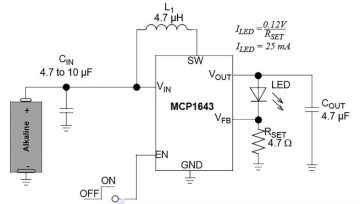
A high-efficiency, fixed-frequency compact step-up DC-DC converter optimized for LED (Light-Emitting Diode) constant-current drive circuits is suitable for applications operating on 1-cell and 2-cell alkaline, NiCd, and NiMH batteries, and can conveniently supply power with a minimal number of external components. This converter can be integrated and used in a wide variety of applications ranging from basic single LED drivers powered by 1-cell alkaline or NiMH/NiCd batteries to multiple infrared, white, and RGB LEDs. One of these converters, Microchip's MCP1643, is a PWM (Pulse-Width Modulation) dedicated device that operates at a fixed 1 MHz switching frequency. Figure 1 shows a simple DC-DC current source step-up boost converter using this device, which employs a resistor (RSET) to set the desired current.
2018.03.19by 김지혜 기자

Intel Unveils Next-Generation 'Core Ultra Series 3' and vPro Platform for Enterprise PCs
Intel has officially unveiled the "Intel Core Ultra Series 3" for next-generation enterprise PCs and the latest vPro platform, addressing a wide range of demands from enterprise notebooks to high-performance workstations.
2026.03.26by 배종인 기자
ROHM Launches ESD Protection Diode Compatible with High-Speed Interfaces of 10Gbps or Higher
Semiconductor specialist ROHM has developed the 'RESDxVx series' of ESD (electrostatic discharge) protection diodes capable of responding to next-generation high-speed data communication environments exceeding 10Gbps, simultaneously enhancing both signal quality maintenance required in high-speed interfaces and IC protection performance.
2026.03.26by 배종인 기자











