



NVIDIA Unveils Isaac SDK to Accelerate Autonomous Robot Development
 Published2018.03.29 12:55
NVIDIA announced the expansion of its Isaac platform for building robot applications, and is expected to accelerate the development and deployment of robots across various industries. NVIDIA founder and CEO Jensen Huang unveiled the Isaac software development kit at the GPU Technology Conference, which integrates libraries, drivers, APIs, and various other tools into a single package.
With the newly released SDK, manufacturers, researchers, startups, and developers can more conveniently apply AI to next-generation robots for sensing, navigation, and control, saving hundreds of hours. The SDK provides a framework for managing communication and transmitting data within the robot architecture, and enables tasks such as adding sensors, managing sensor data, and controlling actuators to be performed easily in real time.
In particular, the inclusion of Isaac Sim in this SDK, a simulation environment that allows for the development, testing, and training of autonomous robots in virtual situations, is drawing attention. When the algorithm trained in the simulation is deployed to NVIDIA Jetson for AI computing on edge devices, the robot enters actual operation.
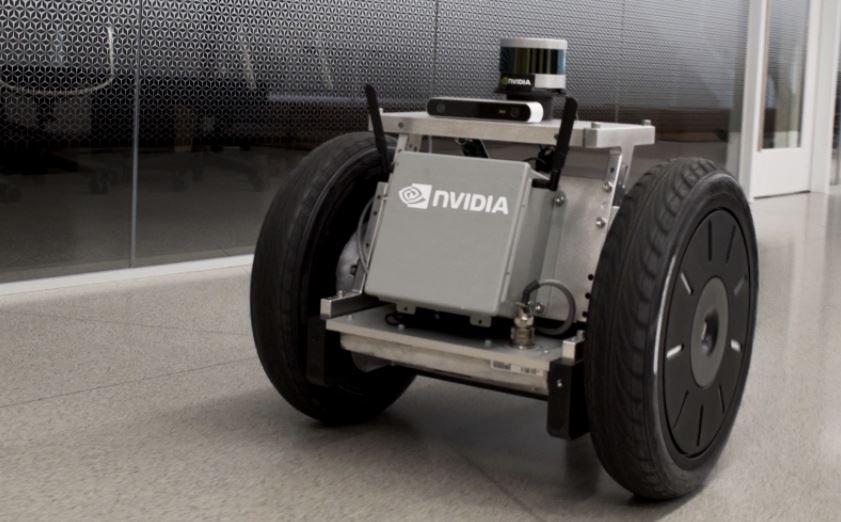
NVIDIA unveiled its first-ever reference design based on the Isaac SDK and named it 'Carter,' emphasizing the convenience of being able to transport objects while avoiding them. Carter, a delivery robot, can be seen at the NVIDIA booth in the GTC exhibition hall this week.
While the potential of the robotics field is limitless, training and testing actual robots requires significant cost and time, and in some cases, carries inherent risks. NVIDIA’s Isaac Sim is an evolved version of the existing Isaac Lab, enabling developers to train and test autonomous machines developed with the Isaac SDK under detailed and realistic scenarios.
This is made possible by using development tools suitable for high-fidelity simulation and more advanced real-time rendering. Since Isaac Sim fits perfectly with the tools and frameworks provided by the Isaac SDK, the transmission and reception of data and algorithms to and from actual robots proceeds seamlessly. This provides the critical prerequisite for very rapid robot development, allowing engineering and testing tasks that typically take several months to be completed in minutes. Once the simulation is complete, the trained system (brain) can be transferred to the actual robot.
The NVIDIA Isaac Platform, with the Isaac SDK and Isaac Sim integrated into Jetson, is expected to play an ideal role in the development and deployment of robotic applications in manufacturing, logistics, transportation, agriculture, services, construction, inspection, and various other fields.
Comments 1
1 Comments:
Related news
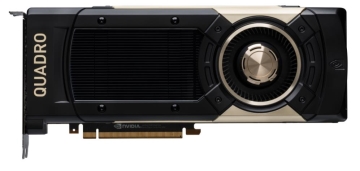
NVIDIA Supports Real-Time Ray Tracing Workstations with Launch of GV100 GPU
NVIDIA announced the NVIDIA Quadro GV100 GPU based on NVIDIA RTX technology, which enables real-time ray tracing for the first time for millions of artists and designers worldwide, at the NVIDIA GPU Technology Conference (GTC) 2018. NVIDIA RTX, combined with the powerful Quadro GV100 GPU, implements computationally intensive ray tracing in real time when driving professional design and content creation applications, and is recognized as the most significant technological advancement in computer graphics since the introduction of shader programs approximately 20 years ago. Media and entertainment professionals can verify and interact with their creations with accurate light and shadow, and can process complex rendering tasks up to 10 times faster compared to cases relying solely on CPU. Product designers and architects can now create photorealistic interactive visualizations in the form of large-scale 3D models in real time.
2018.03.28by 김지혜 기자
NVIDIA Unveils System to Test Self-Driving Cars Using Simulation
NVIDIA has introduced a cloud-based system that enables testing of autonomous vehicles through photorealistic simulations, providing a safer and more scalable approach for deploying autonomous vehicles on roads. At GTC 2018 keynote, Jensen Huang, founder and CEO of NVIDIA, announced NVIDIA DRIVE Constellation, a computing platform based on two different types of servers.
2018.03.28by 김지혜 기자
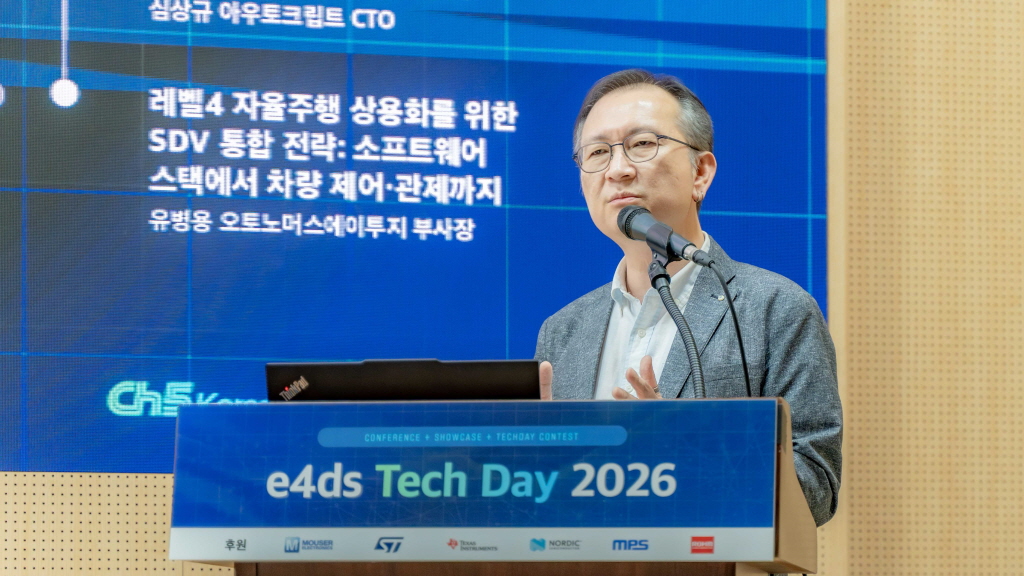
[e4ds Tech Day 2026 ⑨] Sim Sang-gyu, Autocrypt CTO: "In the Physical AI Era, Automotive Security Must Extend Beyond the Vehicle"
At e4ds Tech Day 2026, Sim Sang-gyu, CTO of Autocrypt, explained automotive cybersecurity strategies in the era of Physical AI and SDV (Software-Defined Vehicle). Automobiles are evolving as part of an ecosystem connected to AI, cloud, chargers, IoT, and robots, and he emphasized that the scope of security must expand beyond the vehicle interior to the entire connected environment. In particular, AI model tampering, adversarial attacks, OTA updates, and EV charger hacking were identified as major threats. He explained that response measures require zero trust, AI model integrity protection, intrusion detection, Security by Design and Default, and full lifecycle security management, and that proactive security system establishment beyond regulatory compliance is critical for securing future mobility competitiveness.
2026.10.12by 배종인 기자
NVIDIA to Invest $1 Billion in U.S. Science Over Next Five Years
NVIDIA has announced plans to invest $1 billion over the next five years to strengthen U.S. scientific and technological competitiveness. The company will enhance cutting-edge artificial intelligence research and development capabilities in key areas including quantum computing, healthcare, and energy security, while expanding support for higher education research institutions and cloud service providers. NVIDIA is participating as a major industry partner in the White House Office of Science and Technology Policy's Genesis Mission, and is promoting supercomputer construction in collaboration with national laboratories including Argonne and Los Alamos.
2026.10.12by 배종인 기자
ETRI Unveils 3 Next-Generation Media Technologies Including AI-Dedicated Video Compression
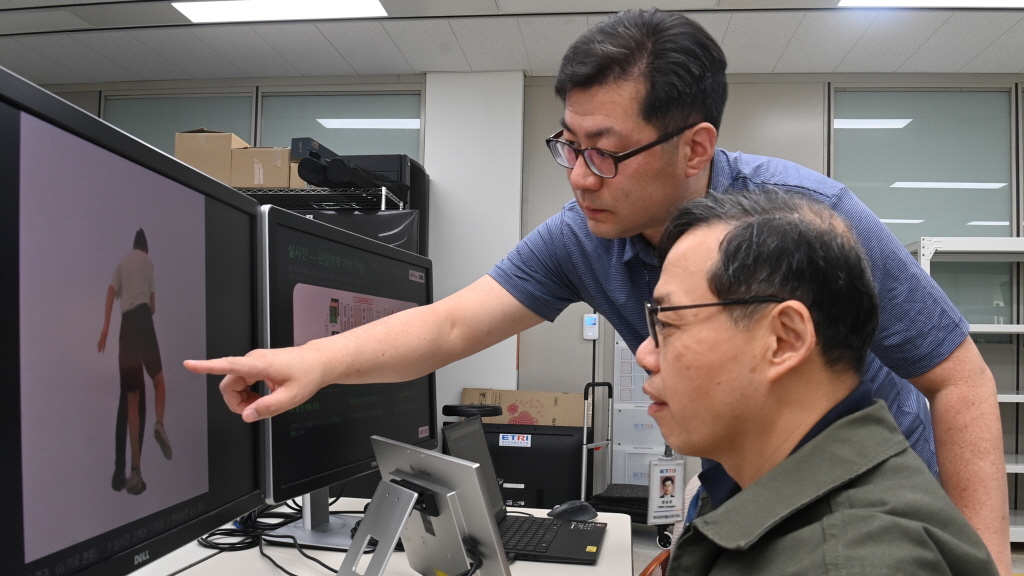
ETRI has unveiled three next-generation media technologies optimized for AI. These include AI-based video encoding (VCM), 3D human generation based on sparse cameras, and generative AI-based pre-visualization technology. In environments where AI directly processes video such as autonomous vehicles, robots, and drones, these technologies enable efficient compression and transmission of large-scale data, and can be applied across various industrial sectors including smart cities, video security, and sports broadcasting.
2026.10.12by 배종인 기자











엔비디아가 솔루션장사도 하네요