



SKT Center Head Kim Yoon: "We Will Develop AI That Changes the World"
 Published2018.04.05 17:28
“We will develop artificial intelligence (AI) that helps humanity and can change the world.”
Kim Yoon, who was appointed as the head of SK Telecom's AI Research Center last February, spoke about the future direction of AI that SK Telecom will introduce.
Center Director Kim Yoon is a machine learning expert who served as the head of Apple’s voice recognition development team and the head of Siri development for the HomePod. “I want to develop AI that can extract knowledge or insights that humans cannot easily derive,” said Kim. “Currently, AI is at a level where it handles a narrow range of tasks. In the future, it will evolve into a form that performs a variety of tasks.”
He added, “The ability to learn two things for every one thing taught is necessary,” and “unsupervised learning methods, which improve performance through data without correct answers, are gaining attention.”
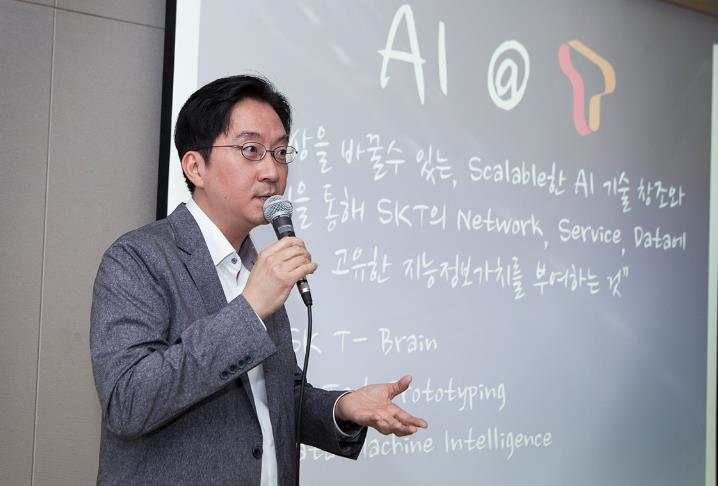
As an AI expert, Center Director Kim explained global AI trends and the four types of artificial intelligence that SK Telecom intends to develop.
The point is that a human-centered approach is necessary, and since humans and machines must evolve together, securing talent is essential. Center Director Kim stated, “We currently have about 30 personnel secured.” "We are planning to double our workforce by the end of the year," he stated, outlining the goal.
Gong explained that since basic technology approaches users' real lives, AI-based products cannot be created without hardware and software engineering. Accordingly, he stated that technological advancement through data feedback is essential.
Center Director Kim stated, “Our goal is to create AI that inevitably contributes to society. Since SK Telecom cannot do everything, we plan to select and focus on areas where we can excel for research and investment.”
He also added that it is important for next-generation AI to secure learning techniques that improve performance without separate supervised learning, identify the cause of errors, and ultimately find and learn what to learn on their own without human instruction.
Neung presented a goal to develop smart networks and content optimized for the upcoming 5G, as well as to reach a level where everything customers can directly see, draw, hear, speak, read, write, and feel is implemented as a user interface.
In conclusion, artificial intelligence was defined as extracting knowledge and insights from complex and unorganized raw data that were previously difficult to obtain, while providing humans with an intuitive and natural interface.
Comments
Related news

MathWorks Integrates MATLAB and NVIDIA TensorRT for AI Model Development
MathWorks announced the integration of MATLAB and NVIDIA TensorRT through GPU Coder. Through the collaboration between the two companies, engineers and scientists can now develop new artificial intelligence (AI) and deep learning models with higher performance and efficiency in MATLAB to meet the increasingly growing demand in data center, embedded, and automotive application fields.
2018.03.30by 김지혜 기자
.jpg)
KT-Green Car “Development of AI Car Sharing Service”
KT, which secured 700,000 subscribers within 1 year and 2 months of launching 'Giga Genie', is now integrating AI technology into car-sharing services. Users will be able to make car-sharing reservations through Giga Genie by the first half of this year at the earliest. KT announced that it has signed a 'Business Agreement for Artificial Intelligence Car-Sharing Service Cooperation' with Green Car. KT's AI Business Division Head Kim Chae-hee and Green Car CEO Kim Jwa-il attended the agreement signing ceremony along with officials from both companies. Going forward, the two companies will pursue ▲providing Green Car search and reservation services through Giga Genie ▲jointly developing customer-customized car-sharing services ▲marketing cooperation. The Green Car search and reservation service through Giga Genie is scheduled to launch in the first half of this year, with the goal of developing innovative service models that combine telecommunications and car-sharing. KT's 'Giga Genie', which recently surpassed 700,000 subscribers, provides not only voice but also audiovisual information simultaneously. It has the advantage of allowing convenient access to various information such as shopping, education, finance, and information search, making it possible to expand services into diverse sectors.
2018.04.02by 김학준 기자
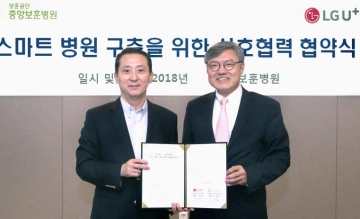
LG Uplus-Central Veterans Hospital to Build AI-Based Smart Hospital
LG Uplus announced that it will work with the Central Veterans Hospital to establish a smart hospital with artificial intelligence services applied. To this end, both companies formed a dedicated task force from January onwards, consisting of ICT specialists from LG Uplus and medical practice and hospital administration experts from the Central Veterans Hospital. They selected short-term and mid-to-long-term projects necessary for smart hospital construction and agreed to promote and conduct joint research through mutual cooperation. In particular, LG Uplus will construct the 'U+ AI Smart Patient Room,' which will be the first in Korea to have an AI speaker, IoT devices, and IPTV installed in patient rooms.
2018.04.02by 김지혜 기자
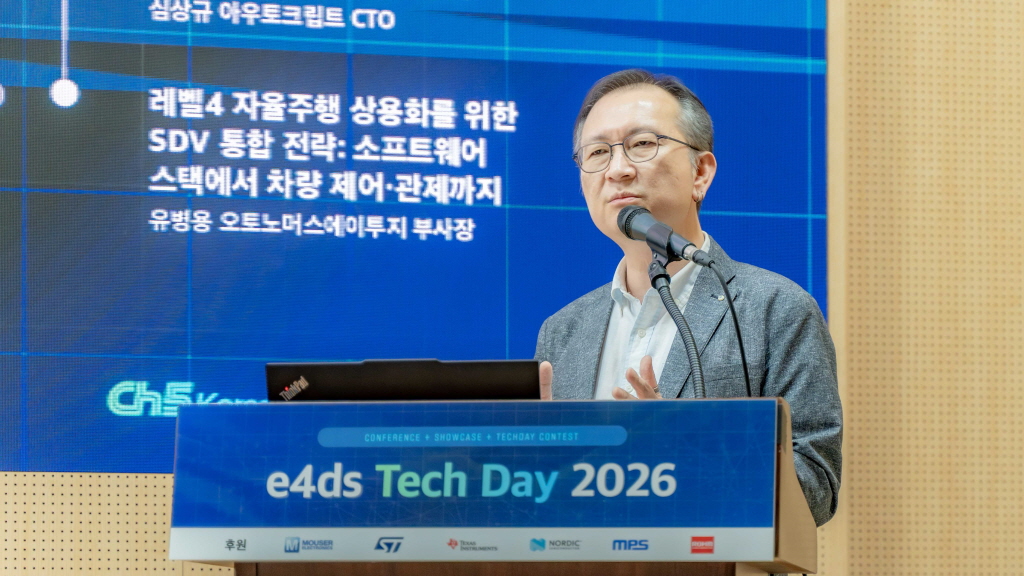
[e4ds Tech Day 2026 ⑨] Sim Sang-gyu, Autocrypt CTO: "In the Physical AI Era, Automotive Security Must Extend Beyond the Vehicle"
At e4ds Tech Day 2026, Sim Sang-gyu, CTO of Autocrypt, explained automotive cybersecurity strategies in the era of Physical AI and SDV (Software-Defined Vehicle). Automobiles are evolving as part of an ecosystem connected to AI, cloud, chargers, IoT, and robots, and he emphasized that the scope of security must expand beyond the vehicle interior to the entire connected environment. In particular, AI model tampering, adversarial attacks, OTA updates, and EV charger hacking were identified as major threats. He explained that response measures require zero trust, AI model integrity protection, intrusion detection, Security by Design and Default, and full lifecycle security management, and that proactive security system establishment beyond regulatory compliance is critical for securing future mobility competitiveness.
2026.10.12by 배종인 기자
NVIDIA to Invest $1 Billion in U.S. Science Over Next Five Years
NVIDIA has announced plans to invest $1 billion over the next five years to strengthen U.S. scientific and technological competitiveness. The company will enhance cutting-edge artificial intelligence research and development capabilities in key areas including quantum computing, healthcare, and energy security, while expanding support for higher education research institutions and cloud service providers. NVIDIA is participating as a major industry partner in the White House Office of Science and Technology Policy's Genesis Mission, and is promoting supercomputer construction in collaboration with national laboratories including Argonne and Los Alamos.
2026.10.12by 배종인 기자











