



Commercialization of hydrogen electric vehicles requires building technological capabilities and 'this' first.
 Published2018.04.06 15:09
Although a technological advantage in hydrogen electric vehicles has been secured, the establishment of infrastructure such as charging stations is insufficient.
The recent consecutive high concentrations of fine dust are a problem. It is difficult to even breathe without wearing a mask. Accordingly, national and local governments are introducing measures such as the alternate-day driving system, wearing masks when going out, emergency reduction measures, and the closure of public institution parking lots, but these are being criticized as being merely one-off solutions.
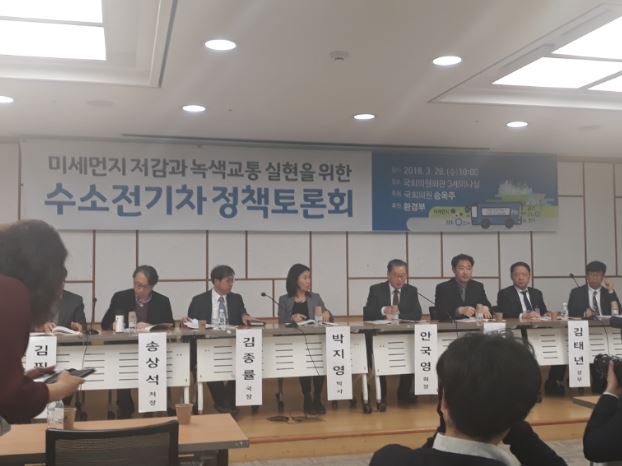
A policy forum on hydrogen electric vehicles was held to establish countermeasures for this issue and to reduce fine dust and realize green transportation. Experts from various fields participated to discuss domestic and international prospects and measures for hydrogen vehicles, and presented details and opinions regarding policy formulation.
In Korea, more than 10% of greenhouse gas emissions originate from the transportation sector, which is dominated by internal combustion engine vehicles, and more than 30% of fine dust emitted in the Seoul metropolitan area comes from diesel vehicles. The public and private sectors recognize that a 30% reduction is a critical factor in establishing an eco-friendly society and are therefore focusing on measures to expand the supply of eco-friendly vehicles.
Representative Park Young-sun of the Democratic Party of Korea stated at a forum, “One hydrogen electric vehicle allows 70 people to breathe purified air for one hour and plays the role of a nuclear power plant, contributing not only to public health but also to securing electricity by generating stored power.” The government aims to build 15,000 hydrogen vehicles and 310 hydrogen charging stations by 2022.
Electric vehicles and hydrogen fuel cell vehicles, often cited as eco-friendly vehicles, differ in their method of using electrical energy. Electric vehicles send electrical energy from a high-voltage battery to an inverter. This converted energy then drives the motor. In other words, electric vehicles require a supply of external power to operate. Although it is considered an eco-friendly vehicle because it reduces smoke emissions from the car itself, the generation of fine dust and harmful substances during the power production process using anthracite coal, petroleum, and chemicals presents a paradoxical situation.
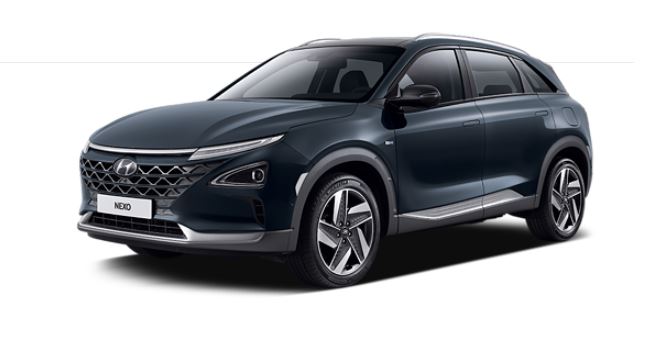
In contrast, electricity in hydrogen electric vehicles is not supplied externally; instead, it is generated within a 'fuel cell stack' through the reaction of hydrogen with oxygen from the air, producing electricity, heat, and water. Compressed hydrogen from a tank mounted on the vehicle body flows to the negative electrode within the stack, while oxygen supplied via a compressor flows to the positive electrode, triggering a chemical reaction. During this process, the hydrogen separates into hydrogen ions and electrons; the electrons are transferred to the electric motor via an inverter. The hydrogen ions react with oxygen from the air to produce water. It is an engine that generates electricity, rather than one that stores and supplies it.
As such, hydrogen electric vehicles do not emit greenhouse gases, and the air supply systems installed in the vehicles are equipped with fine dust removal and air purification functions, giving them high significance and prospects as an effective measure for creating an eco-friendly environment. Furthermore, public awareness and demand for hydrogen electric vehicles have improved following events such as the PyeongChang Winter Olympics and Paralympics. However, actual expansion, distribution, and infrastructure development remain lacking, and measures to address this are necessary.
Park Ji-young, an associate research fellow at the Korea Transport Institute who gave a presentation at the forum, predicted, “Technically, electric vehicles have an advantage for small cars, while hydrogen vehicles will take over the medium and large car segments.” He continued, “As hydrogen cars and electric vehicles have their respective strengths and weaknesses, they will coexist for a considerable period,” adding, “They should be partially applied to public transportation such as taxis and buses, in accordance with the characteristics of hydrogen electric vehicles, which have short charging times and long driving ranges.”
He also added, “Last year, 26 hydrogen buses were in operation in the U.S. and 85 in Europe, and the construction and operation of charging stations were prioritized over technological capabilities,” stating that “infrastructure investment to establish the foundation for operating conditions must be prioritized.”
In his presentation, Koo Young-mo, a team leader at the Automotive Parts Research Institute, shared the same opinion as Commissioner Park, stating, “For hydrogen electric vehicles to be applied to public transportation, the durability of fuel cell systems needs to be improved, and hydrogen charging stations must be built first.”
In addition, Team Leader Gu Young-mo stated, “Demonstration projects involving approximately 250 hydrogen taxis and 50 hydrogen buses must be carried out in parallel to raise public interest and improve the economic viability and efficiency of operators.” He also argued, “Regarding hydrogen pricing, hydrogen must be incorporated as a national energy source to make progress in the distribution of hydrogen electric vehicles and charging stations.” Along with this, they also emphasized incentives, stating, “The air purifier filter needs to be replaced after driving 10,000 km, so support from the government or local authorities is necessary.”
Following the presentation, a designated discussion for policy formulation was held, with Kim Jong-ryul, Director General of Air Environment Policy at the Ministry of Environment; Kim Tae-nyeon, Managing Director of the Korea Automobile Manufacturers Association; Song Sang-seok, Secretary General of Green Transport; Shin Jae-haeng, Head of the Hydrogen Convergence Alliance Promotion Team; and Kim Pil-soo, Professor of Automotive Engineering at Daelim University, participating as panelists.
Kim Tae-nyeon, Managing Director of the Korea Automobile Manufacturers Association
Despite possessing sufficient technological capabilities, we have lost the commercial sector to foreign companies due to delays in commercialization. With Europe leading in internal combustion engines and China in electric vehicles, hydrogen vehicles are expected to possess sufficient competitiveness in the long term. Hydrogen vehicles are technically complex due to their high technical difficulty, making them intricate in terms of engineering and structure. This is expected to benefit the foundation of the ecosystem, including parts suppliers and employment.
Through this, manufacturers must pursue vehicle performance improvements and price reductions, while the government needs to provide R&D support for key component manufacturers. Key elements include fostering self-sustaining competitiveness, securing subsidies to cover operating losses for hydrogen refueling stations, preemptively establishing charging infrastructure, and supporting the localization of core components to reduce costs. Furthermore, a control tower must be designated to systematically manage policies currently dispersed among the Ministry of Trade, Industry and Energy, the Ministry of Environment, and the Ministry of Land, Infrastructure and Transport.
Song Sang-seok, Secretary General of Green Transport
Institutional solutions are necessary. First, a premise must be established regarding whether to move toward a car-centric system like the United States or toward green transportation such as public transport. Since hydrogen is a secondary energy source produced by energy input rather than a primary energy source, there is currently little consideration given to whether the cost is appropriate. Given Korea's infrastructure, electricity will likely be supplied by fossil fuels or KEPCO. I agree that the introduction of hydrogen fuel cell vehicles will reduce fine dust. However, measures must be devised to address the implementation costs. Although the reduction of fine dust through the prioritization of freight trucks and public transportation has not been proven, the Seoul Metropolitan Government has been implementing CNG, but the reason for the lack of results is the issue of charging stations. In other words, rather than blindly pushing forward, it is necessary to provide subsidies to convert diesel freight trucks to LNG and LPG, followed by a gradual transition to hydrogen vehicles. However, now is the time to consider whether we are too hastily rushing to introduce individual hydrogen vehicles while ignoring the overall flow of transportation.
Shin Jae-haeng, Head of the Hydrogen Convergence Alliance Promotion Team
Each hydrogen vehicle reduces annual greenhouse gas emissions by 2 to 56 tons and air pollutants by 5 to 880 kg, and provides an air purification effect equivalent to what 6 to 60 adults can breathe. Replacing public buses with hydrogen buses would yield significant environmental benefits. From a business perspective, the long driving distances required for hydrogen consumption necessitate promoting the deployment of hydrogen refueling stations. Given that overseas competitors such as Toyota and China are entering the hydrogen bus demonstration phase, there is an urgent need for hydrogen bus demonstration projects by domestic companies possessing superior hydrogen electric vehicle technology.
To this end, a roadmap for the deployment of hydrogen buses must be established when formulating the '4th Mid-to-Long-Term Eco-friendly Vehicle Roadmap in 2020.' Demonstration operations are necessary because hydrogen buses require the optimized development of hydrogen electric vehicle technology rather than a new technology. It is also proposed to introduce fuel subsidies along with vehicle subsidies at the government and local government levels, similar to those for electric buses.
Kim Pil-soo, Professor of Automotive Engineering at Daelim University
At a time when public concern regarding the environment, such as fine dust, is rising, interest in the adoption of zero-emission vehicles is growing. While the current focus is on electric and autonomous vehicles, the market will expand over the next few decades as conventional internal combustion engine vehicles and eco-friendly cars coexist. However, it is necessary to convince the public that hydrogen vehicles, which primarily utilize byproduct hydrogen from petroleum products, are truly eco-friendly. Furthermore, there are limitations to widespread adoption aside from charging stations. A balance is required that encompasses not only the adoption and technology of hydrogen vehicles but also the development of infrastructure, such as charging stations, and increased subsidies. We must look at the big picture. It is necessary to consider policy, infrastructure, and employment issues together, rather than focusing on fragmented aspects.
Kim Jong-ryul, Director General of Air Environment Policy at the Ministry of Environment
Korea possesses favorable conditions for the widespread adoption of hydrogen vehicles. It was the first in the world to establish a mass production system for hydrogen vehicles and has secured mass production technology based on high technological capabilities with a localization rate of over 95% for parts. Additionally, approximately 100,000 tons of byproduct hydrogen can be utilized annually. To implement reduction measures, the government is pursuing five major initiatives: securing core technologies, expanding charging stations, improving regulations, providing financial support, and offering incentives.
Comments 1
1 Comments:
Related news
Stop worrying about accidents and emergencies with 5G autonomous vehicles!
SK Telecom (hereinafter SKT) Park Jin-hyo, Head of ICT Technology, said at a 5G autonomous vehicle demonstration conducted by SKT and the Korea Road Traffic Authority, "I am pleased to be able to showcase 5G technology," and "Through autonomous driving, we will prevent traffic accidents and create a world without accidents, improving quality of life." For safe and convenient autonomous vehicle operation, which SKT emphasized on this day, 5G implementation is essential. At CES 2017, Intel announced a 5G modem, signaling innovation in various fields such as wireless broadband and the Internet of Things. 5G, which is a concern for mobile carriers, the automotive industry, and various companies, has the following characteristics in autonomous vehicle operation.
2018.02.08by 김학준 기자
KT Explores Power Demand Management Business Model Using EV Batteries
KT announced that it is establishing a V2G (Vehicle to Grid, bidirectional charging) testbed at its Bundang office in Seongnam, Gyeonggi Province, and will proceed with demonstration of an EV-DR (electric vehicle battery resource-based power demand management) business model following development and verification. V2G is a technology that can respond to power shortage situations by discharging power stored in EV batteries back to the grid, and was designated as a key new energy service in the Ministry of Trade, Industry and Energy's January briefing.
2018.02.12by 김지혜 기자
From electronics manufacturing to electric vehicles...what exhibitions are on?
An exhibition showcasing the entire electronic manufacturing industry from start to finish will be held. The Korea Electronics Manufacturing Industry Exhibition, running from April 11 to 13 at COEX Level 3, will simultaneously host the International Surface Mount and Printed Circuit Board Production Equipment Exhibition, Photonics & LED Seoul, International Printed Electronics and Electronic Materials Industry Exhibition, and International Functional Film Industry Exhibition. In addition to exhibitor seminars, new equipment/new product presentations, and technical demonstrations, the International Future Automobile Forum, KAMP Spring International Symposium, and the Advanced Materials Technology Briefing Session for Electrical and Electronic Applications by the Materials Research Institute will also be held. The Korea Automotive Electronics Manufacturing Industry Exhibition, where visitors can examine automotive electronic components and manufacturing processes, will be held simultaneously in Hall C.
2018.04.04by 김지혜 기자

Nvidia invests $5 billion in Intel
NVIDIA and Intel, leaders in global AI computing technology, are now forging ahead in providing cutting-edge solutions through NVLink-based architecture integration. NVIDIA and Intel have officially announced a strategic partnership and stated that they will jointly develop customized data center and personal computing products to accelerate diverse applications and workloads ranging from hyperscale to enterprise and consumer markets, thereby laying the foundation for the next generation computing era.
2025.09.22by 배종인 기자
.jpg)
Applied Materials Launches Environmental Protection Campaign to Mark World Cleanup Day
Applied Materials Korea (CEO Park Kwang-seon) is carrying out environmental cleanup activities with employees and their families around the Dongtan Sinricheon area on the occasion of World Cleanup Day, evolving into a company that engages with the local community beyond technological innovation.
2025.09.22by 명세환 기자












열심히 청강함!