


KT Prepares for Commercialization of Autonomous Driving with 5G Technology
 Published2018.04.18 10:56
KT held the '2018 1st Future Forum' at the KT WEST building in Gwanghwamun, Seoul, and announced that it is developing a commercial autonomous driving platform (5GaaVP: 5G as a Vehicle Platform) based on KT's innovative 5G technology verified in PyeongChang.
On this day, KT emphasized autonomous driving through 5G as a core technology to lead the Fourth Industrial Revolution and unveiled 5G infrastructure, 5G-V2X (vehicle-to-everything communication) technology, precision positioning, and an intelligent control system that it has been preparing since 2015.
Furthermore, KT stated that it intends to emerge as a '5G autonomous driving platform' operator based on these technologies, and introduced the autonomous driving demonstration complex projects currently underway in Pangyo and Daegu, as well as plans to create an open ecosystem through them.
Targeting the autonomous driving market opening in 2020
In an announcement on this day, KT cited the results of market research firm Navigant Research, stating that it expects the autonomous driving market to blossom starting in 2020 to solve traffic social problems, and that it is beginning full-scale preparations to enter the market.
According to the survey, existing vehicles will be gradually replaced by autonomous vehicles, and it is projected that approximately 75% of vehicles on the road will be autonomous by 2035. Furthermore, if 50% of existing vehicles are replaced by autonomous vehicles, it is estimated that there will be an annual global economic effect of approximately 250 trillion won. In particular, as global companies have recently entered the autonomous driving market and the scale is expected to grow even larger, KT plans to target the relevant market in advance through innovative 5G technology.
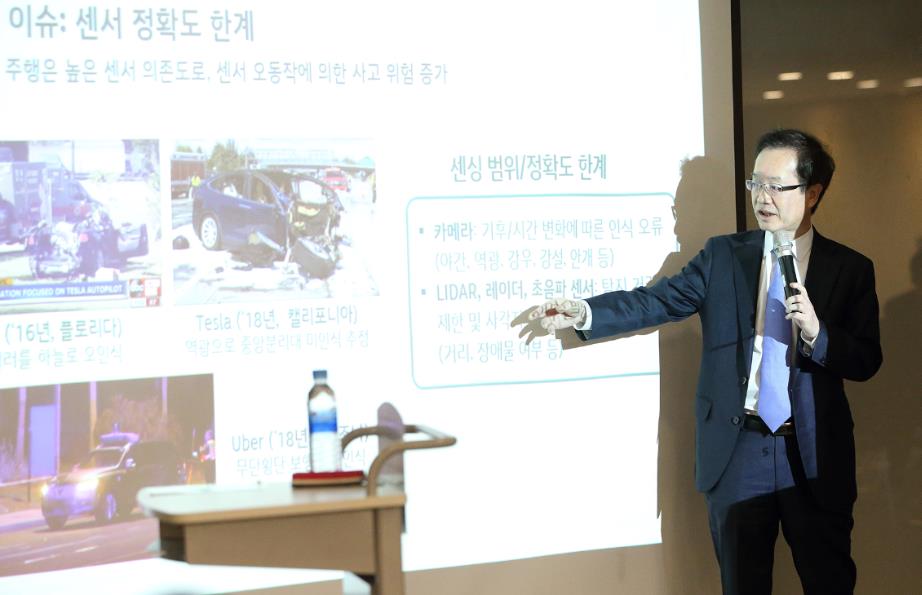
Presenting 4 Differentiating Technologies to Complete Safe Autonomous Driving
Until now, autonomous vehicles have relied solely on their own detection capabilities, such as sensors and LiDAR, so there have often been instances where they were inadequate in responding to unexpected situations. However, KT stated that once '5G autonomous driving' technology, which incorporates four core technologies, is commercialized, vehicles and infrastructure will be simultaneously connected, allowing for proactive responses to risks and preventing accidents caused by autonomous driving.
1) [KT 5G Infrastructure] providing stable coverage and mobility
Based on its experience operating the Pyeongchang 5G pilot service, KT is building a 5G network to lay the foundation for an autonomous driving platform. It plans to establish nationwide coverage using the 3.5GHz band, which has a wide radio wave range, and additionally utilize the faster 28GHz band in urban areas. In areas where 5G has not yet been deployed, the existing LTE network is used to provide seamless network services.
As a result, since the network connection environment changes moment by moment in moving vehicles, we plan to complete total network coverage optimized for autonomous driving by utilizing 5G's 'beam tracking' technology and '5G-LTE interoperability' technology, which can provide stable autonomous driving services in all situations.
2) [5G-V2X] technology providing ultra-low latency vehicle connectivity
Through KT's 5G network, vehicles and traffic infrastructure are connected with ultra-low latency of 1 to 7 ms (millisecond: 1/1000 second), enabling safer autonomous driving than conventional sensor-based autonomous driving. In addition, by providing a dedicated virtual network for vehicles through 5G 'network slicing' (virtual segmented network), it guarantees the security and stability required for autonomous driving.
In particular, during the last PyeongChang Winter Olympics, 5G cooperative autonomous driving using three vehicles was conducted in the Gangneung area, and information was exchanged between each vehicle and traffic signals to successfully complete platooning autonomous driving.
3) KT's [Precise Positioning] technology, identical anywhere in the country
KT has developed precision positioning technology capable of accurately determining the current location with an accuracy of up to 30cm and provides it in the form of a platform. When this precision positioning technology is utilized in a 5G autonomous driving platform, it can even distinguish the lane being driven in, enabling stable vehicle control.
This precision positioning solution from KT has been under development since 2015 and has recently completed real-world verification after being applied to autonomous vehicles. In the future, we are advancing our technology to enable more accurate and seamless location information to be calculated anywhere in the country by utilizing various KT infrastructures, including not only GPS satellites but also LTE and 5G base stations, repeaters, and WiFi APs.
4) Realization of [Intelligent Control] through the establishment of a vehicle communication big data-based platform
KT's autonomous driving platform enables intelligent control, such as traffic signal control, by collecting vehicle location and sensor information in real time and analyzing big data at the control server to predict situations.
In particular, if the autonomous driving platform is developed for Edge nodes in about 50 regions nationwide, it is expected that ultra-low latency control with faster response times than a centralized system will become possible.
Based on these four core technologies, KT is developing a '5G as a Vehicle Platform' that provides infrastructure for safe driving and convenience of vehicles. This platform will be built as an open platform to encourage the participation of various third parties and contribute to the revitalization of the related ecosystem.
Meanwhile, KT plans to unveil a 5G autonomous bus starting next month at Pangyo Zero City in Seongnam, Gyeonggi Province, the nation's first autonomous driving demonstration complex. To this end, it is building an autonomous driving infrastructure based on 5G and LTE. This infrastructure collects and shares traffic signal and pedestrian information, road event information, and vehicle and shuttle operation information, enabling intelligent control of autonomous vehicles through big data analysis.
As such, KT plans to participate in C-ITS (Cooperative Intelligent Transport Systems) autonomous driving demonstration projects in various local governments, including Seoul, Daegu, and Jeju, to verify the core technologies of its 5G autonomous driving platform. In addition, we plan to continue discussions with automobile and parts manufacturers to ensure that 5G technology is applied to autonomous vehicles at an early stage.
Jeon Hong-beom, Executive Vice President and Head of the Infrastructure Research Institute at KT's Convergence Technology Institute, stated, "KT has demonstrated that autonomous driving performance can be significantly improved by connecting 5G to the field," adding, "Going forward, KT will complete an open autonomous driving platform based on 5G technology to revitalize the ecosystem and lead the upcoming autonomous driving market."
Comments
Related news
Autonomous vehicle sensors must increase MIMO and multi-path precision and reduce prices
Safety is an inherent requirement in autonomous vehicles. Regarding the direction of radar and lidar technologies to achieve this, researcher Lee Sun-young from the Electronics and Telecommunications Research Institute stated, "Radar must focus on precision enhancement based on MIMO technology and multi-path improvement, while lidar must continuously address the issues of expensive equipment and low resolution." Domestic and international companies are targeting the commercialization of autonomous vehicles by 2020. According to a market research firm, demand for autonomous vehicles is projected to increase during 2020-2025. Aligned with this, while companies continue research and development, the Tesla collision accident last month and Uber's recent fatal accident have caused vehicle owners and many people to develop anxiety and skepticism regarding Tesla's Autopilot and full commercialization of autonomous vehicles. Autopilot is Tesla's autonomous driving system in which radar and lidar, cameras, sensors and other components continuously monitor the vehicle's surroundings and independently perform calculations to prevent accidents and collisions. Autopilot is divided into four levels: Level 1 where driving is conducted without sensor assistance, Level 2 with sensors playing a supporting role, Level 3 where autonomous driving is possible in specific sections, and Level 4 where complete autonomous driving is possible.
2018.04.09by 김학준 기자
Domestic Autonomous Vehicle Roadmap Must Be Drawn Together with the Public and Private Sectors
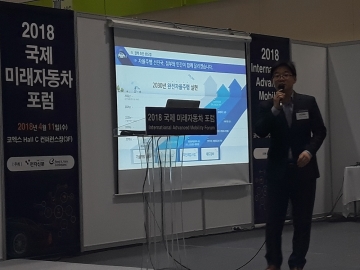
The Ministry of Land, Infrastructure and Transport is advancing autonomous vehicles to Level 4 and 5, which enable fully autonomous driving by 2022, and is moving beyond early commercialization toward widespread adoption. Major companies such as BMW, Mercedes-Benz, Audi, Honda, Toyota, and Ford are pursuing commercialization of autonomous vehicles targeting 2020. Major developed countries including the United States, Europe, and Japan are establishing smart infrastructure tailored to traffic characteristics by city and accelerating commercialization timelines. Accordingly, domestic private enterprises, government, and national agencies are focusing on 'safety' and working to develop autonomous cooperative driving integrated with infrastructure. Kim Chang-gi, assistant director at the Ministry of Land, Infrastructure and Transport, stated at the 2018 International Future Automobile Forum that "the government is establishing the foundation for commercialization this year, targeting the commercialization of Level 3 autonomous vehicles capable of autonomous driving during specific periods by 2020, and the expansion of Level 4 and 5 based autonomous vehicles by 2022."
2018.04.12by 김학준 기자
Why LiDAR for Autonomous Vehicles?
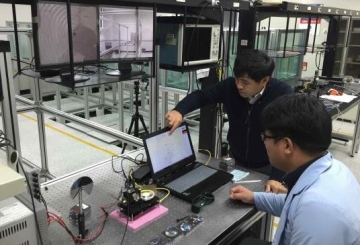
For autonomous vehicles to become a reality, multiple technologies are required. Dozens of systems must be fulfilled, including HDA (which automatically maintains inter-vehicle distance), Lane Departure Warning System (LDWS), Lane Keeping Assist System (LKAS), Blind Spot Detection (BSD), AEB, ACC, and others. The ultimate goal of all these technologies is defined as 'safety'. To realize this technology, development of LiDAR performance and technical capabilities is necessary. LiDAR is a sensor that uses light to determine distance and velocity. Interest in LiDAR is increasing due to growing demand in industrial fields requiring distance information, such as unmanned mobile objects, autonomous vehicles, safe operation, drones, robots, and machine vision. LiDAR form factors are evolving into fixed-type, beam-splitting, 360-degree scanning, and multi-channel types. The Korea Electronics Technology Institute (hereinafter KETI), a government-funded research institution, is developing all four types and leading efforts to advance Korea's LiDAR market.
2018.04.13by 김학준 기자

[e4ds Tech Day 2026 ⑨] Sim Sang-gyu, Autocrypt CTO: "In the Physical AI Era, Automotive Security Must Extend Beyond the Vehicle"
At e4ds Tech Day 2026, Sim Sang-gyu, CTO of Autocrypt, explained automotive cybersecurity strategies in the era of Physical AI and SDV (Software-Defined Vehicle). Automobiles are evolving as part of an ecosystem connected to AI, cloud, chargers, IoT, and robots, and he emphasized that the scope of security must expand beyond the vehicle interior to the entire connected environment. In particular, AI model tampering, adversarial attacks, OTA updates, and EV charger hacking were identified as major threats. He explained that response measures require zero trust, AI model integrity protection, intrusion detection, Security by Design and Default, and full lifecycle security management, and that proactive security system establishment beyond regulatory compliance is critical for securing future mobility competitiveness.
2026.10.12by 배종인 기자

Practical HIL Construction Strategy for Automotive and Off-Highway Controller Validation
As vehicle E/E architecture transitions to zonal structures and shifts to software-defined vehicles (SDV), the number of controllers (ECUs) requiring validation and software complexity are surging dramatically. Meanwhile, real vehicle testing cannot provide repeated verification under identical conditions and entails lead time and safety concerns. This white paper explains the principles of HIL (Hardware-in-the-Loop) validation and the structure of the NI platform composed of PXI, SLSC, and VeriStand, and through two actual implementation cases—Camera Record & Replay HIL for In-Cabin Monitoring Controller (ICMU) and Forklift Controller (VCU) HILS—describes how controller-level regression testing becomes possible. Additionally, it explicitly states application boundaries and limitations, such as lack of A2B support.
2026.10.12by 편집부











