



How will the 5G frequency auction on the 15th of next month proceed?
 Published2018.05.04 16:02
The frequency auction for the world's first 5G commercialization will be held on June 15.
The Ministry of Science and ICT announced that it will accept applications for 5G frequency allocation until the 4th of next month and hold an auction on the 15th. Commercialization is expected to begin in March of next year.
With the goal of supplying the maximum allocatable frequency bandwidth at once, a total of 2,680 MHz bandwidth is supplied, consisting of 280 MHz in the 3.5 GHz band (3,420–3,700 MHz) and 2,400 MHz in the 28 GHz band (26.5–28.9 GHz).
Regarding the 20 MHz bandwidth of the 3.5 GHz band that was excluded from this auction due to interference issues, we plan to form an expert research team with telecommunication operators immediately after the auction to review the analysis methods and timing of the interference issues.
Considering that this is the first frequency supply to launch 5th generation mobile communication, the total amount of frequency that can be allocated to one company is limited to 100 MHz for the 3.5 GHz band and 1,000 MHz for the 28 GHz band.
In determining the total limit level, the Ministry of Science and ICT focused on providing opportunities for all operators to attempt 5th generation innovation in a similar environment at the dawn of a new generation. It was also stated that the readiness of the initial equipment and terminal ecosystem, as well as domestic and international trends in 5th generation technology discussions, were taken into consideration.
Given that this auction imposed strict total quantity limits considering it is the starting frequency for 5G, if additional 5G frequencies are supplied in the future, each operator [will respond to] traffic increase
.jpg) We plan to relax the total limit to a level that allows us to secure as much frequency as is necessary to respond.
We plan to relax the total limit to a level that allows us to secure as much frequency as is necessary to respond.The 3.5 GHz band with a bandwidth of 280 MHz was set at 2.6544 trillion won for a usage period of 10 years, and the 28 GHz band with a bandwidth of 2,400 MHz was set at 621.6 billion won for a usage period of 5 years.
When determining the minimum competitive price, the Ministry of Science and ICT considered the environment of this 5G frequency auction, including the allocation price by mobile communication technology generation, past frequency auction results, and the supply of ultra-wideband/5G market outlook.
They stated that the allocation fee was determined at a level that allows for the imposition of an appropriate fee by balancing the recovery of costs for mobile carriers generating profits through the exclusive use of frequencies, which are a public good, with the possibility that the allocation fee could be passed on to communication charges.
In particular, the 28 GHz band is expected to have significant future market potential, but there is currently a great deal of uncertainty. To reduce the investment risk associated with this, it was decided to set the period to 5 years and significantly lower the minimum competitive price.
The auction method adopted the Clock auction method, which divides the auction into a stage for determining the amount of frequency (Stage 1) and a stage for determining the frequency location (Stage 2).
Specifically, to prevent the winner's curse from occurring due to an overheated competition for frequency allocation, the detailed auction rules were designed so that Stage 1 proceeds for up to 50 rounds within a maximum bid increment of 1%.
For the 3.5 GHz band, the standard number of base stations was set at 150,000, with a construction obligation of 15% over 3 years and 30% over 5 years, while for the 28 GHz band, the standard number of equipment was set at 100,000 units, with a construction obligation of 15% over 3 years.
Additionally, the Ministry of Science and ICT announced that, in order to support Korean SMEs in having growth opportunities in the 5G market, it has decided to include small cell base stations and repeaters subject to reporting in the standard base stations, and to include support measures for SME-specific products, such as small cells that do not fall under this category, in the frequency usage plan after consultation with telecommunication companies.
Minister Yoo Young-min of the Ministry of Science and ICT stated, “The government’s efforts to alleviate the burden of 5G investment costs for telecommunication operators—such as devising a plan for the joint use of essential facilities in preparation for 5G commercialization and supplying the maximum available bandwidth all at once rather than in multiple installments—were intended to provide the optimal environment for our companies to lead the 5G market.” He urged, “Starting with this frequency supply, I hope that all economic entities will devote themselves to ensuring that Korea leads the global market in the era of 5G mobile communication and the Fourth Industrial Revolution.”
Comments 1
1 Comments:
Related news
SK Telecom Unveils New Campaign 'THIS IS 5G'
SK Telecom has unveiled a new 5G campaign titled "THIS IS 5G." Figure skating queen Kim Yuna and skeleton emperor Yun Sung-bin will serve as models to promote SK Telecom's 5G. The campaign will roll out across various spaces including TV, social media, and baseball stadiums starting today. The "THIS IS 5G" campaign presents SK Telecom's answer to the question "What is 5G?" The core attributes of 5G—speed, stability, and security—are clearly expressed through conversations between Kim Yuna and Yun Sung-bin, as well as skeleton training scenes.
2018.03.21by 김지혜 기자
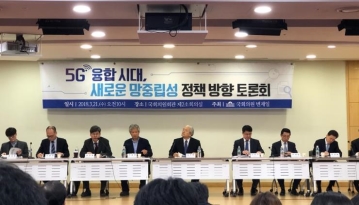
Improvement of Net Neutrality Needed Ahead of 5G Commercialization..."Revenue and Investment Costs Must Be Considered"
As preparation for commercialization in March 2019 of fifth-generation (5G) mobile communication services progresses, there are calls to revise the 'net neutrality guidelines.' The United States abolished its net neutrality policy at the end of last year. Following this, Democratic Party lawmaker Byun Jae-il held a '5G Convergence Era, New Directions in Net Neutrality Policy Discussion Forum' regarding the reestablishment of domestic net neutrality policy. Net neutrality is a concept that all data transmitted over Internet networks should be treated equally regardless of content, type, or provider. This concept emerged in the early 2000s. It was raised due to concerns that Internet service providers (ISPs) could discriminate against or block traffic due to insufficient high-speed Internet infrastructure, concerns about abuse of dominance, and infringement of users' right of access.
2018.03.27by 김지혜 기자
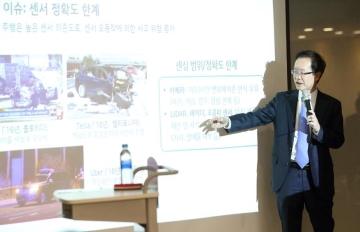
KT Prepares for Commercialization of Autonomous Driving with 5G Technology
KT held the '2018 1st Future Forum' at its KT WEST headquarters in Gwanghwamun, Seoul, and announced the development of a commercial autonomous driving platform (5GaaVP: 5G as a Vehicle Platform) based on KT's 5G innovative technologies verified in PyeongChang. On this day, KT emphasized autonomous driving through 5G as a core technology to lead the Fourth Industrial Revolution, and unveiled ▲5G infrastructure, ▲5G-V2X (vehicle-to-everything communication) technology, ▲precise positioning, and ▲intelligent traffic management systems that have been in preparation since 2015.
2018.04.18by 김지혜 기자
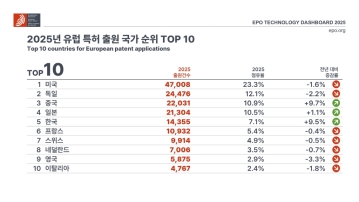
European Patent Applications Surpass 200,000 for the First Time… South Korea Maintains 5th Place, Led by Batteries and Telecommunications
According to the European Patent Office (EPO)'s 'Technology Dashboard 2025', European patent applications last year reached 201,974, surpassing 200,000 for the first time. Korean companies and inventors filed 14,355 applications, representing a 9.5% increase from the previous year and maintaining 5th place by country. Battery, digital communication, and semiconductor technologies led the growth, with Samsung ranking as the top EPO applicant for the second consecutive year and LG reaching 3rd place. The presence of major domestic cities such as Seoul, Suwon, and Yongin was also confirmed. It was also revealed that Korea's European patent strategy is expanding beyond individual technologies to span the entire industry.
2026.03.24by 명세환 기자
SK Telecom First Applies AI-Based Network Operations at Gwanghwamun K-Pop Concert
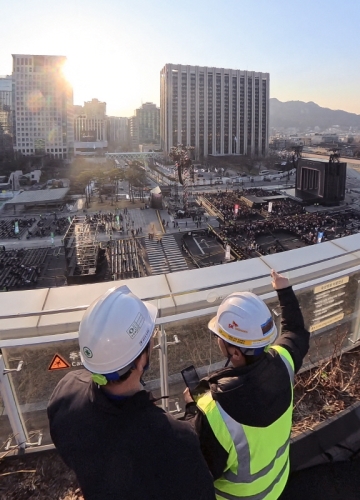
SK Telecom announced that it applied an AI-based network operation system for the first time at a large-scale K-pop concert held in the Gwanghwamun area of Seoul on March 21st, managing communication quality throughout the event. Mobile data usage during the three hours before and after the concert reached 12.15TB, approximately doubling compared to the same time slot the previous weekend. SK Telecom monitored traffic using the AI system 'A-One' in five-minute and 50-meter units to respond to potential overload situations, while also operating temporary communication facilities and on-site personnel in parallel. This case is interpreted as confirmation of the practical applicability of AI-based autonomous network operation in an environment where demand from dense events and foreign users increases simultaneously.
2026.03.23by 명세환 기자












좋은 정보 감사합니다.