


KT and the Nakdong River Environmental Office established a "Comprehensive Fine Dust Situation Room" to respond to fine dust.
 Published2018.05.08 11:15
Installation is planned at key locations, including Ulsan Mipo and Onsan National Industrial Complex.
KT announced that it signed a 'Fine Dust Environment Improvement Business Agreement' with the Nakdong River Basin Environmental Office to measure and respond to fine dust in industrial complexes in the Ulsan region.
Through this business agreement, KT and the Nakdong River Basin Environmental Office will measure fine dust emissions from major industrial complexes in Busan, Ulsan, and South Gyeongsang Province and use big data analysis to improve perceived air quality. To achieve this, KT will install an IoT-based air quality measurement network and, based on this network, establish an intelligent fine dust management system.
KT plans to install IoT air quality monitoring devices at key locations in the Ulsan Mipo National Industrial Complex and Onsan National Industrial Complex, both of which are high-concentration sites of fine dust emissions. This air quality monitoring network will measure air quality in real time, including fine dust, ultrafine dust, temperature, and humidity, in the industrial complexes and surrounding areas. Through big data analysis, including weather data and KT's floating population data, the network will identify areas vulnerable to fine dust and support the Nakdong River Basin Environmental Office in developing fine dust reduction measures.
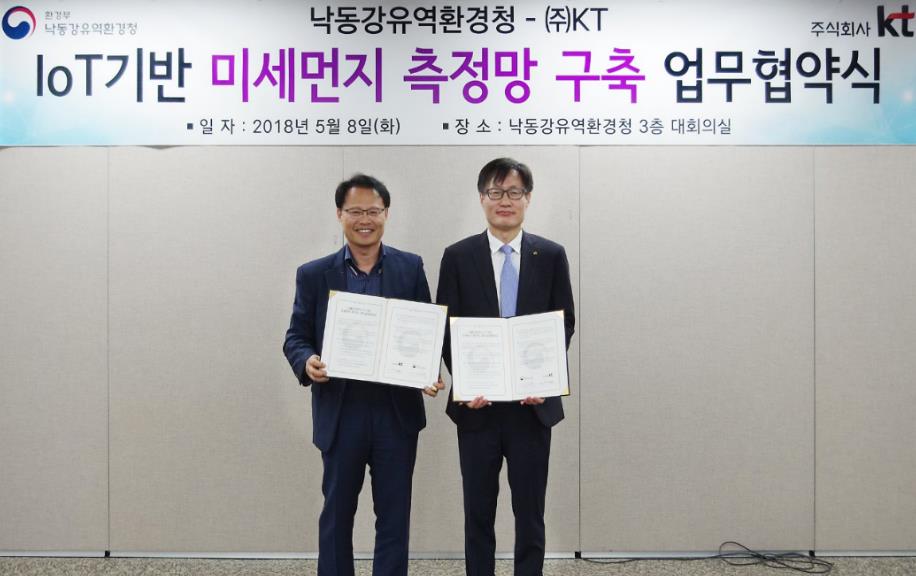
Once this air quality measurement network is established, the Nakdong River Basin Environmental Office plans to establish a 'Fine Dust Comprehensive Situation Room' to check real-time air quality information and disseminate it to pollutant-emitting businesses and local governments, and take countermeasures such as ▲managing emission and prevention facilities and ▲operating sprinkler trucks to reduce fine dust. This air quality measurement network will be expanded to all regions within the region, including Ulsan, Busan, and Gyeongnam, in the future, to complete an intelligent fine dust management system.
Kim Jun-geun, executive director of KT GiGA IoT Business Unit, said, “This project is very meaningful in that the public and private sectors are cooperating to take a proactive approach to the fine dust issue, which is directly related to the public’s health.” He added, “Going forward, KT will join the national effort to respond to fine dust by establishing an air quality measurement network in key areas of industrial complexes.”
Comments
Related news
KT Leads Joint Entry of SME Partners into Global Markets
KT held the "2018 First Half Global Business Council General Assembly" at KT Square in Jongno-gu, Seoul, with approximately 170 executives and employees in attendance, including KT President Koo Hyun-mo, Head of Management Planning Division, and Vice President Yun Kyung-rim, Head of Global Business Promotion Division, along with employees from approximately 70 partner companies, the company announced. KT launched the "Global Business Council" in November 2017 to support small and medium-sized partner companies' global expansion, and holds regular general assemblies twice a year in the first and second halves. KT's Global Business Council consists of partner companies with intentions to expand overseas among KT's suppliers.
2018.05.04by 김지혜 기자

KT, Strengthening Educational Content and Expanding Services with Target of '1.5 Million Subscribers by Year-End'
"We will achieve 1 million Giga Genie subscribers in the first half of this year and 1.5 million by year-end, leading the era of artificial intelligence (AI) democratization." KT announced plans to strengthen content such as kids and education for its AI speaker 'Giga Genie' and expand service areas from homes to automobiles and hotels. Kim Chae-hee, head of the AI Business Division, stated, "As global players enter the market, this year will see fierce competition in the AI speaker market in earnest." He explained, "Consumers no longer purchase speakers for simple reasons like novelty or aesthetics. They make judgments based on voice recognition quality and provided AI services. We will ensure consumers experience clear utility value across service aspects, device aspects, and platform aspects."
2018.05.04by 김지혜 기자

KT to Launch Nationwide Commercial 10 Gigabit Internet Soon
KT announced that it is opening an experience space called "KT 10 GiGA Arena" at the "AfreecaTV Open Studio" located in Songpa-gu, Seoul, and is accelerating the nationwide commercialization of 10-gigabit internet this September. 10-gigabit internet not only offers speeds 100 times faster than mega internet, but can also provide high-quality services such as ultra-high-definition (UHD) video services, virtual reality (VR), and augmented reality (AR) that require large bandwidth capacity more stably than before.
2018.05.08by 김지혜 기자
Korea Instrument, KOLAS Accredited Calibration Agency First to Simultaneously Acquire ISO/IEC 27,001·27,701
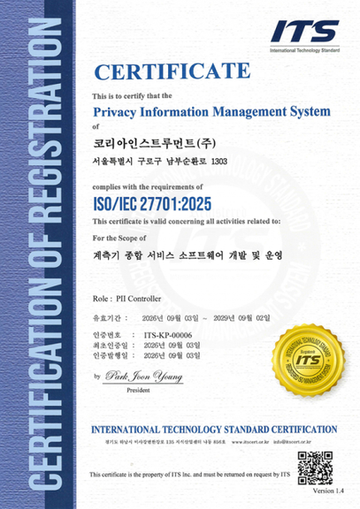
Korea Instrument has become the first among KOLAS accredited calibration agencies to simultaneously acquire ISO/IEC 27,001 and ISO/IEC 27,701 certifications. Through its proprietary platforms CWIZ Enterprise and CWIZ Partners, the company has embedded information security and personal data protection requirements across all business processes including customer information, equipment data, and calibration reports, with plans to continuously advance its management system through regular audits and security inspections.
2026.10.12by 배종인 기자

TeamViewer One, IT Incident Automation Workflow and Resolution Center Enhanced
TeamViewer has added IT incident automation capabilities and an advanced Resolution Center to its integrated digital workplace management platform 'TeamViewer ONE'. Recurrent service disruptions, configuration errors, and capacity shortages are automatically handled according to preset policies, and device status verification through script deployment can be managed in a unified interface, significantly reducing repetitive tasks for IT teams.
2026.10.12by 배종인 기자











