



TI Launches Automotive Ethernet Physical Layer Transceiver that Reduces Board Space and Power Consumption
 Published2018.05.09 09:17
Texas Instruments (TI) announced the launch of a new automotive Ethernet physical layer (PHY) transceiver product.
This product reduces external component count, board space, and power consumption by half compared to competing solutions. With support for serial gigabit media independent interface (SGMII), compact packaging, and integrated diagnostic capabilities, the new DP83TC811S-Q1 enables space-constrained automotive body control units, infotainment and clusters, and ADAS applications to achieve greater intelligence via Ethernet connectivity.
The DP83TC811S-Q1 Ethernet PHY is the first 100BASE-T1 device to support SGMII, enabling flexible design by connecting to multiple switches and interfaces. Supporting all media independent interfaces (MIIs), it allows developers to implement Ethernet connectivity with a variety of media access controllers (MACs) and processors, such as TI's Jacinto automotive processors. It also includes diagnostic features, including patent-pending ESD monitoring, which allows the system to monitor and detect cable breaks, temperature and voltage fluctuations, and electrostatic discharge (ESD).

The DP83TC811S-Q1 not only requires fewer external components but is also available in a 6 mm x 6 mm wettable flank package, reducing solution size by up to 50%. Additionally, the device complies with the IEEE 802.3bw standard and OPEN Alliance specifications, allowing the use of unshielded single twisted-pair copper cables, reducing overall cable weight and cost.
Developed using one of TI's low-power process technologies, the DP83TC811S-Q1's low power output minimizes heat dissipation and allows components to be placed closer together. It also includes power-saving features such as standby, inactive, and Wake-on-LAN.
It includes diagnostic features such as cable diagnostics, temperature and voltage sensors, and ESD monitoring, ensuring it can withstand ESD and overvoltage events. These diagnostic features allow for continuous monitoring of the integrity of the Ethernet link. The DP83TC811S-Q1 also provides ESD protection up to 8 kV, protecting the device from high-voltage faults.
Comments
Related news

TI Launches Multi-Standard MCUs to Meet Growing Connectivity Demands
Texas Instruments announced the launch of new SimpleLink wireless and wired microcontroller (MCU) products to meet increasing connectivity requirements for buildings, factories, and power grids. The product features industry-leading low power consumption and supports simultaneous multi-standard/multi-band connectivity including Thread, Zigbee, Bluetooth 5, and sub-1GHz. The new product expands the SimpleLink MCU platform with larger memory capacity and diverse connectivity options. With 100% code reusability among TI's ARM Cortex-M4 based MCUs, users can conveniently enhance sensor networks and connect to the cloud.
2018.03.05by 김지혜 기자
TI Unveils Power Management Chip for Higher Efficiency and Smaller Size
TI announced the launch of multiple new power management chip products that can reduce the size of power supplies and charging solutions for personal electronic devices and portable industrial equipment while improving efficiency. TI's new chipset product operating at up to 1MHz combines the UCC28780 active clamp flyback controller and UCC24612 synchronous rectifier controller, enabling power supply size reduction by half in AC/DC adapters and USB PD (Power Delivery) chargers. Additionally, the bq25910 6A 3-level buck battery charger is a suitable product for battery-powered electronic devices requiring maximum charging efficiency with minimal solution size, capable of reducing solution footprint by up to 60% in smartphones, tablets, and electronic POS devices.
2018.03.08by 김지혜 기자
.jpg)
TI Adds High-Speed GaN Driver to GaN Power Product Family
TI announced that it is adding two new high-speed GaN FET driver products to its industry-leading gallium nitride (GaN) power product portfolio. These new products enable more efficient and high-performance designs in speed-critical applications such as LIDAR and 5G RF envelope tracking. The LMG1020 and LMG1210 are capable of 50MHz switching frequency, improve efficiency, and achieve a solution size five times smaller than what was possible with silicon MOSFETs.
2018.03.12by 김지혜 기자

Intel Unveils Next-Generation 'Core Ultra Series 3' and vPro Platform for Enterprise PCs
Intel has officially unveiled the "Intel Core Ultra Series 3" for next-generation enterprise PCs and the latest vPro platform, addressing a wide range of demands from enterprise notebooks to high-performance workstations.
2026.03.26by 배종인 기자
ROHM Launches ESD Protection Diode Compatible with High-Speed Interfaces of 10Gbps or Higher
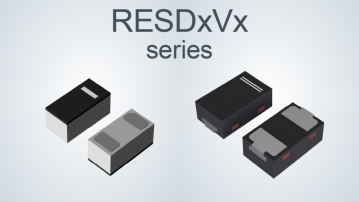
Semiconductor specialist ROHM has developed the 'RESDxVx series' of ESD (electrostatic discharge) protection diodes capable of responding to next-generation high-speed data communication environments exceeding 10Gbps, simultaneously enhancing both signal quality maintenance required in high-speed interfaces and IC protection performance.
2026.03.26by 배종인 기자











