


KT to Launch Digital Healthcare Pilot Project on Trans-Siberian Railway
 Published2018.05.21 16:28
KT announced that it has been selected for the second consecutive year as the operator of the '2018 ICT-based Medical System Entry Project,' which is organized by the Ministry of Health and Welfare and entrusted to the Korea Health Industry Development Institute.
KT was selected as an operator for the ICT-based medical system expansion in 2017 and successfully carried out a project to establish digital healthcare solutions and platforms in 12 hospitals in Almaty, Aktobe, and East Kazakhstan. Following last year, it has once again been recognized as Korea's leading digital healthcare company.
Russian Railways, with which KT is conducting a digital healthcare pilot project in 2018, is one of the world's top three railway transport companies engaged in passenger rail transport and operates 173 hospitals across Russia. In December 2017, KT signed a business agreement with Russian Railways for a digital healthcare project and agreed to pilot a mobile health diagnostic solution capable of providing primary care at station hospitals and on trains. Since then, KT has been reviewing the scale of the project and the required budget.
KT, together with Bundang Seoul National University Hospital, will establish a remote consultation system between five regional hospitals affiliated with Russian Railways and the Moscow Central Hospital (base hospital) by June. In addition, it will conduct a pilot project to establish a telemedicine system on the Trans-Siberian Railway by the end of the year. KT will be responsible for building and supplying digital healthcare solutions, while Seoul National University Bundang Hospital is scheduled to handle medical consultations between Korea and Russia and training local medical staff based on diagnostic results.
The Trans-Siberian Railway, which takes about 6 nights and 7 days to travel from Vladivostok in the Russian Far East to its final destination, Moscow, is equipped with only a limited number of diagnostic devices, such as thermometers and blood pressure monitors, despite being a long-distance route. Consequently, it was difficult to check the health status of passengers who require frequent health checks, such as those with cardiovascular disease or pregnant women, or to identify patients with abnormal abdominal organs requiring rapid medical attention, such as those with kidney, liver, or gallbladder problems.
KT plans to establish a mobile health diagnostic solution integrated with ICT technology on the Trans-Siberian Railway, creating an environment where diseases such as cardiovascular (angina, myocardial infarction), respiratory diseases, diabetes, and prostate cancer can be rapidly diagnosed using small amounts of blood and urine anytime and anywhere; abnormalities in abdominal organs like the kidneys, liver, and gallbladder can be checked through simple ultrasound examinations; and ultrasound examinations of the fetus in pregnant women, as well as basic musculoskeletal and vascular tests, can be performed.
In particular, KT's digital healthcare platform embeds Bluetooth and Wi-Fi communication capabilities into mobile diagnostic devices, enabling the management of patient diagnostic data history or direct storage in mobile electronic medical records (Mobile EMR). Furthermore, by integrating artificial intelligence (AI) functions, such as machine learning-based chest X-ray interpretation, it facilitates more precise and accurate diagnoses.
Ko Yun-jeon, Head of KT’s Future Business Development Group, stated, “We expect to successfully carry out this public offering project based on the digital healthcare business capabilities KT has steadily built up,” adding, “We plan to make a full-scale entry into the Russian market next year across the entire healthcare business sector, including hospital ICT (health checkup centers, nursing hospitals, etc.), online telemedicine, and healthcare platforms.” "To this end, we are enhancing our platform with AI and big data analysis modules, and accelerating strategic partnerships with local Russian operators, including cooperation on eHealth projects with Sberbank, Russia's largest state-owned bank," they stated.
Jeon Sang-hoon, President of Seoul National University Bundang Hospital, stated, “The convergence of healthcare and IT has now firmly established itself as a global trend, and Seoul National University Bundang Hospital is making various efforts to enter the global market through this,” adding, “With the selection of this project, we would like to showcase the excellent capabilities of South Korea’s medical ICT to Russia.”
Comments
Related news
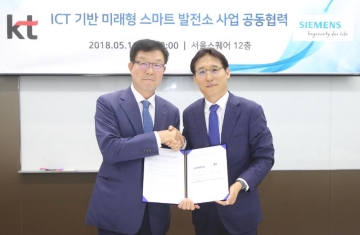
KT and Siemens Partner to Build ICT-Based Smart Power Plants
KT announced that it has signed a Memorandum of Understanding (MOU) with Siemens at Seoul Square in Jung-gu, Seoul for 'ICT-based smart power plant business cooperation.' According to this MOU, both companies have agreed to cooperate in jointly responding to the smart power plant trend as the Fourth Industrial Revolution approaches. Specific areas of cooperation include ▲joint promotion of domestic smart power plant business development and pilot projects ▲construction of wireless networks (LTE/IoT) and smart sensing/monitoring of power generation facilities ▲discovery and expansion of smart services specialized for power plants based on AI, AR, drones, and mobile platforms.
2018.05.16by 김지혜 기자
.jpg)
KT Launches NB-IoT-Based Real-Time Child Location Transmission Service
KT announced the launch of "Our Child Location Notification" service, which utilizes its nationwide narrowband IoT (NB-IoT) coverage to transmit children's locations in real-time to parents with greater accuracy. "Our Child Location Notification" is a package service that combines the functionality of "Connect Tag," jointly developed and launched by KT and Samsung Electronics in October 2017, with character designs of "Pinkfong" and "Baby Shark" from "SmartStudy," which are popular among children.
2018.05.18by 김지혜 기자

KT to take charge of disaster network maintenance
KT announced that it has signed a contract with the Ministry of the Interior and Safety regarding the 'Disaster Safety Communication Network (hereinafter referred to as disaster network) control and maintenance operations.' Following its award of the disaster network pilot project in 2015, KT is now also winning the maintenance operations contract, and expects to further strengthen its expertise in the disaster safety communications field. Above all, KT places significance on the fact that, as the pilot project operator, it has secured continuity in disaster safety operations by taking on both the direct construction of the network and its subsequent maintenance. Under this contract, KT will perform maintenance operations through the end of this year on disaster network-related equipment constructed during the disaster network pilot project period in the Seoul and Gangwon (Pyeongchang, Jeongseon, Gangneung) regions, including 221 main control units and base stations, approximately 2,500 portable terminals, and other related equipment.
2018.05.21by 김지혜 기자
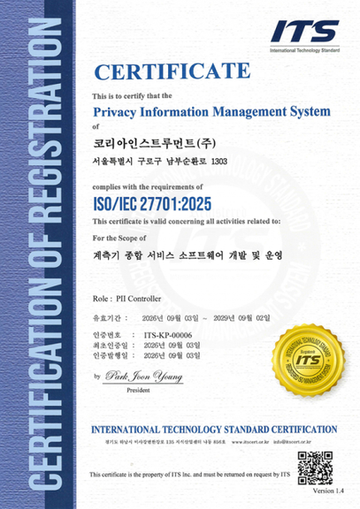
Korea Instrument, KOLAS Accredited Calibration Agency First to Simultaneously Acquire ISO/IEC 27,001·27,701
Korea Instrument has become the first among KOLAS accredited calibration agencies to simultaneously acquire ISO/IEC 27,001 and ISO/IEC 27,701 certifications. Through its proprietary platforms CWIZ Enterprise and CWIZ Partners, the company has embedded information security and personal data protection requirements across all business processes including customer information, equipment data, and calibration reports, with plans to continuously advance its management system through regular audits and security inspections.
2026.10.12by 배종인 기자
TeamViewer One, IT Incident Automation Workflow and Resolution Center Enhanced
TeamViewer has added IT incident automation capabilities and an advanced Resolution Center to its integrated digital workplace management platform 'TeamViewer ONE'. Recurrent service disruptions, configuration errors, and capacity shortages are automatically handled according to preset policies, and device status verification through script deployment can be managed in a unified interface, significantly reducing repetitive tasks for IT teams.
2026.10.12by 배종인 기자











