



Maxim Launches Industry's First Radiation-Tolerant Security Authentication Device
 Published2018.07.16 10:04
Maxim Integrated Korea has launched the DS28E83 DeepCover Secure Authenticator, the industry's first secure authentication solution designed for use in gamma-irradiation sterilization environments. Medical device designers can leverage the DS28E83 DeepCover Secure Authenticator to protect surgical instruments from memory corruption caused by high-energy gamma rays used for sterilization, while also providing secure instrument management and anti-counterfeiting capabilities.
Medical device manufacturers typically sterilize surgical instruments using gamma rays or electron beams. The high doses of radiation generated during this process can interfere with or damage the automatic identification, data correction, and non-volatile memory (NVM) used in electronic medical devices. This poses a threat to medical device data, which is crucial for medical device manufacturers, and to patient safety.
The DS28E83 security authentication device features a radiation-resistant NVM to prevent data loss during the sterilization process. This robust NVM can withstand up to 75 kGy (kiloGray) of radiation, which is used in gamma and electron beam medical sterilization. This allows designers to prevent unauthorized reuse of electronic surgical instruments and counterfeiting in the parts market. Additionally, the DS28E83 can sterilize electronic surgical tools with gamma rays or electron beams, significantly improving patient safety.
To protect patients from risks associated with counterfeit or unintended reuse of unauthorized devices, the DS28E83 secure authenticator provides authentication capabilities using industry-standard and ECDSA key encryption.
▲ECDSA (Elliptic Curve Digital Signature Algorithm) asymmetric security authentication
▲SHA-256 HMAC (Hash-based Message Authentication Code) symmetric key security authentication
▲NIST (National Institute of Standards and Technology) Special Publication (SP) 800-90B standard random number generator for ECDSA signature and HMAC operations
▲One general-purpose input/output (GPIO) pin with optional authentication control function
▲10kb of secure memory for keys, certificates, and user data
▲Prevents device counterfeiting, overuse, and security breaches by providing a unique read-only serial number for tool identification and encryption operations.
The DS28E83 security authentication device has a 1-wire interface that connects data, signaling, and power all at once, reducing the number of components required for surgical tool design.
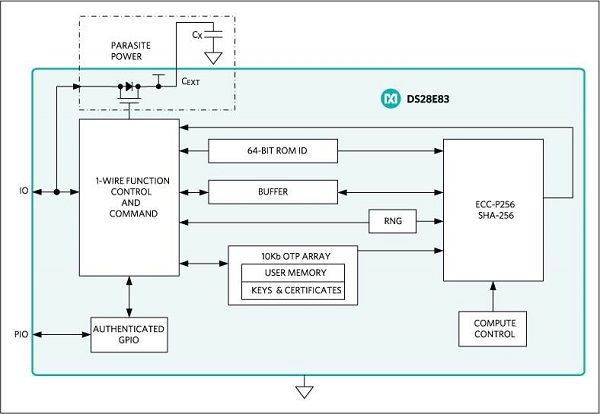
▲Maxim DS28E83 DeepCover Secure Authentication Device Block Diagram
“In the past, manufacturers would have to use gamma-ray technology,” said Nathan Sharp, business manager for the Micro, Security, and Software Business Unit at Maxim Integrated.“We could not incorporate secure and non-volatile memory into a product that undergoes an electron beam sterilization process,” he said. “The DS28E83 provides two important functions: protecting patients from infection and sterilizing surgical instruments to the highest standards.
“The certification feature helps medical professionals verify the quality of the equipment they use and ensure the highest level of precision for their devices,” he said.
For more information about the Maxim DS28E83 DeepCover Secure Authenticator, including high-resolution images, block diagrams, high-resolution images, and the DS28E83EVKIT evaluation kit, please visit the Maxim website.

Comments
Related news
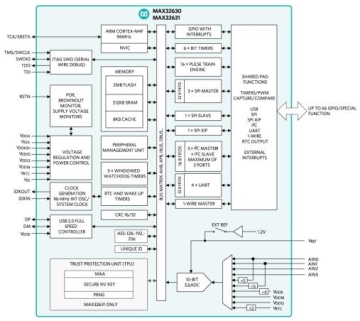
Maxim Simplifies Medical Wearable Design with Ultra-Low Power, High Performance MCUs
Maxim Integrated Korea (CEO Choi Heon-jeong) has announced the ARM Cortex-M4F microcontrollers (MCU) 'MAX32630' and 'MAX32631', which simplify the design of high-performance medical and fitness wearable devices. As the wellness and medical wearable application market grows rapidly, the requirements for electronic components inside wearable devices have become increasingly complex and diverse. Internal electronic components must provide high-level functionality, processing power, and optimal integration with peripherals in a small form factor. In addition to high precision and low noise, power consumption must be extremely low across various operating modes to ensure long battery life with a single charge. The Maxim MAX32630 and MAX32631 MCUs address these challenges.
2016.11.16by 김수지 기자
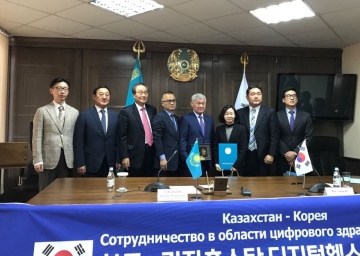
KT Launches Healthcare Platform-Based Medical ICT Business in Kazakhstan
KT announced on the 26th that it held an opening ceremony for the Korea-Kazakhstan digital healthcare cooperation project at Aktobe Medical Center in Kazakhstan, together with Pusan National University Hospital and the Busan Technopark Foundation. KT has completed the installation of digital healthcare solution devices and user training at 10 hospitals located in Almaty, Aktobe, and the East Kazakhstan regions of Kazakhstan, and has been conducting patient diagnoses based on digital healthcare solutions at these hospitals since September.
2017.09.26by 김자영 기자
Maxim Launches Ultra-Low-Power MCUs That Enhance Battery Life and Performance
Maxim Integrated Korea has launched ultra-low-power microcontrollers (MCUs) 'MAX32660' and 'MAX32652' that enhance battery life and functionality. Maxim's DARWIN MCU product family is an integrated solution combining ultra-low-power technology applied to wearables, industry-leading embedded memory, and the most advanced embedded security technology. System designers can develop excellent applications under limited power conditions using Maxim MCUs based on 'ARM Cortex-M4' processors with FPU (Floating Point Unit) when designing IoT and environmental sensors, smartwatches, medical and disease prevention wearable devices, and other compact devices. Memory, size, power consumption, and processing capability are critical factors in designing complex algorithms for smart IoT applications. However, conventional solutions tend to show a trade-off: when power consumption is kept low, processing and memory capabilities are compromised, and when equipped with powerful processors and sufficient memory, power consumption increases.
2018.04.04by 김지혜 기자

Intel Unveils Next-Generation 'Core Ultra Series 3' and vPro Platform for Enterprise PCs
Intel has officially unveiled the "Intel Core Ultra Series 3" for next-generation enterprise PCs and the latest vPro platform, addressing a wide range of demands from enterprise notebooks to high-performance workstations.
2026.03.26by 배종인 기자

ROHM Launches ESD Protection Diode Compatible with High-Speed Interfaces of 10Gbps or Higher
Semiconductor specialist ROHM has developed the 'RESDxVx series' of ESD (electrostatic discharge) protection diodes capable of responding to next-generation high-speed data communication environments exceeding 10Gbps, simultaneously enhancing both signal quality maintenance required in high-speed interfaces and IC protection performance.
2026.03.26by 배종인 기자











