


KT to Make Driving Safety in Jeju Island Through Telecommunications
 Published2018.07.18 19:05
It will contribute to collecting traffic information across Jeju and preventing traffic accidents.
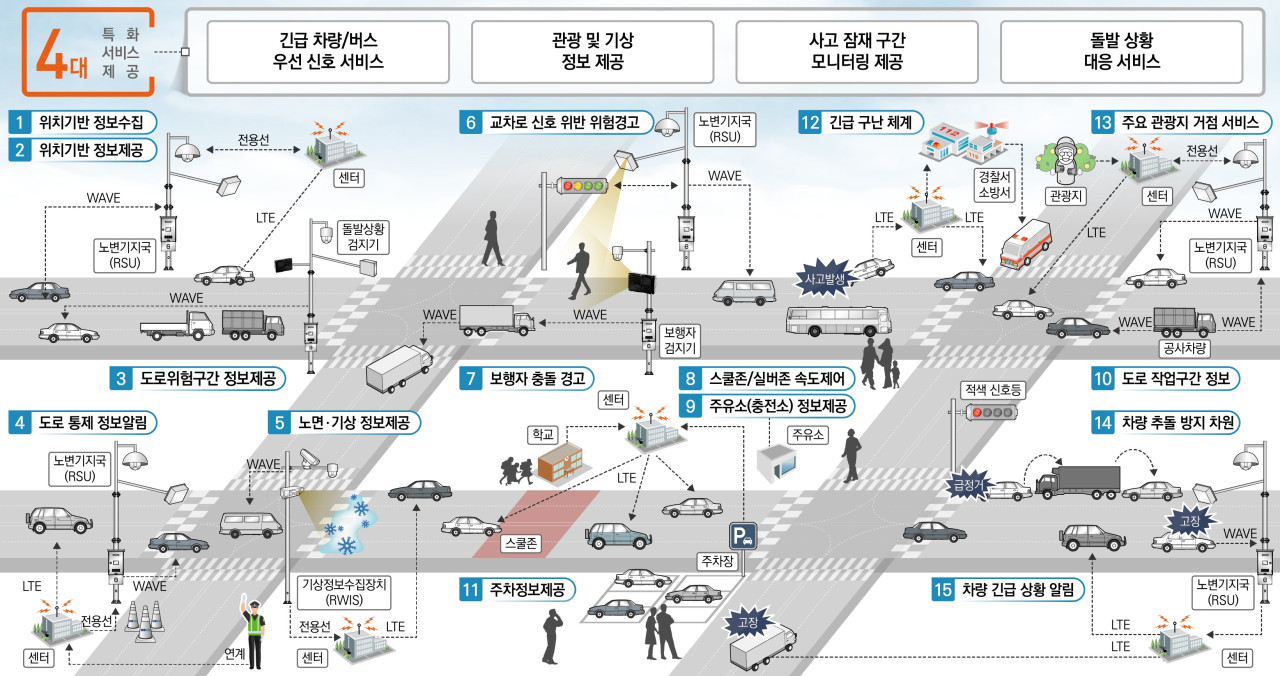
Jeju's transportation system effectively and safely controlled through KT's four specialized services
Smart cities and autonomous driving services must be designed together based on 5G. While the technology applied to individual entities is important, the infrastructure capable of communicating with them at all times is equally crucial. KT has broken ground on the infrastructure.
KT announced on the 18th that it has completed the kick-off report for the Jeju Special Self-Governing Province Cooperative-Intelligent Transport Systems (C-ITS) and will begin the construction of the nation's first local government C-ITS.
C-ITS is a futuristic, advanced system that exchanges real-time information on dynamic traffic conditions surrounding individual vehicles with sensors installed on the road; it is an infrastructure that serves as the foundation for traffic accident prevention, the modernization of road traffic management, and cooperative autonomous driving.
The Jeju C-ITS construction project, worth approximately 22 billion won, is the first C-ITS demonstration project in Korea. While a C-ITS pilot project between Daejeon and Sejong has been conducted in the past, this is the first full-scale demonstration project by a local government. The KT Consortium was finally selected last June, and the consortium included KT as the main contractor, as well as VitzroSys, Kwangmyung D&C, and SD System.
The Jeju C-ITS construction project officially began today with a kick-off meeting. KT plans to proceed with this project over a three-year period until 2020, developing and implementing 15 basic services and 4 Jeju-specific services.
KT is establishing a V2X (Vehicle to Everything) communication infrastructure that combines LTE and WAVE (Wireless Access in Vehicular Environments) as the foundation for C-ITS. Covering the entirety of Jeju Island, LTE-WAVE V2X facilitates communication between vehicles and objects and supports real-time information collection.
In addition, by developing and integrating LTE-based precision positioning technology, we will construct high-precision maps with an error margin of within 30 cm. For autonomous vehicles, precise location tracking and control are crucial for autonomous driving, such as for self-driving lane changes. Therefore, this precision positioning technology and the construction of high-precision maps will play a key role in accelerating the commercialization of cooperative autonomous driving.
Due to the high proportion of tourists and the consequently high accident rate involving rental cars in Jeju, C-ITS terminals will be prioritized for distribution to rental cars. These terminals include Connected ADAS (Advanced Driver Assistance Systems) functions, enabling them to collect road conditions and traffic information across Jeju and immediately transmit risk warnings to drivers. Therefore, it is expected that once the system is completed, traffic accidents involving rental cars in Jeju Island will be reduced.
Kim Hyung-wook, Head of KT’s Platform Business Planning Office, stated, “The Jeju C-ITS demonstration project is a key initiative for Jeju Island to transform into a smart transportation city,” adding, “Through this project, KT aims to foster an autonomous cooperative driving industry ecosystem capable of mutual growth with SMEs and to take a leap forward as a telecommunications-based transportation service provider.”
Comments
Related news
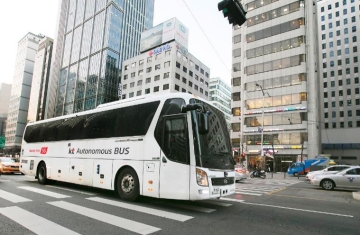
Self-driving buses and trucks will be available on public roads starting next year.
Demonstration research on autonomous buses and cargo vehicles will commence, aimed at developing and deploying these vehicles in transportation services such as public transit and logistics. The Ministry of Land, Infrastructure and Transport will hold a project kickoff meeting on the 25th (Friday) at El Tower for two R&D projects: "Demonstration Research on Autonomous Driving-based Public Transportation System" and "Development of Vehicle/Object Communication (V2X)-based Cargo Vehicle Platooning Operation Technology." There is an urgent need to introduce autonomous driving technology into public transportation (buses) and logistics (cargo vehicles) that people encounter in their daily lives. However, to date, South Korea's autonomous vehicle technology development has primarily focused on personal passenger vehicles, with buses and cargo vehicles only now entering the initial stages of development.
2018.05.24by 김지혜 기자
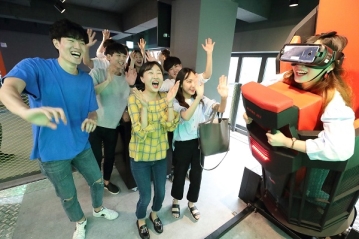
KT and GS Retail Open Second Urban VR Theme Park 'VRIGHT'
Breaking through 18,000 visitors within four months of opening, will contribute to VR ecosystem activation through future direct store expansion and franchise business growth
2018.06.28by 명세환 기자
KT, “Socioeconomic Value of 5G to Reach 47.8 Trillion Won by 2030”
5G will drive innovation and evolution across society and the economy by combining with core technologies of the Fourth Industrial Revolution, such as AI and big data, much like other foundational core technologies (GPT) positioned at the top, including electricity, computing, and the steam engine.
2018.07.10by 명세환 기자
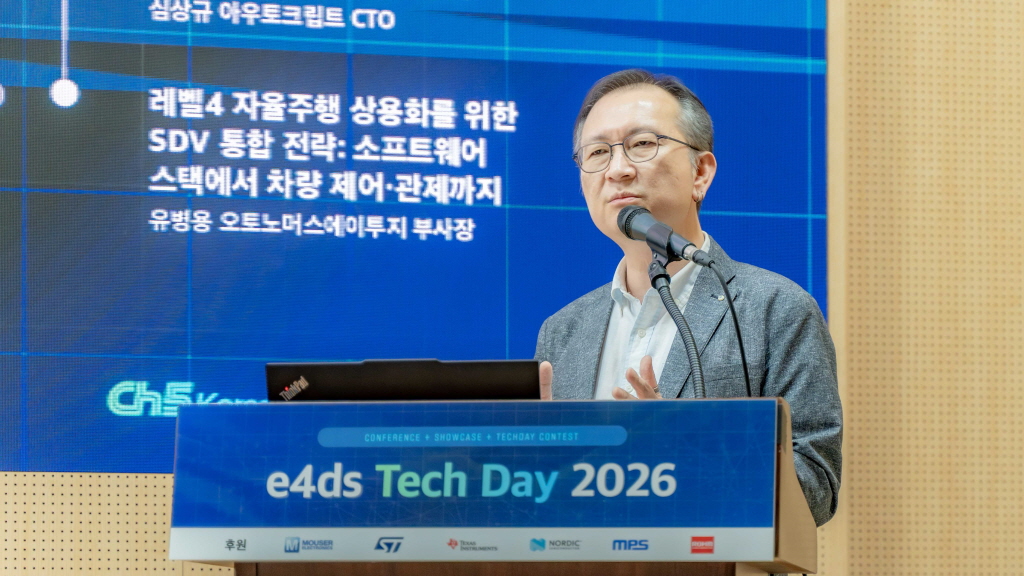
[e4ds Tech Day 2026 ⑨] Sim Sang-gyu, Autocrypt CTO: "In the Physical AI Era, Automotive Security Must Extend Beyond the Vehicle"
At e4ds Tech Day 2026, Sim Sang-gyu, CTO of Autocrypt, explained automotive cybersecurity strategies in the era of Physical AI and SDV (Software-Defined Vehicle). Automobiles are evolving as part of an ecosystem connected to AI, cloud, chargers, IoT, and robots, and he emphasized that the scope of security must expand beyond the vehicle interior to the entire connected environment. In particular, AI model tampering, adversarial attacks, OTA updates, and EV charger hacking were identified as major threats. He explained that response measures require zero trust, AI model integrity protection, intrusion detection, Security by Design and Default, and full lifecycle security management, and that proactive security system establishment beyond regulatory compliance is critical for securing future mobility competitiveness.
2026.10.12by 배종인 기자

Practical HIL Construction Strategy for Automotive and Off-Highway Controller Validation
As vehicle E/E architecture transitions to zonal structures and shifts to software-defined vehicles (SDV), the number of controllers (ECUs) requiring validation and software complexity are surging dramatically. Meanwhile, real vehicle testing cannot provide repeated verification under identical conditions and entails lead time and safety concerns. This white paper explains the principles of HIL (Hardware-in-the-Loop) validation and the structure of the NI platform composed of PXI, SLSC, and VeriStand, and through two actual implementation cases—Camera Record & Replay HIL for In-Cabin Monitoring Controller (ICMU) and Forklift Controller (VCU) HILS—describes how controller-level regression testing becomes possible. Additionally, it explicitly states application boundaries and limitations, such as lack of A2B support.
2026.10.12by 편집부











