


Bluetooth Mesh Networking Enables Smart Industries
 Published2018.07.26 10:35
Lighting control systems are leading the way in implementing Bluetooth mesh.
Contributing to smart buildings, smart cities, etc.

Bluetooth, introduced in 1999, has been applied to a wide range of fields, from wireless audio to connected devices, for nearly 20 years. Bluetooth mesh networking, announced a year ago, is also growing, with applications spanning a wide range of new markets, such as smart buildings, smart industries, smart cities, and smart homes.
Bluetooth mesh networking supports many-to-many device communication and is optimized for creating large-scale device networks. Additionally, mesh networking technology, developed to meet the scalability, stability, and security requirements of commercial and industrial environments, is being used to implement smart buildings and smart industries where tens to thousands of devices must communicate reliably with each other.
The Bluetooth SIG said that since the launch of Bluetooth mesh in July of last year, more than 65 products supporting mesh networking have been certified by silicon, stack, component and device vendors.
“Bluetooth Mesh is a wireless protocol that can meet our customers’ scale, performance, and reliability requirements in the home,” said Miffy Chen, general manager of Alibaba AI Labs. “We are confident that Bluetooth will become the standard for home and building automation in the coming years.”
“Bluetooth mesh is a fundamental enabler of the future IoT market,” said Stuart Carlaw, chief research officer at ABI Research. “Bluetooth mesh, along with Bluetooth beacons, will enable real-time location system (RTLS) services, and we expect annual shipments of 360 million Bluetooth smart building devices to reach 2022.”
Lighting control systems, in particular, are driving the expansion of Bluetooth mesh implementations. A building's lighting system creates a natural grid where all devices in a Bluetooth mesh network can communicate with each other, enabling building-wide control, monitoring, and automation systems within the facility. This wireless lighting solution can also serve as a platform to enable services such as point-of-interest solutions, indoor positioning, asset tracking, and improved space utilization.
“Bluetooth mesh has transformed the landscape of connected lighting by providing solutions that enable lighting to serve a greater purpose in industrial and commercial spaces,” said Mark Needham, Vice President of European Sales at Fulham. “These are just the beginning, with lighting system analytics helping visitors find their way around a building, building operators pinpointing the location of assets, and collecting a wealth of data from sensors throughout a building.”
According to the Bluetooth Market Trends Update 2018 conducted by ABI Research, annual commercial smart lighting device shipments are expected to increase approximately fivefold by 2022.
Comments
Related news
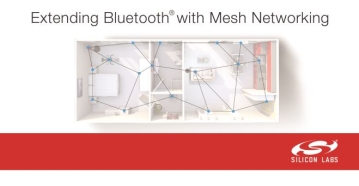
Silicon Labs Accelerates IoT Product Launch with Bluetooth Mesh Solution
Silicon Labs announced that it is providing a comprehensive software and hardware suite based on the new Bluetooth Mesh specification that enables developers to simplify the design of mesh network devices for the Internet of Things and accelerate time-to-market. The new Bluetooth Mesh solution is based on Silicon Labs' proven mesh networking expertise and includes development tools, software stack, and mobile applications that support Silicon Labs' wireless SoC devices and certified modules. Through the combination of Silicon Labs' patented network analysis tools and Bluetooth Mesh stack for smartphones, IoT developers can now accelerate product launch timelines by up to six months compared to when using conventional wireless development tools and technologies.
2017.07.19by 김자영 기자
.jpg)
Nordic Semiconductor Launches Zigbee Wireless Connectivity Solution for Multiprotocol SoCs
Nordic Semiconductor has launched its first Zigbee wireless connectivity solution for the nRF52840 multiprotocol SoC. The first engineering version has been released, with plans to achieve industrial-grade Zigbee 3.0 certification in the second half of 2018. By introducing the Zigbee solution, Nordic has expanded its portfolio of mesh networking products (including Bluetooth Mesh and Thread) for the smart home, enterprise, and industrial sectors. Like Nordic's other mesh solutions, the nRF52840 SoC, which is supported by the S140 v6.0 SoftDevice (stack), can support simultaneous operation of Zigbee and Bluetooth 5 (Bluetooth® 5) and Bluetooth LE (Bluetooth Low Energy).
2018.05.03by 김지혜 기자
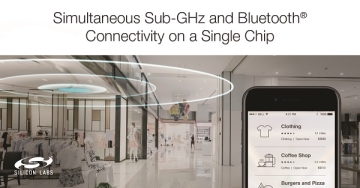
Silicon Labs Announces Software for Simultaneous Sub-GHZ and Bluetooth Communication
Silicon Labs announces new software technology that enables simultaneous sub-GHz and 2.4GHz Bluetooth® Low Energy (BLE) connectivity implementation on a single chip as an option for the Wireless Gecko product family.
2018.06.14by 명세환 기자
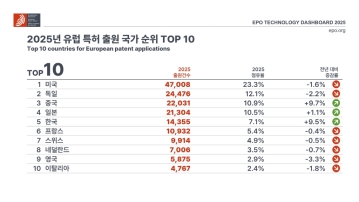
European Patent Applications Surpass 200,000 for the First Time… South Korea Maintains 5th Place, Led by Batteries and Telecommunications
According to the European Patent Office (EPO)'s 'Technology Dashboard 2025', European patent applications last year reached 201,974, surpassing 200,000 for the first time. Korean companies and inventors filed 14,355 applications, representing a 9.5% increase from the previous year and maintaining 5th place by country. Battery, digital communication, and semiconductor technologies led the growth, with Samsung ranking as the top EPO applicant for the second consecutive year and LG reaching 3rd place. The presence of major domestic cities such as Seoul, Suwon, and Yongin was also confirmed. It was also revealed that Korea's European patent strategy is expanding beyond individual technologies to span the entire industry.
2026.03.24by 명세환 기자

SK Telecom First Applies AI-Based Network Operations at Gwanghwamun K-Pop Concert
SK Telecom announced that it applied an AI-based network operation system for the first time at a large-scale K-pop concert held in the Gwanghwamun area of Seoul on March 21st, managing communication quality throughout the event. Mobile data usage during the three hours before and after the concert reached 12.15TB, approximately doubling compared to the same time slot the previous weekend. SK Telecom monitored traffic using the AI system 'A-One' in five-minute and 50-meter units to respond to potential overload situations, while also operating temporary communication facilities and on-site personnel in parallel. This case is interpreted as confirmation of the practical applicability of AI-based autonomous network operation in an environment where demand from dense events and foreign users increases simultaneously.
2026.03.23by 명세환 기자











