


The IaaS cloud market grew 29.5% in 2017 compared to 2016.
 Published2018.08.02 08:47
Amazon dominates, while Microsoft doubles its growth year-over-year.
The Infrastructure as a Service (IaaS) market, which allows users to use ICT resources like servers, storage, and software as a service (as a service) over the Internet when needed, rather than purchasing them, is growing by the day. IaaS leverages virtualization technology in cloud computing to charge users for computing services like CPUs and memory, storage services for storing and managing data, and network services for communication between distributed application software.
Gartner reported that the global IaaS market size, which was $18.2 billion in 2016, reached $23.5 billion in 2017, recording an annual growth rate of 29.5%.
According to Gartner, Amazon was the leader in the IaaS market in 2017, followed by Microsoft, Alibaba, Google, and IBM.
“The top four providers offer strong IaaS solutions and have seen robust growth as well-known enterprises actively adopt their IaaS offerings and cloud availability expands into new regions and countries,” said Sid Nag, research director at Gartner. “Cloud-driven IT spending now accounts for more than 20% of the total IT budgets of cloud users, many of whom are using the cloud to support their production environments and business-critical operations.”
The competitive landscape of the IaaS market is consolidating around the top companies. The top four companies—Amazon, Microsoft, Alibaba, and Google—all offer hyperscale IaaS, accounting for approximately 73% of the overall IaaS market and 47% of the combined IaaS and Infrastructure Utility Services (IUS) market.
| Company name | 2017 Sales (million dollars) | 2017 Market share (%) | 2016 Sales (million dollars) | 2016 Market share (%) | 204, 204, 204); width: 100px;"> 2016-2017|
| Amazon | 12,221 | 51.8 | 9,775 | 53.7 | 25.0 |
| Microsoft | 3,130 | 13.3 | 1,579 | 8.7 | 98.2 |
| Alibaba | 1,091 | 4.6 | 670 | 3.7 | 62.7 |
| 3.3 | 500 | 2.7 | 56.0 | ||
| IBM | 457 | 1.9 | 297 | 1.6 | 53.9 |
| etc | 5,902 | 25.0 | 5,392 | 29.6 | 9.5 |
| aggregate | 23,580 | 100.0 | 04, 204);">18,213100.0 | 29.5 |
Amazon became the global leader in the IaaS market in 2017, achieving $12.2 billion in revenue, a 25% increase year-over-year. As the largest IaaS provider, Amazon offers the most mature enterprise IaaS offering, boasting numerous customer success stories and a robust partner ecosystem. The growth in 2017 was driven not only by customers migrating their existing data centers to cloud IaaS but also by customers pursuing innovative digital business projects, reflecting a broad range of use cases.
Microsoft ranked second in the IaaS market, achieving over 98% growth in its IaaS solutions and generating over $3.1 billion in annual revenue. Microsoft provides IaaS capabilities through its Microsoft Azure solution, which combines infrastructure and platform services.
Alibaba, ranked third, achieved a 63% growth rate in 2017, driven by its successful investment in R&D. The fact that Alibaba has the financial capacity to sustain this trend and invest in global expansion suggests that it could potentially replace global hyperscale cloud providers in some regions.
“The purpose and way in which companies consume technology is fundamentally changing,” he said. “The combined IaaS and IUS market is being impacted as some legacy infrastructure offerings, such as IUS, lose their share,” he said. “Furthermore, the surge in demand for cloud professionals is forcing technology companies to change the way they compete.”
Comments
Related news
Oracle Strengthens Competitiveness by Introducing Cloud Infrastructure to Korean Enterprises
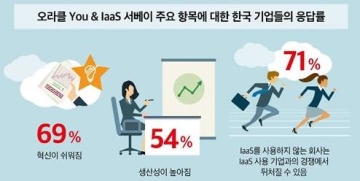
Oracle announced that satisfaction levels among Korean enterprises with IaaS cloud have risen significantly. According to 'You & IaaS: The News Generation (hereinafter You & IaaS),' a quarterly survey conducted by Oracle on cloud infrastructure (IaaS) adoption status and awareness regarding future adoption, 69% of enterprises responded that IaaS has made corporate innovation easier, and 54% of enterprises answered that IaaS is superior in terms of speed and availability. These figures represent increases of 13% and 19%, respectively, compared to the previous quarter.
2017.10.13by 김지혜 기자

Samsung SDS to Target Business Cloud Market through Strategic Alliance
Samsung SDS has entered into a strategic partnership with US-based Virtustream and Dell EMC to target the enterprise critical business cloud market where system stability, performance, and security are paramount. Virtustream is one of the leading hosted private cloud service providers and possesses xStream, a core solution that maximizes cloud operational efficiency. Samsung SDS will be able to further strengthen the competitiveness of its IaaS (Infrastructure as a Service) business, which provides IT resources such as cloud-based servers, storage, and networks, by leveraging xStream.
2018.01.24by 김지혜 기자
Gartner Forecasts 21.4% Growth in Global Public Cloud Revenue in 2018
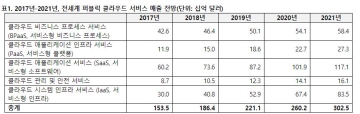
Gartner forecasted that the global public cloud services market would reach $186.4 billion in 2018, representing 21.4% growth from the previous year's $153.5 billion. The fastest-growing segment in the public cloud services market is Cloud System Infrastructure Service (Infrastructure as a Service, hereinafter IaaS), which is expected to record $40.8 billion with 35.9% growth in 2018. Gartner projected that the market share of the top 10 cloud service providers reached 50% in 2016 but would account for 70% of the IaaS market by 2021. Sid Nag, Gartner principal research director, stated, "Driven by the expanding trend of multi-cloud adoption, enterprises are expected to seek easy ways to freely move across multiple cloud vendors' IaaS solutions and transfer workloads, applications, and data."
2018.04.13by 김학준 기자
.jpg)
SalePoint Signs Multi-Year Partnership Agreement with AWS… Promoting Identity Security that Integrates Even AI Agents
Sailpoint has entered into a multi-year strategic partnership agreement with AWS and is moving forward with establishing an integrated governance system that manages both human and non-human identities together. The plan is to consistently manage access permissions in an environment where AI agents are increasing as work execution entities, while applying the principle of least privilege and automated policy enforcement. The two companies plan to jointly expand capabilities to manage the identities of various entities, including AI agents, within a single layer in the AWS environment. This collaboration is interpreted as a move to design security and governance together in corporate environments where AI adoption is expanding.
2026.03.26by 배종인 기자
.png)
Databricks Unveils Open AI Security Monitoring 'Lakewatch'
Databricks entered the security market on March 24 by unveiling LakeWatch, an open-source agentic SIEM. The core functionality of this product is to integrate and analyze security, IT, and business data in a single environment to support AI-based threat detection and investigation. The company explained that it reduces the limitations of existing security operations centers, which have had to forgo some data due to high cost structures, and enables large-scale data analysis and automation based on open formats and ecosystems. LakeWatch is currently offered as a private preview, with Adobe and Dropbox mentioned as early customers. Databricks also announced an expanded partnership with Anthropic as well as the acquisition of Antimatter and SiftD.ai.
2026.03.26by 배종인 기자











