


Self-driving cars that come and go automatically according to smartphone instructions
 Published2018.08.03 10:05
Precision maps are updated with deep learning.
The Electronics and Telecommunications Research Institute (ETRI) and domestic electric vehicle manufacturer IT Engineering have developed Level 3 and 4 autonomous vehicle technology that allows users to call for a ride via mobile phone, and successfully demonstrated it on July 19.
According to the Society of Automotive Engineers (SAE)'s autonomous vehicle technology levels, Level 3 means the car can perform basic driving tasks, but a driver must take over in hazardous situations. Level 4 means the car can drive itself even in hazardous situations.
IT Engineering's autonomous vehicle, which uses ETRI's technology, automatically comes to the passenger's location when the passenger inputs the departure and destination points into the smartphone and calls out the destination using the voice recognition function, and autonomously drives the passenger to the destination.
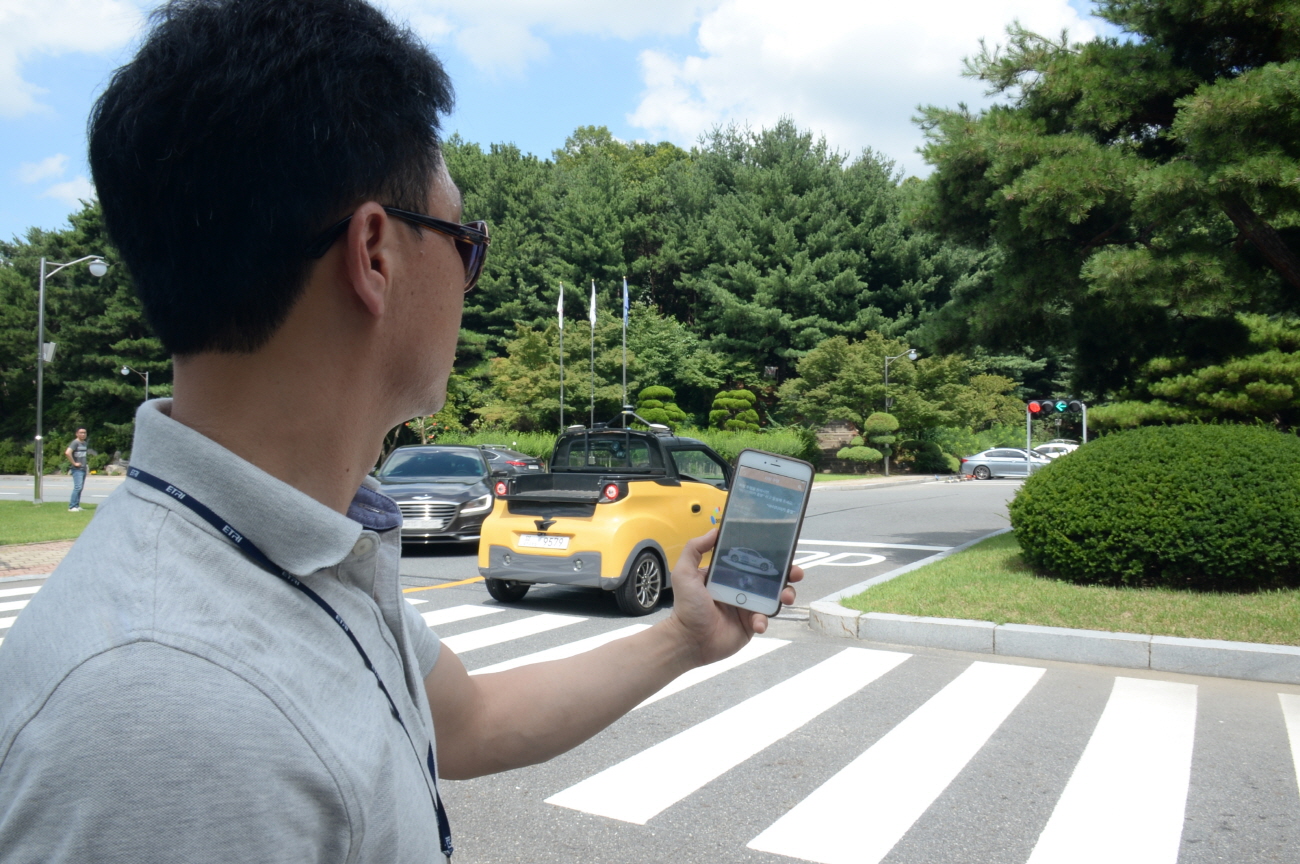
In this demonstration, IT Engineering's autonomous vehicle was parked in front of Research Building 3. When an ETRI researcher called it via smartphone, it autonomously drove to Research Building 1, where the researcher was located. The vehicle carrying the researcher autonomously traveled to its destination, Research Building 3, reacting immediately to various unexpected situations. The autonomous vehicle stopped after seeing the signal, pedestrians, and vehicles cutting in, and stopped exactly in front of Research Building 3.
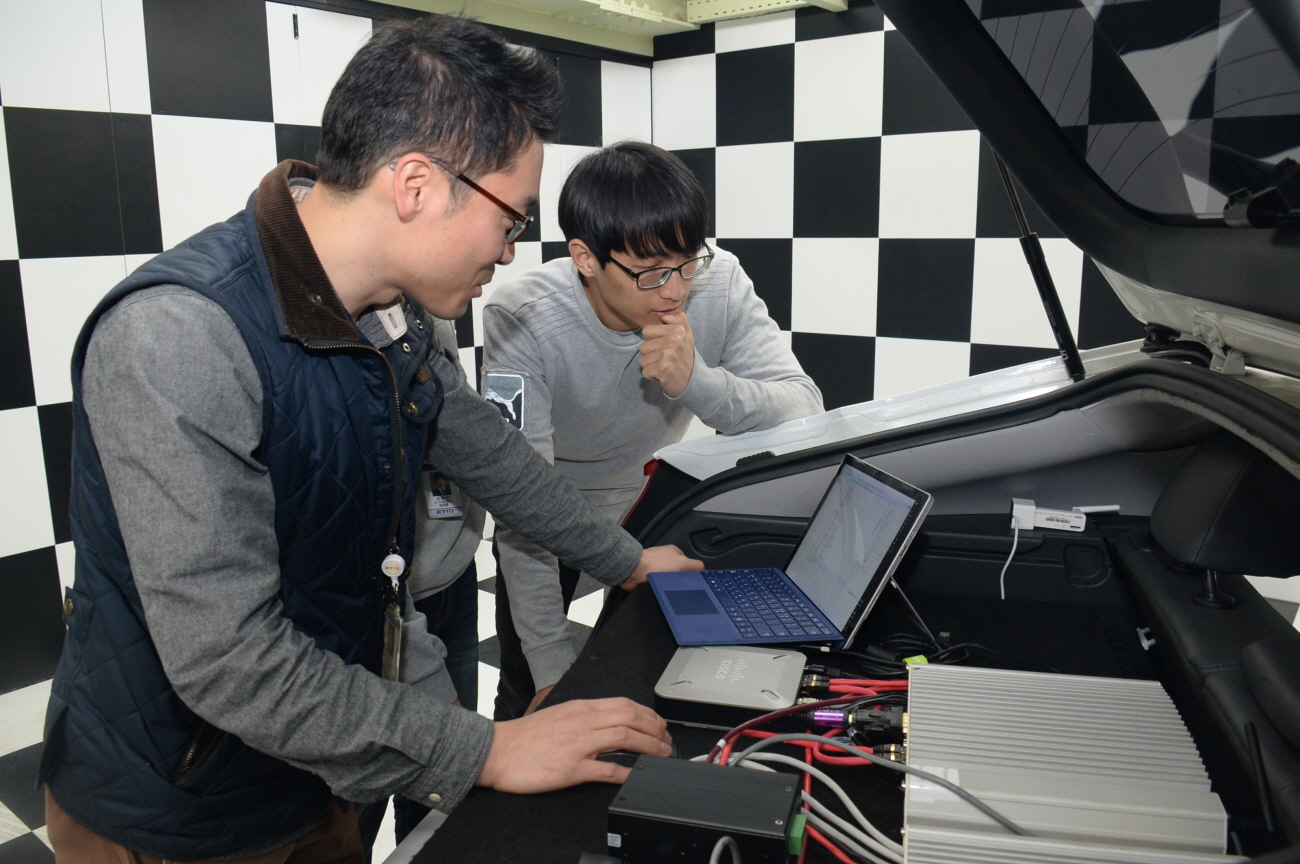
For this demonstration, ETRI equipped the vehicle with two low-cost camera sensors, one lidar sensor, and used one small PC and one standard PC to operate the recognition, judgment, and control software. ETRI explained that the researchers' technology will enable them to directly install components and other components into regular vehicles in the future.
The core technology of this demonstration is one that automatically creates and updates a high-precision map that helps autonomous vehicles perceive their surroundings. This technology allows autonomous vehicles to perceive the surrounding road conditions based on sensor data and a high-precision map, and then precisely updates the high-precision map based on this perception. The margin of error is also small, within 10 cm.
Existing autonomous vehicles require power supplies exceeding hundreds of watts to simultaneously process a vast amount of sensor data and operate autonomous driving AI algorithms. Consequently, development has focused solely on mid- to large-sized sedans and SUVs. However, ETRI has successfully integrated AI algorithms and optimized software to run autonomous driving algorithms using less than 100 watts (W), the equivalent of two laptops.
ETRI is currently conducting research to improve the performance, stabilize, and optimize algorithms to advance autonomous driving technology using deep learning technology. The company announced plans to share data collected so far, including road characteristics and real-time traffic information acquired from cameras, lidar sensors, etc., with universities and companies conducting research on autonomous driving.
The head of ETRI's Advanced Autonomous Driving System Research Group said, "The success of this demonstration has lowered the high barrier to entry for autonomous driving technology development. We expect autonomous driving technology to establish itself as a new convergence industry that generates value while in motion, rather than simply a means of transportation."
IT Engineering CEO Kim Young-han explained, "With the help of our research team, we are witnessing a ray of hope for the mass production of electric vehicles. We will continue to strive to secure future mobility service technologies and enhance market competitiveness."
This technology was developed as a result of the Ministry of Science and ICT's "Development of Collaborative Driving Situation Recognition and Open Platform Technology for Cloud-Based Autonomous Mobility Services." This development led to 26 domestic and international patent applications, 26 academic papers, and 7 technology transfers.
ETRI announced plans to focus on developing autonomous vehicles that can be used by the elderly and physically challenged who cannot drive. To achieve this, the company plans to focus on developing autonomous vehicles that can support an aging society and facilitate transportation in areas with limited public transportation.
Comments 1
1 Comments:
Related news
ANSYS Acquires Optis to Provide Simulation Solutions for Autonomous Vehicle Sensor Development
ANSYS has announced the completion of the final acquisition of OPTIS, a supplier of physics-based visual simulation software for light and human vision. Through this acquisition of OPTIS, ANSYS has added optical sensors and closed-loop simulation platforms to its Multiphysics portfolio, thereby providing comprehensive autonomous vehicle sensor development simulation solutions to verify the safety and reliability of autonomous vehicles. Additionally, ANSYS has built an expanded portfolio through simulation of all sensors including lidar, cameras, and radar in its solutions, multiphysics simulation of physical and electronic components, system safety analysis, and development of safety-certified embedded software.
2018.05.08by 김지혜 기자
Self-driving buses and trucks will be available on public roads starting next year.
Demonstration research on autonomous buses and cargo vehicles will commence, aimed at developing and deploying these vehicles in transportation services such as public transit and logistics. The Ministry of Land, Infrastructure and Transport will hold a project kickoff meeting on the 25th (Friday) at El Tower for two R&D projects: "Demonstration Research on Autonomous Driving-based Public Transportation System" and "Development of Vehicle/Object Communication (V2X)-based Cargo Vehicle Platooning Operation Technology." There is an urgent need to introduce autonomous driving technology into public transportation (buses) and logistics (cargo vehicles) that people encounter in their daily lives. However, to date, South Korea's autonomous vehicle technology development has primarily focused on personal passenger vehicles, with buses and cargo vehicles only now entering the initial stages of development.
2018.05.24by 김지혜 기자
KT Participates in 'Autonomous Vehicle National Experience Event'
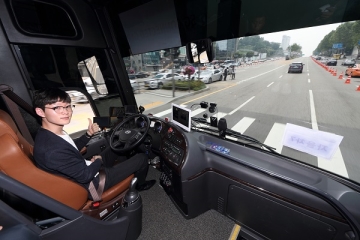
KT Demonstrates Cooperative Autonomous Driving Where Vehicles Recognize Risk Factors Using V2X Technology, Successfully Avoiding Obstacles on Yeongdong-daero and Receiving Traffic Signal Information in Real-Time
2018.06.17by 명세환 기자
[e4ds Tech Day 2026 ⑨] Sim Sang-gyu, Autocrypt CTO: "In the Physical AI Era, Automotive Security Must Extend Beyond the Vehicle"
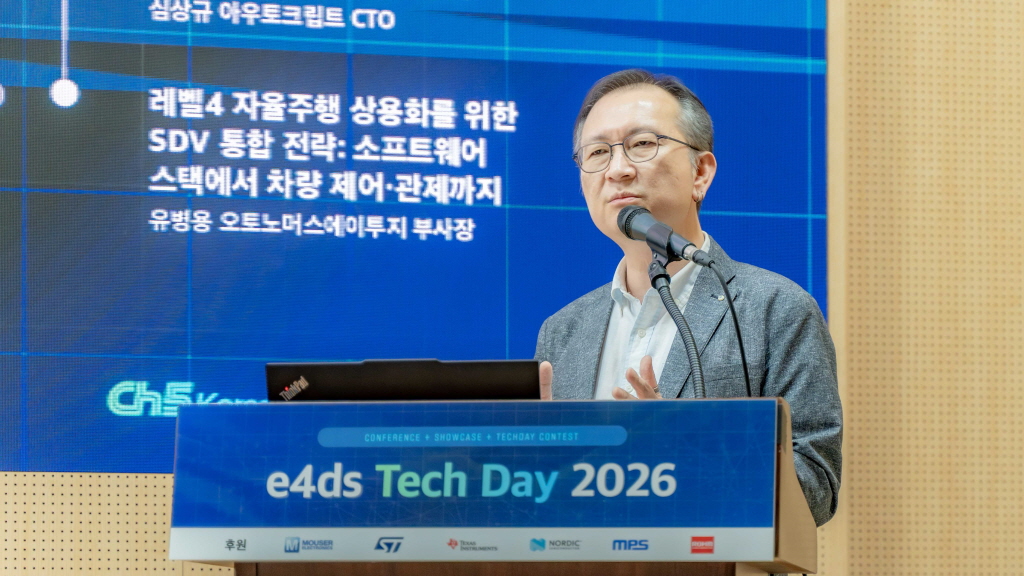
At e4ds Tech Day 2026, Sim Sang-gyu, CTO of Autocrypt, explained automotive cybersecurity strategies in the era of Physical AI and SDV (Software-Defined Vehicle). Automobiles are evolving as part of an ecosystem connected to AI, cloud, chargers, IoT, and robots, and he emphasized that the scope of security must expand beyond the vehicle interior to the entire connected environment. In particular, AI model tampering, adversarial attacks, OTA updates, and EV charger hacking were identified as major threats. He explained that response measures require zero trust, AI model integrity protection, intrusion detection, Security by Design and Default, and full lifecycle security management, and that proactive security system establishment beyond regulatory compliance is critical for securing future mobility competitiveness.
2026.10.12by 배종인 기자

Practical HIL Construction Strategy for Automotive and Off-Highway Controller Validation
As vehicle E/E architecture transitions to zonal structures and shifts to software-defined vehicles (SDV), the number of controllers (ECUs) requiring validation and software complexity are surging dramatically. Meanwhile, real vehicle testing cannot provide repeated verification under identical conditions and entails lead time and safety concerns. This white paper explains the principles of HIL (Hardware-in-the-Loop) validation and the structure of the NI platform composed of PXI, SLSC, and VeriStand, and through two actual implementation cases—Camera Record & Replay HIL for In-Cabin Monitoring Controller (ICMU) and Forklift Controller (VCU) HILS—describes how controller-level regression testing becomes possible. Additionally, it explicitly states application boundaries and limitations, such as lack of A2B support.
2026.10.12by 편집부












기대됩니다