


Controlling the variable speed of the "motor", the core of home appliances
 Published2018.08.20 18:00
Motor control PCB size can be reduced by up to 30% of existing size
It has been several years since Dyson's cordless vacuum cleaner changed the vacuum cleaner market. Unlike existing cordless vacuum cleaners that had weaker suction power than corded vacuum cleaners and were used only as auxiliary devices, Dyson's cordless vacuum cleaner captured the hearts of male consumers in particular with its powerful suction power. Needless to say, the world's leading home appliance companies, inspired by Dyson's success, jumped into the cordless vacuum cleaner market. LG's 'Cord Zero' and Samsung's 'Power Gun' are representative products. How did Dyson become the Apple of the cordless vacuum cleaner market?
This is because of the development of motors. Powerful motors that can freely control speed have become small enough to be installed in small home appliances, allowing manufacturers to implement the performance they want. Dyson's cordless vacuum cleaner is a representative product that symbolizes the miniaturization and power of motors. Dyson's hair dryer is also receiving great response in the market.
The motor is only one part of the home appliance, but it is a key part that affects energy efficiency, performance, and noise. It is extremely rare to find a home appliance without a motor. The motor accounts for most of the power consumed by the home appliance. Of the power consumed by refrigerators and air conditioners, 70-80% is used by the compressor motor. In the case of washing machines, the motor accounts for about 40-60%.
As various home appliances are used, the types of motors are also diverse. AC motors are electric motors that use alternating current power and have the advantages of high efficiency and long lifespan. However, they have the disadvantage of being difficult to control speed and direction. DC motors that use direct current power, on the other hand, are easy to control speed and direction. Recently, BLDC (BrushLess DC) that eliminates wear parts such as brushes has become widely used, which has improved the shortcoming of shorter lifespan compared to AC motors.
There are other advantages to BLDC motors. First of all, there is no mechanical friction inside the motor, so there is less noise. Since there is no commutator or brush, there is no spark, and it is completely sealed from the outside, so it is safe because foreign substances do not enter. Also, the speed is easy to control, the torque is high, so it is energy efficient, and it generates less heat than existing DC motors, so it is safe for continuous use. Dyson's hair dryer uses the low heat characteristic of BLDC motors to appeal to many female consumers with a cold air function that is 10 degrees lower than other companies' products.
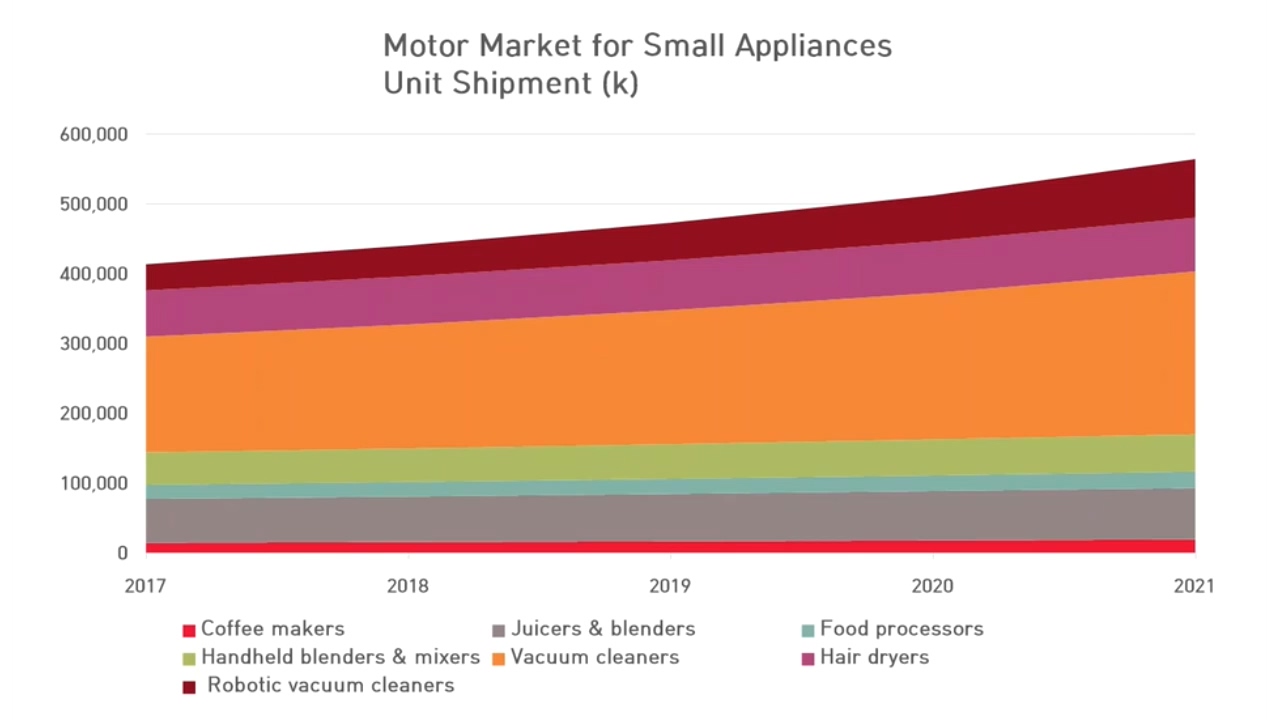
The motor market for small appliances is growing.
In order to effectively use BLDC motors, the application rate of variable speed drives rather than fixed speed drives is increasing. According to a survey conducted by e4ds, 94.2% of respondents answered that the application of BLDC and inverters will increase in various devices using motors in the future.
In order to implement a variable speed drive, power semiconductor switches, gate driver ICs, and sensors for implementing the inverter stage, and power semiconductor switches and gate driver ICs for the PFC stage to respond to power factor regulation are required, and an MCU and control algorithm for motor control are required.
On August 17, e4ds held a webinar on motor control solutions optimized for variable speed drives using Infineon’s iMOTION. iMOTION is a solution optimized for motor drive. Since its launch in 2006, it has been continuously developed and more than 30 products have been applied to various home appliances. iMOTION consists of the hardware required for implementing motion control engines and inverters. It provides customers with a comprehensive solution for motor drive, shortening the system development period. This can shorten the system course and the time to market.
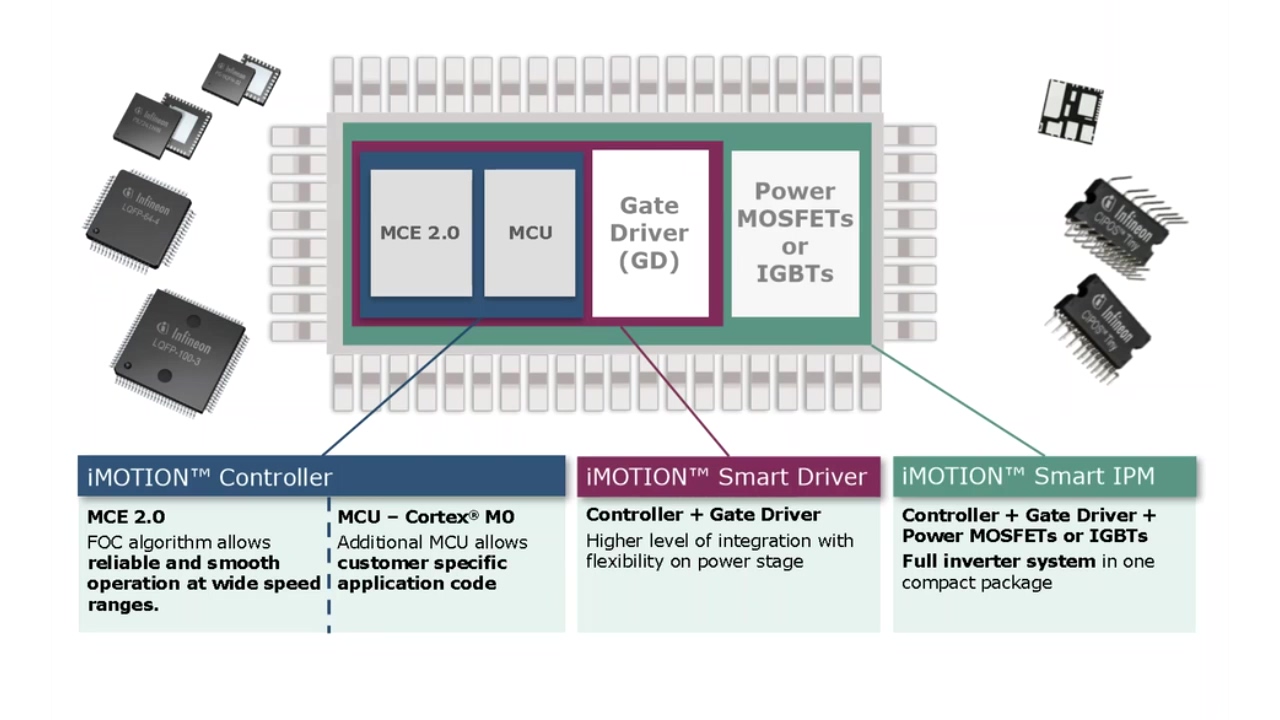
A variety of iMOTION products tailored to our customers’ needs
iMOTION products can be broadly classified into three types. The first is the 'iMOTION Controller' which has a motion control engine and a separate Cortex-M0 built-in. The second is the 'iMOTION Smart Driver' which includes a gate driver IC in the iMOTION control. The third is the 'iMOTION Smart IPM (Intelligent Power Module)' which combines the power device with the 'iMOTION Smart Driver'.
The controller is equipped with a proven motion control engine and does not require separate software coding for motor driving. It supports both sensor and sensorless types, and boost and totem-pole PFC are possible for PFC. In addition, a Cortex-M0 option is available for implementing customer applications other than motor driving.
Smart Driver is a version that adds a gate driver IC to the smart controller and can be applied to various discrete products in the power block. Smart Driver is available in two versions. The A-version can implement customer code and offers high flexibility. The T-version has Infineon's motion control engine embedded. Motion control is possible without separate code implementation by the customer.
Smart IPM integrates motion controller, gate driver IC, and power device in one package. Also available in A or T versions. Smart IPM can reduce PCB size by up to 30%.
.jpg)
Process of reducing the size of the air conditioner indoor fan PCB using smart IPM
The iMOTION 2nd generation product is equipped with the proven motion control engine 2.0. It is Class B certified, so no separate certification is required for entry into Europe. There were many questions during the webinar about whether this certification is valid for automotive electronics, but automotive electronics require a different solution.
As explained above, for the smart IPM, the gate driver IC and power device are integrated into a single package. In addition, variable speed drive can be easily implemented by simply entering the motor specifications into the MCE wizard and designer software provided free of charge by Infineon. In addition, a Cortex-M0 option is prepared for implementing customer-specific code.
The motion control engine itself can be used for various applications in the case of various sensorless FOC and includes various protection functions. And it provides analog and digital Hall sensors of sensor type. Customer code can be implemented with Cortex-M0. Simple algorithm control is also possible with scripting functions. The built-in PFC control algorithm supports high-speed single boost and totem-full PFC.
IPM is in charge of the inverter stage among variable speed drivers. IPM is a product that combines various components required for implementing an inverter into a single module, and has the advantage of shortening the development period, simplifying the assembly process, and simplifying the product supply channel. In addition, it can prevent damage due to temperature by measuring the temperature of the power element in real time using a built-in thermometer.
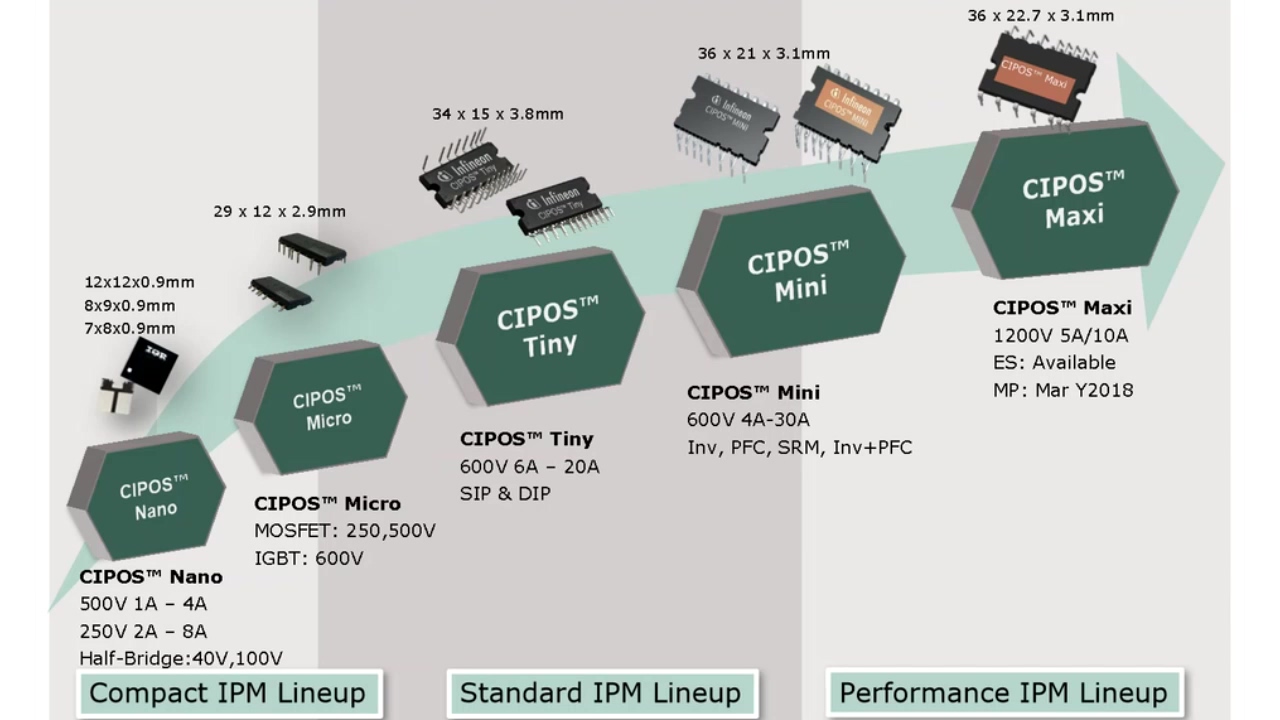
Diverse Infineon CIPOS lineup
Infineon has a range of IPM products that meet the diverse needs of customers. Customers can select the appropriate IPM to secure and design space for small devices suitable for large home appliances.
MADK (Modular Application Design Kit) is designed so that the control and power stages are connected with M1 and M3 connectors, allowing for a variety of combinations between the control board and power board. As a 3-phase motor system solution platform with each controller and inverter board modularized, the iMOTION controller with a built-in motion control engine integrates essential hardware and control algorithms to reduce system development costs and time-to-market.
Infineon provides MCE Wizard and Designer on their website. You can drive the motor by simply creating initial parameters and downloading them to the evaluation board. Additionally, fine tuning optimized for the motor can be done with software.
IGBT discrete can be applied to PFC stage and inverter stage. Infineon proposes IGBT product line optimized for home appliance PFC. Diodes required for PFC stage are provided suitable for high-speed switching.
New Power Device Packaging, Advanced Isolation
Power devices use insulating paper for heat dissipation and insulation. The most commonly used product is FullPAK. The package is all insulated, making it convenient to use, but it has the disadvantage of having a high thermal resistance coefficient, limited power density, and being more expensive than general packages. As an alternative, you can consider using insulating paper in a general TO-247 package. However, the thermal resistance coefficient is slightly lower than that of FullPAK. In addition, the price of insulating paper is not cheap, and there is a possibility that the insulating paper may be slightly damaged during the assembly process. This can cause problems in terms of reliability.
To compensate for all these shortcomings, Infineon has proposed the Advanced Isolation method. This method is compatible with the existing TO-247 package, and has a thermal resistance coefficient that is improved compared to the existing FullPAK type. This method is achieved by adding an isolation layer to the existing package. The product itself is hard and easy to handle during the production process.
Previously, the product warranty range varied depending on the characteristics of the insulation. However, Advanced Isolation can maximize the warranty range by knowing the exact thermal resistance coefficient in the semiconductor manufacturing process. Since no insulating paper is used, the thermal grease included in FullPAK is not required.
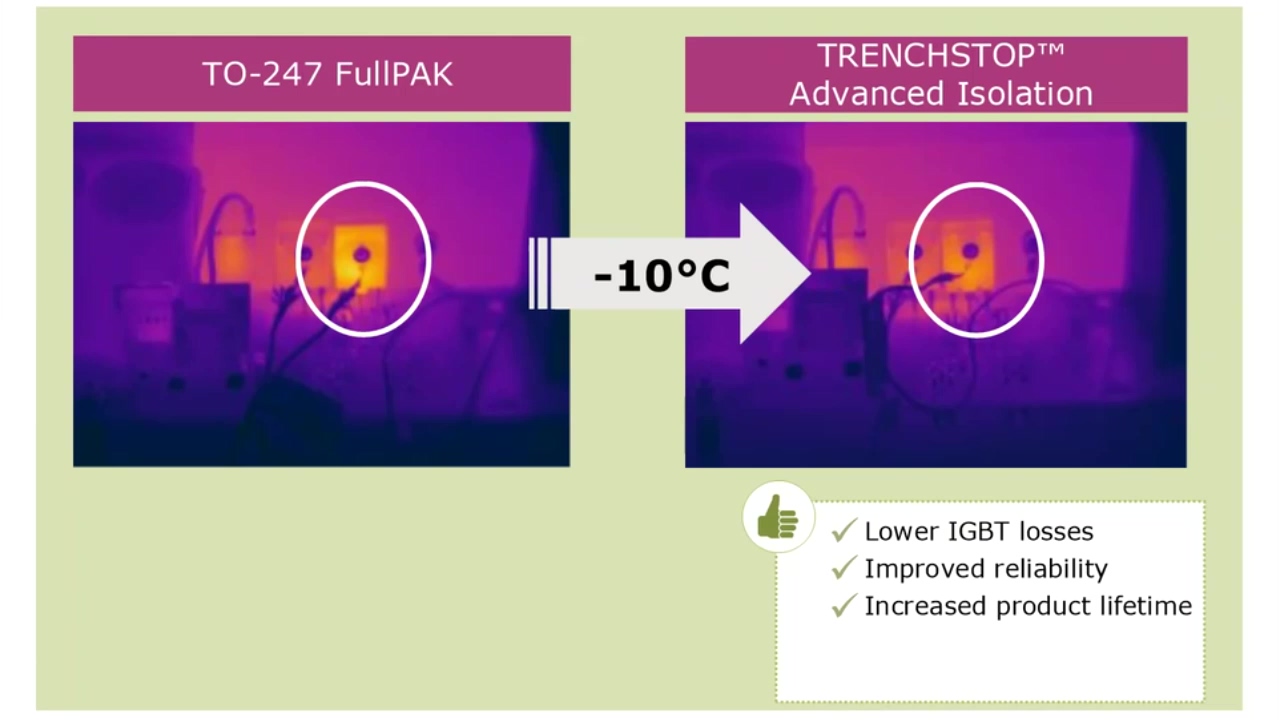
An example of applying advanced isolation is that it is 10 degrees lower than conventional packaging. Thanks to this, low IGBT loss can be achieved, which increases reliability and extends the life of the product.
organize
Recently, the spread of BLDC motors is increasing, especially in the small home appliance market. Accordingly, the demand for variable speed drives to realize power efficiency improvement and various customer demands is also increasing. Variable speed drive solutions such as Infineon's iMOTION are one of the good ways to reduce and recover the existing fragmented and unreliable system design.
Comments
Related news
.jpg)
Infineon Resonant Controller IC for Implementing LED Lighting Solutions
Infineon has launched a high-performance resonant controller IC with integrated PFC, specifically designed for power supplies and lighting drivers.
2018.08.10by 이수민 기자
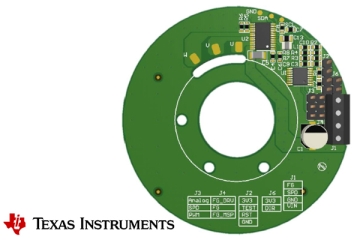
Designing High-Efficiency, High-Performance Home Appliances with BLDC Motors
Brushless DC motors are increasingly being used in home appliances due to cost-effectiveness and efficiency considerations. Unlike brushed DC motors and AC motors, brushless DC motors can be driven by various methods. This article examines the advantages and disadvantages of each method in detail and considers their applications.
2018.08.12by 이수민 기자
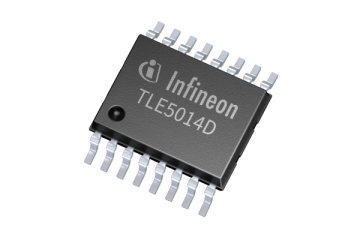
Infineon Launches Convenient and Precise Angle Sensor
Infineon has launched the XENSIV TLE5014 angle sensor, which combines the highest functional safety rating with user convenience.
2018.08.16by 이수민 기자

Intel Unveils Next-Generation 'Core Ultra Series 3' and vPro Platform for Enterprise PCs
Intel has officially unveiled the "Intel Core Ultra Series 3" for next-generation enterprise PCs and the latest vPro platform, addressing a wide range of demands from enterprise notebooks to high-performance workstations.
2026.03.26by 배종인 기자

ROHM Launches ESD Protection Diode Compatible with High-Speed Interfaces of 10Gbps or Higher
Semiconductor specialist ROHM has developed the 'RESDxVx series' of ESD (electrostatic discharge) protection diodes capable of responding to next-generation high-speed data communication environments exceeding 10Gbps, simultaneously enhancing both signal quality maintenance required in high-speed interfaces and IC protection performance.
2026.03.26by 배종인 기자











