


Dell EMC Launches Modular PowerEdge MX Without Midplane
 Published2018.09.06 14:00
Supports next-generation workloads such as IoT, AI, and machine learning
Organic replacement possible through kinetic infrastructure design

Dell EMC Executive Director Yang Won-seok
Dell EMC held a press conference in Yeoksam-dong, Seoul on the 6th and announced the launch of a new high-performance modular server product family.
The new PowerEdge MX series features a design that implements what Dell EMC calls "Kinetic Infrastructure." Because there is no midplane, compute and I/O modules are directly connected, reducing costs during future upgrades. Including server separation and software-defined technologies, the PowerEdge MX series supports not only existing workloads but also next-generation applications ranging from IoT and AI to machine learning.
The PowerEdge MX Series consists of standardized blocks that connect to infrastructure, such as servers and storage, through a smart I/O fabric, along with a newly designed chassis. It separates computing, storage, and networking fabric resources to allocate and reallocate them on demand.
Configurations can be changed as needed from a shared pool of isolated resources. Therefore, resources can be re-provisioned on the fly when more or less performance or capacity is required, preventing over-allocation and waste. By dynamically allocating IT resources, it breaks down barriers between applications while helping to free users from time-consuming system operation tasks.
The PowerEdge MX series, which implements kinetic infrastructure, adopts a midplane-less design that connects compute directly to I/O modules, allowing for upgrades to next-generation technology without service interruption. If you wish to upgrade specific storage in the future, you can simply replace the storage without replacing the chassis, as the midplane—the board connecting the storage and I/O modules—is absent from the chassis.
In the future, it is planned to support not only individual storage but also memory-intensive devices such as SCM (Storage Class Memory), GPU, and FPGA.
The PowerEdge MX series supports the latest low-latency NVMe drives and native 25GbE (Gigabit Ethernet) networks, making it suitable for implementing SDDC (Software-Defined Data Center), such as high-density virtualization and SDN (Software Defined Networking).
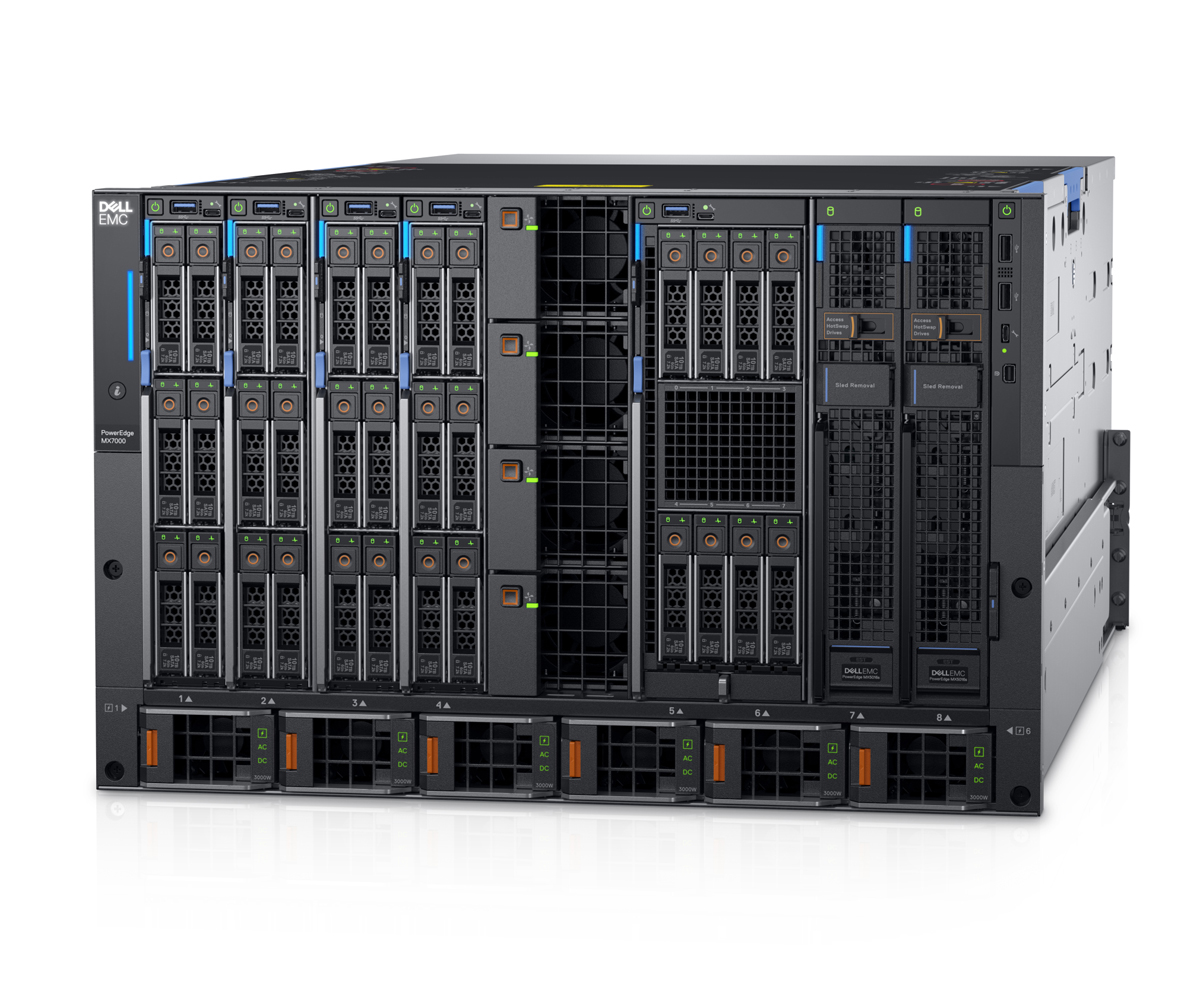
PowerEdge MX Series Key Portfolio
The PowerEdge MX7000 chassis supports multiple generations of server processors and provides a single interface and end-to-end lifecycle management capabilities for all components. This allows you to reduce wasteful maintenance and focus on business priorities. The 7U chassis includes 8 bays, allowing for various single- and double-width compute and storage combinations.
The PowerEdge MX740c and MX840c server sleds—available as 2-socket or 4-socket blade sleds—offer powerful processing capabilities and various storage options, including NVMe drives. The single-wide MX740c and double-wide MX840c support up to 6 terabytes of memory and the entire Intel Xeon Scalable processor family. The MX740c is a single-wide 2-socket modular server capable of tiering up to six 2.5-inch NVMe, SAS, or SATA drives. The MX840c can accommodate and tier up to eight drives.
PowerEdge MX5016s Storage Sled / A high-density, single-wide scale-out storage sled that supports up to 16 hot-pluggable SAS storage hard disk drives. Up to seven MX5016 sleds can be installed in the MX chassis, allowing for the installation of up to 112 DAS drives. Drives can be mapped individually to one or multiple servers, enabling the application of optimal storage ratios as needed.
PowerEdge MX Ethernet and Fibre Channel Switch Module / A new low-latency, high-bandwidth switching module optimized for multi-chassis environments, providing optimal network performance. PowerEdge MX's single management interface supports automated processes for topology compliance, quality of service, and automatic recovery functions. PowerEdge MX is a modular infrastructure that provides end-to-end 25GbE and 32Gbps Fibre Channel. By combining 100GbE and 32G Fibre Channel uplinks, a highly scalable multi-chassis fabric architecture can be implemented, reducing switching latency by up to 55%.
Software support
PowerEdge MX includes Dell EMC OpenManage Enterprise–Modular Edition, which provides the key features of the system management console software OpenManage Enterprise within the server chassis for all environments. Lifecycle management for all components deployed across multiple PowerEdge MX chassis can be performed at once.
In addition to quickly applying changes and templates, remote server access is also possible using the Dell EMC OpenManage Mobile application and the new Quick Sync 2 feature. Furthermore, OpenManage Enterprise can manage racks and modular solutions through a single interface.
In addition to PowerEdge MX, designed for flexible customization, Dell EMC’s end-to-end support and deployment services provide everything from fully integrated modular solutions to customized installations and configurations tailored to individual customer requirements. Furthermore, the 24/7 ProSupport Plus service offers comprehensive system support, allowing direct connection to senior ProSupport Plus engineers and designated Technology Service Managers.
The Dell EMC PowerEdge MX series is scheduled to be released in Korea on September 13. Further details can be found on the Dell EMC website .
Comments
Related news
New markets open with cloud and FPGA-based servers
The F1 instance is optimized for high-speed, high-volume data processing centered on FPGA. For applications requiring high efficiency such as CCTV, real-time video streaming, and image size scaling, FPGA usage is essential. This is also related to the fact that existing FPGAs are mostly used in expensive cameras employed by broadcast companies. Digitization of 4K and 8K images at up to 64 frames per second (capturing and digitally converting 64 images per second) is within the FPGA domain, which is not easily achievable with conventional CPUs or GPUs.
2018.05.14by 명세환 기자
Dell EMC Expands Disk Array Supply to Nara Jangteo
Dell EMC has additionally registered eight types of mid-range storage and enclosures under the "disk array" category on the National Procurement Service's Nara Jangter Comprehensive Shopping Mall.
2018.08.05by 이수민 기자
Dell EMC Announces Updates for 'Unity, SC Series OS'
Dell EMC has announced software OS updates for its midrange storage products 'Unity' and 'SC Series'. Dell EMC plans to continue investment and innovation in its midrange storage portfolio.
2018.08.11by 이수민 기자
.jpg)
SalePoint Signs Multi-Year Partnership Agreement with AWS… Promoting Identity Security that Integrates Even AI Agents
Sailpoint has entered into a multi-year strategic partnership agreement with AWS and is moving forward with establishing an integrated governance system that manages both human and non-human identities together. The plan is to consistently manage access permissions in an environment where AI agents are increasing as work execution entities, while applying the principle of least privilege and automated policy enforcement. The two companies plan to jointly expand capabilities to manage the identities of various entities, including AI agents, within a single layer in the AWS environment. This collaboration is interpreted as a move to design security and governance together in corporate environments where AI adoption is expanding.
2026.03.26by 배종인 기자
.png)
Databricks Unveils Open AI Security Monitoring 'Lakewatch'
Databricks entered the security market on March 24 by unveiling LakeWatch, an open-source agentic SIEM. The core functionality of this product is to integrate and analyze security, IT, and business data in a single environment to support AI-based threat detection and investigation. The company explained that it reduces the limitations of existing security operations centers, which have had to forgo some data due to high cost structures, and enables large-scale data analysis and automation based on open formats and ecosystems. LakeWatch is currently offered as a private preview, with Adobe and Dropbox mentioned as early customers. Databricks also announced an expanded partnership with Anthropic as well as the acquisition of Antimatter and SiftD.ai.
2026.03.26by 배종인 기자











