


KT Partners with Companies and Government to Usher in the 5G Era
 Published2018.09.15 07:02
Invest 23 trillion won over 5 years and create 140,000 jobs
Strengthening cooperation with global partners such as Intel and Qualcomm
KT announced that, in line with the world's first commercialization of 5G in 2019, it is developing 5G services in collaboration with businesses (B2B) and the government (B2G), focusing on five major areas: smart cities, smart factories, connected cars, media, and cloud. Through this, the company aims to showcase more realistic 5G services to customers while providing the driving force for South Korea's Fourth Industrial Revolution.
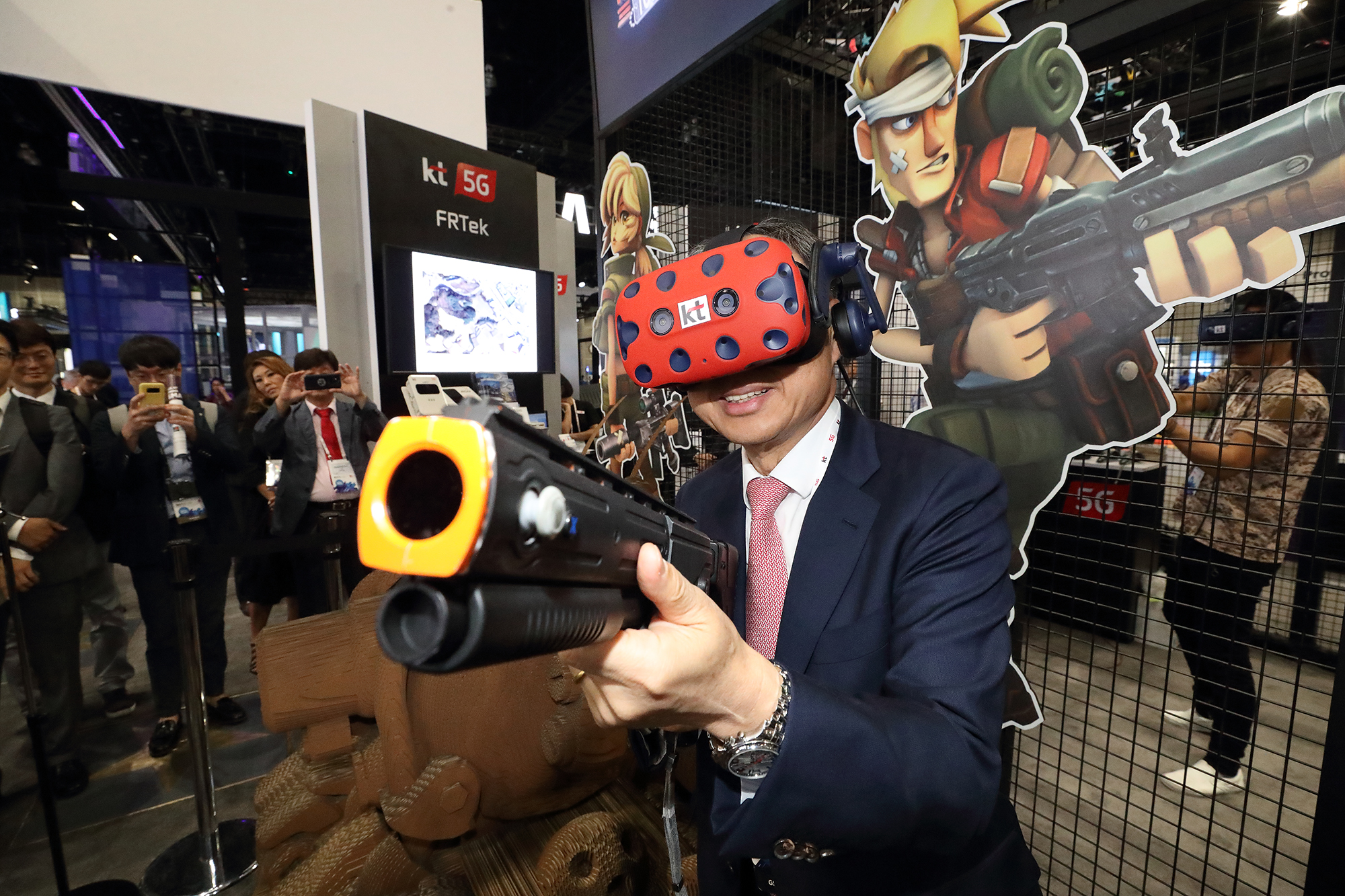
KT Chairman Hwang Chang-kyu is experiencing the 'Metal Slug' game using VR at the KT exhibition hall.
KT Promotes B2B and B2G Collaboration
KT Chairman Hwang Chang-kyu attended Mobile World Congress (MWC) America 2018, which opened in Los Angeles, USA, on the 12th (local time), and announced that the company is preparing 5G-based B2B services in five major areas. Along with this, he unveiled plans to further strengthen global collaboration in the era of 5G.
In its report "Analysis of the Socioeconomic Impact of 5G" published last July, the KT Economic and Management Research Institute projected that 5G would generate 47.8 trillion won in socioeconomic value by 2030. Among these, it was predicted that a value of over 42.3 trillion won would be generated in 10 industries including energy, security and safety, manufacturing, automobiles, and media, and a value of over 5.4 trillion won would be generated in 4 infrastructure environments including smart cities and smart offices.
Experts predict that 5G will enable communication between things by possessing technological characteristics such as ultra-high speed, ultra-connectivity, and ultra-low latency, and will become a core infrastructure of the Fourth Industrial Revolution when combined with AI and big data. For this reason, while 4G provided value directly to consumers (B2C), the view is gaining traction that starting with 5G, consumers' lives will become more convenient through value created via B2B and B2G.
23 trillion won investment over 5 years until 2023
Recently, KT announced a plan to invest 23 trillion won from 2019 to 2023. Of this amount, 13.5 trillion won will be invested in the Fourth Industrial Revolution sector, including 9.6 trillion won in networks such as 5G (wireless) and 10-gigabit internet (wired), and 3.9 trillion won in convergence ICT such as AI, IoT, energy, VR, and big data. This accounts for approximately 60% of the total investment.
KT expects to create a total of 140,000 jobs through a 23 trillion won investment over five years, comprising 36,000 direct regular hires (including 6,000 university graduates) and 104,000 indirect hires through partner companies. In addition, it is establishing the 4th Industrial Revolution Academy and the 5G Academy to foster specialized personnel in AI, VR, and 5G. These institutions aim to train 2,000 specialized professionals over the five-year period leading up to 2023.
In addition, KT is pursuing the development of various services across five major areas through B2B and B2G collaborations. Services being prepared in the 'Smart City' sector include public safety solutions utilizing drones and sky ships, as well as smart schools and smart stadiums. In line with the improvement of regulations, we are also reviewing 5G-based remote medical services (healthcare) and smart energy-related services. In the 'smart factory' sector, we are preparing real-time sharing of work status through wireless-based manufacturing equipment, AR-based remote diagnosis, and remote control to ensure productivity and safety.
In the 'Connected Car' sector, we are pursuing technology development and collaboration with related companies regarding real-time traffic and signal information, vehicle control, driver management, information, and precise positioning. '5G Media' includes immersive media such as SyncView, OmniView, and 360-degree VR, which were showcased at the PyeongChang Winter Olympics, as well as immersive games linked with AR and VR. In the case of '5G Cloud,' we are collaborating to provide Edge Cloud, which complements the shortcomings of existing cloud services.
Traditional cloud services suffered from problems such as connection delays and helplessness in the event of a hack, as data management was centralized across one or two data centers. In contrast, edge cloud services distribute data collection, analysis, and processing functions across various locations, offering the advantages of faster processing times and secure data management. For this reason, they are being evaluated as a cloud service suitable for the 5G era.
Establishment of Africa's First Nationwide LTE Network, Strengthening Cooperation with Global Partners
Chairman Hwang Chang-kyu emphasized that KT has been raising its global profile through active global expansion in preparation for the 5G era. He also explained that KT is accelerating cooperation with global partners.
Following the establishment of a nationwide LTE network in Rwanda, the first in Africa, in May of this year, KT exported a fisheries monitoring system to two West African countries, Sierra Leone and Liberia. In July, we built an advanced ICT-based electronic national registration data center in Tanzania and won a project to build an optical network in Botswana.
In August, a contract worth 53 billion won was signed with a local company in the Philippines, Southeast Asia, for an optical cable construction project. Additionally, it was selected as a consulting firm to verify and manage the design, construction, and operation of the national backbone network in Chile, South America.
KT is continuously discussing 5G commercialization strategies and service development with China Mobile and NTT Docomo through the Strategic Cooperation Alliance (SCFA), a group of the largest telecommunications companies in Korea, China, and Japan. In addition, it has maintained a cooperative relationship with Verizon, a leading mobile carrier in North America, since 2016 and is sharing the progress of 5G technology and service development.
Recently, KT signed a Memorandum of Understanding (MOU) with Intel for the verification and commercialization of Intel platform architecture and performance optimization technologies for 5G services. Subsequently, on the 12th, at MWC America in Los Angeles, USA, it signed a comprehensive MOU with Qualcomm for 5G business cooperation, further strengthening its cooperative relationship.
It is true that since 5G has not been commercialized, it is not easy to conduct related technologies and tests. KT expects that the '5G Open Lab,' which recently opened at its R&D center in Seocho-gu, Seoul, will become a space for conducting joint 5G research with global partners and developing new services.
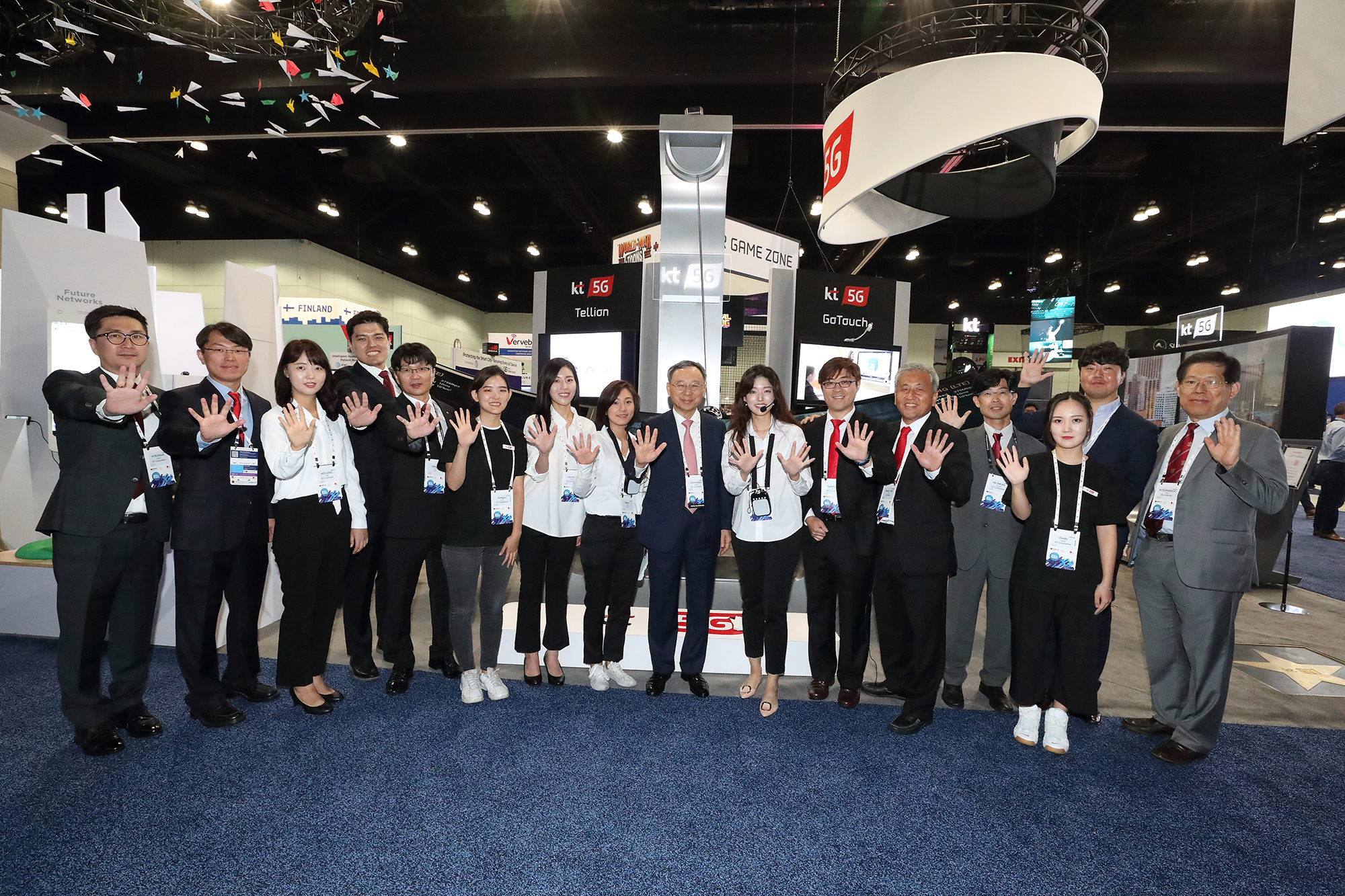
KT Chairman Hwang Chang-kyu is taking a commemorative photo with employees at the KT exhibition hall.
Chairman Hwang Chang-kyu said, “5G must be a technology for people, such as extending the golden time for emergency patients and enabling people with limited mobility to drive,” adding, “KT will strive to maximize the value of 5G, the core infrastructure of the Fourth Industrial Revolution, through active collaboration with other companies and the government.”
Comments
Related news
.jpg)
"Wow" KT Holds Diverse Events on 555th Day Since 5G Commercialization Declaration
Following the declaration of "world's first 5G commercialization," KT has reached the 555-day milestone and is now conducting a review of 5G commercialization preparation status. KT is launching the 5G Open Lab to accelerate early activation of the 5G ecosystem, participating in MWC America 2018, and hosting the Jarasum Festival, among other initiatives to promote 5G awareness.
2018.09.04by 이수민 기자
LG U+ AI Remote Adds IoT to Non-IoT Home Appliances
LG U+ has introduced the U+ AI Remote Control, which helps customers who want to use IoT appliances that can be easily controlled via smartphones or AI speakers but find the purchase cost burdensome, by enabling them to use their existing appliances as if they were IoT appliances.
2018.09.09by 이수민 기자
KT's 5G Commercialization Blueprint: Taking Root at Home, Looking to the World
KT is undertaking various activities to mark the 555th day since its 5G commercialization declaration. KT plans to provide its 5G infrastructure and technological capabilities to domestic companies to enrich the domestic 5G ecosystem. Additionally, KT will expand its 5G competencies to the Asia-Pacific region, starting with China and Japan. Going forward, KT will collaborate with global ICT companies to lead the world's first 5G commercialization of the highest quality.
2018.09.10by 이수민 기자
European Patent Applications Surpass 200,000 for the First Time… South Korea Maintains 5th Place, Led by Batteries and Telecommunications
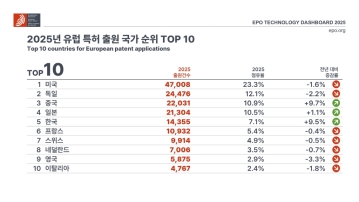
According to the European Patent Office (EPO)'s 'Technology Dashboard 2025', European patent applications last year reached 201,974, surpassing 200,000 for the first time. Korean companies and inventors filed 14,355 applications, representing a 9.5% increase from the previous year and maintaining 5th place by country. Battery, digital communication, and semiconductor technologies led the growth, with Samsung ranking as the top EPO applicant for the second consecutive year and LG reaching 3rd place. The presence of major domestic cities such as Seoul, Suwon, and Yongin was also confirmed. It was also revealed that Korea's European patent strategy is expanding beyond individual technologies to span the entire industry.
2026.03.24by 명세환 기자
SK Telecom First Applies AI-Based Network Operations at Gwanghwamun K-Pop Concert
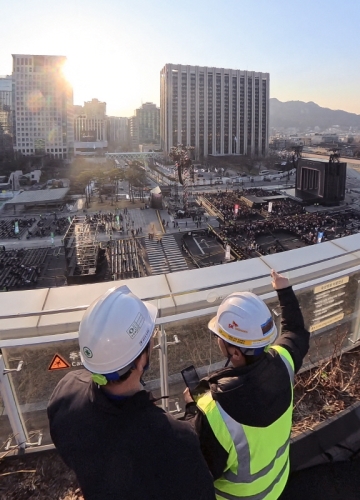
SK Telecom announced that it applied an AI-based network operation system for the first time at a large-scale K-pop concert held in the Gwanghwamun area of Seoul on March 21st, managing communication quality throughout the event. Mobile data usage during the three hours before and after the concert reached 12.15TB, approximately doubling compared to the same time slot the previous weekend. SK Telecom monitored traffic using the AI system 'A-One' in five-minute and 50-meter units to respond to potential overload situations, while also operating temporary communication facilities and on-site personnel in parallel. This case is interpreted as confirmation of the practical applicability of AI-based autonomous network operation in an environment where demand from dense events and foreign users increases simultaneously.
2026.03.23by 명세환 기자











