


KETI Develops Korea's First AI-Based Sign Language Recognition Technology
 Published2018.09.21 06:01
Extracting feature points from the hands, face, and mouth of sign language implementers
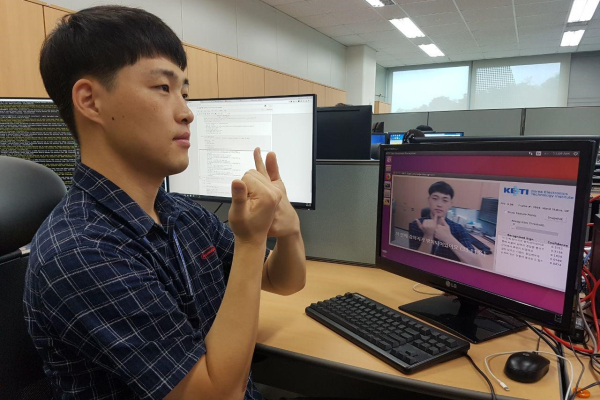
KETI researchers are demonstrating sign language recognition technology developed by KETI researchers.
On the 11th, the Korea Electronics Technology Institute (KETI) announced that it had developed Korea's first artificial intelligence-based sign language recognition technology through the government's 'Autonomous Intelligence Digital Companion' project.
The developed technology performs machine learning based on bidirectional LSTM (Long short-term memory), a type of recurrent neural network. This is a technology that extracts features from the hands, face, and mouth of a sign language implementer and interprets them into Korean sentences. Compared to other technologies, it has high practicality, simplicity, and accuracy.
To develop this technology, KETI has been working with Professor Byeong-Cheon Yoon's team at Nazareth University, Korea's leading institution for sign language interpretation research, to build sign language data for artificial intelligence learning since 2017.
“We hope that through the development of this technology, artificial intelligence will serve as a bridge connecting the world so that no one can experience inconvenience,” said Jeong Hye-dong, director of the KETI Artificial Intelligence Research Center, who oversaw the research. “In the future, we plan to expand the application of AI-based behavioral recognition technology to intelligent CCTVs for use in urban safety, or to equip self-driving cars so that they can even recognize police officer hand signals, thereby upgrading them to highly intelligent AI technology that understands all ‘words and actions.’”
Comments
Related news
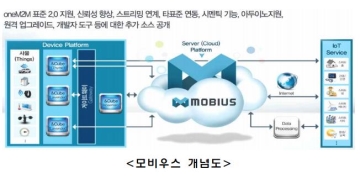
KETI is building a global IoT ecosystem with Mobius.
The Electronics and Telecommunications Research Institute (KETI) announced on the 27th that it is leading the creation of an IoT ecosystem by developing "Mobius," a global standard IoT platform with government support, and supporting domestic companies' technology development and commercialization through open source policies and IoT Open Lab operations. Mobius is a domestic IoT platform capable of compatibility with various other standard technologies and was developed with government support. In particular, Mobius is the world's first open source IoT platform developed based on oneM2M, the global Internet of Things standard, and △leads international standardization through continuous oneM2M standardization activities, and △has secured world-class compatibility through various global compatibility tests including OCF standards and non-standard devices. Additionally, △it offers the advantage of high openness and easy, convenient development, making it easily accessible for small and medium-sized enterprises.
2018.05.25by 김지혜 기자

KETI Opens Door to Public Network 4K Content Streaming Service
The Electronics and Telecommunications Research Institute announced on the 21st that it has developed a screening platform capable of Live/VOD streaming of encrypted 4K cultural and arts content using a standard internet network. The platform can transmit 4K resolution video content at 60 frames per second—equivalent to twice the image quality of conventional UHD broadcasting and approximately ten times that of HD broadcasting—at approximately 50Mbps through standard internet networks of 100Mbps class that are already in place.
2018.08.27by 이수민 기자
Facebook Develops Deep Learning ASIC / Launches 6G Development / Apple Announces 7nm SoC Products!
[Americas Weekly IT News] 1. Facebook collaborates with five chip companies to develop ASIC chips for deep learning, focusing on differentiation from Google 2. Kinect and iPhone X Depth Sensing technology developer transforms into startup, succeeds in developing GPU that outperforms AI chips 3. Finland begins developing 6G ecosystem, plans to establish 6G standards based on 5G 4. Apple announces iPhone product equipped with 512GB memory on 7nm SoC
2018.09.20by 류아연 외신

[e4ds Tech Day 2026 ⑨] Sim Sang-gyu, Autocrypt CTO: "In the Physical AI Era, Automotive Security Must Extend Beyond the Vehicle"
At e4ds Tech Day 2026, Sim Sang-gyu, CTO of Autocrypt, explained automotive cybersecurity strategies in the era of Physical AI and SDV (Software-Defined Vehicle). Automobiles are evolving as part of an ecosystem connected to AI, cloud, chargers, IoT, and robots, and he emphasized that the scope of security must expand beyond the vehicle interior to the entire connected environment. In particular, AI model tampering, adversarial attacks, OTA updates, and EV charger hacking were identified as major threats. He explained that response measures require zero trust, AI model integrity protection, intrusion detection, Security by Design and Default, and full lifecycle security management, and that proactive security system establishment beyond regulatory compliance is critical for securing future mobility competitiveness.
2026.10.12by 배종인 기자
NVIDIA to Invest $1 Billion in U.S. Science Over Next Five Years
NVIDIA has announced plans to invest $1 billion over the next five years to strengthen U.S. scientific and technological competitiveness. The company will enhance cutting-edge artificial intelligence research and development capabilities in key areas including quantum computing, healthcare, and energy security, while expanding support for higher education research institutions and cloud service providers. NVIDIA is participating as a major industry partner in the White House Office of Science and Technology Policy's Genesis Mission, and is promoting supercomputer construction in collaboration with national laboratories including Argonne and Los Alamos.
2026.10.12by 배종인 기자











