



[Telecom Trends] Convenient and Secure Payments with Blockchain
 Published2018.09.25 07:03
KT to Issue Local Currency Used Like Real Money in First Half of Next Year

LG Uplus Offers Blockchain-Based Overseas Payment Service
LG Uplus announced on the 16th that it has entered into a business agreement with Japan's SoftBank and Taiwan's Far East to build a blockchain-based overseas payment system, CCPS (Cross Carrier Payment System), provided by TBCA Soft of the United States, and will launch a pilot service.
Japan's SoftBank, Taiwan's Far East, and the U.S.'s TBCA Soft are board members of the Carrier Blockchain Study Group (CBSG), a global blockchain cooperation framework for telecommunications companies, and LG Uplus joined in February of this year. Through business agreements with global companies leading blockchain technology, LG Uplus utilizes CCPS, a blockchain system dedicated to telecommunications carriers, to provide services that connect electronic finance in each country based on blockchain technology.
CCPS connects payment systems between telecommunication carriers via blockchain, enabling subscribers of each carrier to make purchases through the carrier's payment system when visiting overseas locations such as Korea, Japan, and Taiwan.
LG Uplus, SoftBank, and Far East, the telecommunications companies participating in the overseas payment system pilot service, plan to offer online and offline Direct Carrier Billing (DCB) payment services as a pilot program for visitors from various countries in the first half of next year. Customers will pay the amount paid overseas as part of their next month's phone bill.
Simple payment based on blockchain technology is expected to minimize losses due to exchange rate fluctuations, thereby saving on existing credit card overseas payment fees or currency exchange fees. Customers can make payments overseas as easily and economically as using their own domestic cash, and also enjoy the advantages of credit card post-payment by paying the amount as part of their next month's phone bill.
In addition, blockchain-based payment systems settle payment amounts between telecommunication companies in real time, reducing the final foreign currency payment amount for each company and thereby lowering the burden of fees for operators associated with overseas foreign currency payments.
LG Uplus plans to expand its service scope following the pilot commercialization of the service in the first half of next year, including increasing the number of merchants accepting payment system merchants as well as offering discounts on travel products linked to rate plans.
Joo Young-jun, Head of Mobile Service 1 at LG Uplus, stated, “Customers can now enjoy the advantages of a convenient, economical, and secure blockchain-based overseas payment system,” adding, “Going forward, we will explore various new businesses utilizing blockchain technology, not only for overseas payments but also in partnership with global telecommunications companies.”
"The CBSG consortium is an innovative leader in the transition to mobile and digital payments," said Daichi Nozaki, Vice President and Head of Global Business at SoftBank. "This pilot service enables consumers and businesses to overcome concerns regarding mobile payment infrastructure, services, and security by utilizing a blockchain platform they can trust."
KT to Issue Convertible Blockchain-Based Local Currency
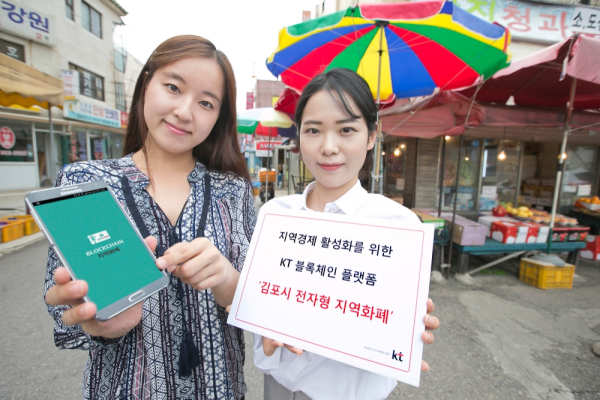
On the 17th, KT and KT Mhouse announced that they will establish a 'blockchain local currency platform' by the end of this year to issue local currency worth approximately 10 billion won in Gimpo City They stated that they would apply it.
Currently, more than 90 types of local currencies are being issued domestically, but most are distributed in the form of physical vouchers, failing to gain significant traction among consumers who prefer convenient payment methods such as mobile phone payments. On the other hand, local currencies issued and distributed through the platforms of KT and KT Mhouse are being used like cash at local currency affiliated stores in Gimpo City during the first half of 2019.
The blockchain-based local currency platform that KT is introducing to Gimpo City is designed for the issuance and distribution of various local currencies tailored to specific uses and purposes, and incorporates KT's proprietary "Smart Contract" technology. Utilizing this technology enables the issuance of coding-capable currency, the provision of direct payment services without intermediaries, and highly reliable settlements without data loss. Furthermore, based on "Distributed Ledger Technology," where a decentralized network continuously updates and verifies all payment lists, it fundamentally prevents double spending, forgery, falsification, repudiation, and fraudulent circulation, thereby supporting local governments in managing and executing local currencies more transparently.
KT plans to offer Gimpo City's local currency in the form of QR codes via smartphone apps and rechargeable prepaid cards, based on a blockchain-based local currency platform. KT anticipates a high likelihood of acceptance by Gimpo citizens and merchants for the local currency, as both QR codes and prepaid cards allow for convenient payments at participating merchants without the need to install new payment terminals. In particular, Gimpo City's local currency has the advantage of being convertible. For example, Mr. A, who sells fish at Gimpo Market in exchange for local currency, can have cash, rather than the local currency, immediately deposited into his bank account as payment for the sale. This is the first time a convertibility function has been introduced among blockchain-based local currencies circulating in the country.
KT predicted that if blockchain technology is introduced to local currency, it will significantly enhance the convenience of use for local consumers and merchants, the transparency of the distribution process, and operational efficiency, and unlike existing local currencies that are mainly distributed in the form of paper vouchers, it will be able to contribute substantially to the revitalization of the local economy.
Gimpo City plans to distribute youth allowances, postpartum care expenses, and a portion of civil servant welfare points starting in 2019 as electronic local currency based on a blockchain local currency platform. The scale of Gimpo City's local currency is estimated at approximately 10 billion won annually. Gimpo City plans to prioritize securing merchants for its local currency in downtown alley commercial districts and expand its usage in various forms by applying it to online shopping malls and delivery services to increase utilization rates.
KT plans to expand and apply its blockchain local currency platform to over 160 local governments nationwide, starting with Gimpo City, and will introduce various blockchain-based services for administrative innovation in local governments, such as electronic voting, citizen participation, and rewards.
Gimpo Mayor Jeong Ha-young stated, “I hope that the introduction of Gimpo’s local currency will prevent our city’s resources from flowing out to nearby major cities and instead encourage consumption within the region, leading to a substantial increase in sales for small business owners,” adding, “I ask for the citizens’ interest and participation so that the local currency can establish itself as a foundation for the growth of our local economy.”
Moon Jeong-yong, Senior Vice President and Head of KT’s Blockchain Commercialization TF, said, “The blockchain local currency platform to be introduced in Gimpo City will be the first successful case where the public and private sectors work together to provide citizens with the value of ease of use and information transparency, and to promote the revitalization of the local economy,” adding, “We look forward to KT playing an important role in the implementation of blockchain-based local currencies by local governments across the country.”
Meanwhile, KT has been operating a dedicated organization for blockchain technology research and development since 2015 and is developing a network-based blockchain platform capable of processing 100,000 transactions per second and is pursuing its expansion into various service areas such as finance, data storage, authentication, and energy trading.
Comments
Related news

Can the 'Blockchain Promotion Act' revitalize the industry?
For the first time in Korea, a blockchain-related bill has been proposed. The Korea Blockchain Industry Promotion Association held a grand forum with the Korea Trade Association for blockchain industry promotion and proposed the enactment of the 'Blockchain Industry Promotion Basic Act.' Rep. Hong Ui-rak, who is preparing to introduce the Blockchain Industry Promotion Basic Act, stated, "Despite blockchain being a core foundational technology for the Fourth Industrial Revolution, the government's dual policy direction is causing confusion," and added, "Rather than short-term crisis avoidance, resources should be concentrated on infrastructure and facilities to foster it as a new growth engine."
2018.05.11by 김지혜 기자
KT Develops Blockchain-Based Real-Time Roaming Settlement Technology
KT announced that it has developed a "real-time roaming auto-settlement" technology based on blockchain smart contracts. By utilizing this technology, roaming settlement between telecommunications carriers, which previously took a month, can now be processed in real-time on a per-transaction basis. A "smart contract" is a digital contracting method based on blockchain technology in which contracts and transactions are executed when predetermined conditions are met.
2018.05.23by 김지혜 기자
[Telecom Trends] The Three Major Carriers Accelerate Expansion
As the heat wave winds down, the three telecommunications companies are stepping up efforts to expand their respective focus areas. SKT is partnering with institutions and other companies to develop 5G small cell base stations, expanding the domestic small cell ecosystem. KT is unveiling a disaster safety platform that handles everything from disaster prevention to post-incident response, expanding into the public services sector. LG U+ has expanded its U+tv professional baseball and golf broadcast services, which were previously mobile-only, to IPTV.
2018.08.28by 이수민 기자
European Patent Applications Surpass 200,000 for the First Time… South Korea Maintains 5th Place, Led by Batteries and Telecommunications
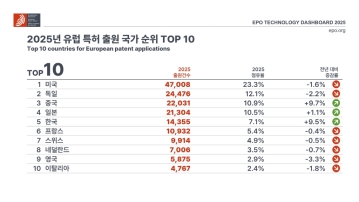
According to the European Patent Office (EPO)'s 'Technology Dashboard 2025', European patent applications last year reached 201,974, surpassing 200,000 for the first time. Korean companies and inventors filed 14,355 applications, representing a 9.5% increase from the previous year and maintaining 5th place by country. Battery, digital communication, and semiconductor technologies led the growth, with Samsung ranking as the top EPO applicant for the second consecutive year and LG reaching 3rd place. The presence of major domestic cities such as Seoul, Suwon, and Yongin was also confirmed. It was also revealed that Korea's European patent strategy is expanding beyond individual technologies to span the entire industry.
2026.03.24by 명세환 기자

SK Telecom First Applies AI-Based Network Operations at Gwanghwamun K-Pop Concert
SK Telecom announced that it applied an AI-based network operation system for the first time at a large-scale K-pop concert held in the Gwanghwamun area of Seoul on March 21st, managing communication quality throughout the event. Mobile data usage during the three hours before and after the concert reached 12.15TB, approximately doubling compared to the same time slot the previous weekend. SK Telecom monitored traffic using the AI system 'A-One' in five-minute and 50-meter units to respond to potential overload situations, while also operating temporary communication facilities and on-site personnel in parallel. This case is interpreted as confirmation of the practical applicability of AI-based autonomous network operation in an environment where demand from dense events and foreign users increases simultaneously.
2026.03.23by 명세환 기자











