


A domestically developed electronic skin-type tactile sensor capable of replacing neural tissue has been successfully developed.
 Published2018.10.25 10:17
More than 10 times more sensitive than existing sensors, good elasticity, and chemical stability
A Korean research team has successfully developed a rubber-type pressure sensor that can be directly attached to prosthetic limbs, prosthetic arms, and robots for people with disabilities. This suggests that future use of this sensor could mimic the function of the human nervous system, aiding in sensory perception.
Following the development of a fabric-type sensor based on graphene composites earlier this year, the Electronics and Telecommunications Research Institute (ETRI) has now developed a rubber-type sensor. This has resulted in the development of a rubber-type pressure and strain composite sensor that boasts high reproducibility even after thousands of bends and stretches and offers sensitivity more than 10 times higher than existing sensors.
The researchers created a 1cm x 1cm sensor for testing purposes. The sensor size can be adjusted in the future. Initially, they plan to develop a small sensor that can be applied to gloves or fingers, maximizing sensitivity to even the smallest pressure.
ETRI stated that although existing pressure sensors can secure sensitivity, their response to pressure changes is low, and that they have worked hard to solve this problem.
The researchers also used a resistive sensor method in which resistance changes as area or length changes. This is because changes in resistance make it easy to check whether the sensor is operating.
In particular, we tried to find a material that was not hard or uncomfortable to the skin, especially for application to human skin. So, he explained that he chose a rubber-like material called Ecoflex, which is elastic and harmless to the human body.
The research team explained that 3D graphene resembles a sponge, and when pressed and released with a hand, the resistance changes as the length or area changes. Because the sponge's surface is coated with graphene and thus conductive, applying vertical pressure allows for changes in resistance according to changes in surface area.
Afterwards, they revealed that they were able to create a flexible rubber-type sensor with high sensitivity by making a relief flat sheet using molybdenum disulfide (MoS2) on the surface of a graphene sponge and then combining it with Ecoflex, a flexible polymer. This resulted in the creation of a sensor that exhibited excellent electrical conductivity and high sensitivity even to low pressure changes.
The research team predicts that this type of rubber sensor will be first applied to prosthetic limbs and robots in the future, and will also be of great help in rehabilitation treatment in hospitals.
Especially in the case of rehabilitation treatment, it was very difficult to know the degree of recovery during the treatment process, but it is explained that if this sensor is attached to the patient and used, accurate quantitative analysis of the degree of treatment is possible.
In other words, if a sensor is attached to the skin during the rehabilitation process of the patient raising his or her arm, it is possible to easily observe the change in resistance according to the arm lifting.
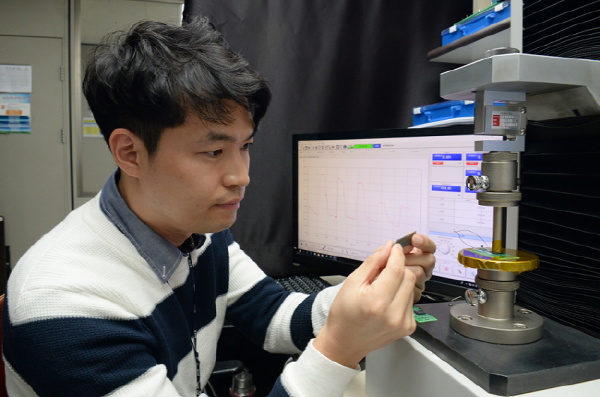
Testing a human-safe, electronic skin-type tactile sensor.
It is also reported that if this sensor is attached to a car seat and utilized, it will be possible to easily understand the driver's habits, and the cause of specific diseases or musculoskeletal diseases that appear when driving for long periods of time can be identified, which can help with treatment.
Using a rubber-like composite material, the research team created motion sensors that can be attached to fingers, temples next to the eyes, and the back of the neck, detecting body movements such as finger bending, eye blinking, and neck bending. They also successfully created a 3 x 3 tactile sensor module for use as a touch sensor.
In particular, the research team believes that the rubber-type sensor will be advantageous for commercialization because it is inexpensive and can be easily attached to the skin. Furthermore, the research team stated that the sensor maintained a constant resistance even after repeating pressure changes over 4,000 times, showing no degradation in performance.
The research team believes that commercialization of this technology will be possible within two to three years. Currently, the related technology is in the process of being patented domestically and internationally, and technology transfer is possible immediately, it was revealed.
Dr. Choi Chun-ki, a researcher at the ETRI ICT Components and Materials Research Institute's New Devices Research Group, said, "This sensor can be attached to the skin and rapidly detect physical movements, posture, blood pressure, and heart rate in real time. It will provide a flexible bio-environment similar to human skin, replacing rigid, mechanical limbs, and will be widely used in medical rehabilitation."
The research team explained that the optimized 1 cm x 1 cm unit sensor also demonstrated superior sensing performance, with the measurement process taking place within hundreds of milliseconds while maintaining linearity as the measurement range changes.

Comments
Related news
ETRI Develops Core Technology for E-Books for the Visually Impaired
The Electronics and Telecommunications Research Institute (ETRI) announced that it has developed core foundational technology that enables visually impaired individuals to freely listen to general e-books based on EPUB (the international standard technology) through a project sponsored by the Ministry of Culture, Sports and Tourism (MCST) titled "Development of Electronic Book Service Platform Technology for Accessibility of People with Disabilities." Currently, this technology is in the process of trademark registration under the name "SEA Platform" and is preparing for commercialization. With the support of the National Library for the Disabled this year, the research team is also planning to conduct pilot services targeting visually impaired individuals.
2018.04.19by 김지혜 기자
ETRI succeeds in developing satellite frequency interference cancellation technology.
The Electronics and Telecommunications Research Institute has successfully developed technology for efficiently utilizing limited frequency resources currently used in satellites. This technology overlaps transmit and receive frequencies and enables signal separation of terminal signals from the overlapped frequencies. As a result, it is possible to allocate twice as many additional channels compared to existing methods while reducing costs.
2018.08.16by 이수민 기자
ETRI Develops 5G Small Cell Hardware Following Software Success
The Electronics and Telecommunications Research Institute (ETRI) has achieved localization of LTE small cell software for compact base stations used like wireless access points within a radius of 10m to 1km, and is now embarking on full-scale research for localization of small cell equipment essential to future 5G infrastructure. ETRI is targeting commercialization by 2022.
2018.08.25by 이수민 기자
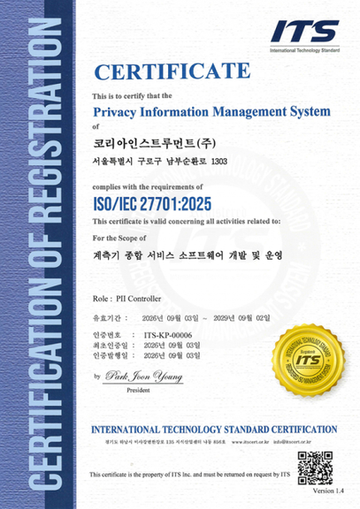
Korea Instrument, KOLAS Accredited Calibration Agency First to Simultaneously Acquire ISO/IEC 27,001·27,701
Korea Instrument has become the first among KOLAS accredited calibration agencies to simultaneously acquire ISO/IEC 27,001 and ISO/IEC 27,701 certifications. Through its proprietary platforms CWIZ Enterprise and CWIZ Partners, the company has embedded information security and personal data protection requirements across all business processes including customer information, equipment data, and calibration reports, with plans to continuously advance its management system through regular audits and security inspections.
2026.10.12by 배종인 기자

TeamViewer One, IT Incident Automation Workflow and Resolution Center Enhanced
TeamViewer has added IT incident automation capabilities and an advanced Resolution Center to its integrated digital workplace management platform 'TeamViewer ONE'. Recurrent service disruptions, configuration errors, and capacity shortages are automatically handled according to preset policies, and device status verification through script deployment can be managed in a unified interface, significantly reducing repetitive tasks for IT teams.
2026.10.12by 배종인 기자











