


Samsung Electronics Announces Q3 Earnings... Records All-Time High Quarterly Operating Profit
 Published2018.11.01 14:33
Semiconductor performance increases due to improved yield and productivity
Semiconductor market slowdown in Q4, earnings expected to decline
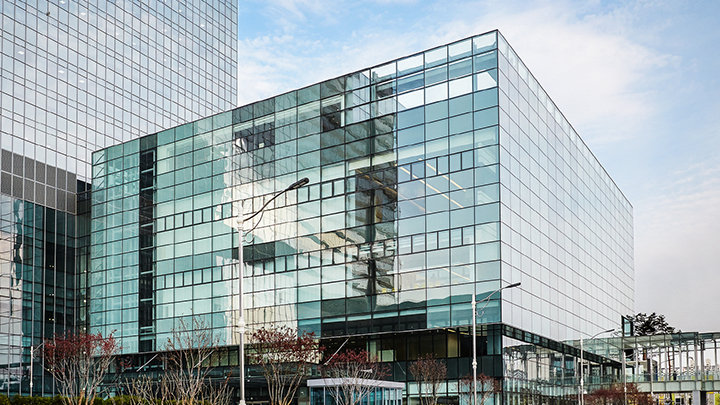
Samsung Electronics Headquarters
Samsung Electronics announced its third-quarter 2018 results on October 31, reporting consolidated revenue of 65.46 trillion won and an operating profit of 17.57 trillion won.
Sales increased by 5% and operating profit by 3 trillion won compared to the same period last year.
Operating profit is the highest ever for a quarter, and sales are the second highest following 65.98 trillion won in the fourth quarter of 2017.
Q3 Earnings Summary
In the third quarter, increased sales of memory and OLED panels led to strong performance.
The semiconductor business saw increased performance as yield and productivity improved alongside process miniaturization, amidst continued robust memory market conditions.
The display business also saw a significant improvement in performance compared to the previous quarter due to the increased utilization rate of flexible OLEDs.
Despite increased sales of the Galaxy Note 9, the IM division saw its profits decline due to factors such as increased promotional costs, while smartphone sales remained at the same level as the previous quarter amidst intensifying competition in the mid-to-low price range.
The CE division features premium TVs such as QLED and extra-large models. Performance improved due to increased sales.
Meanwhile, although the set business experienced some negative exchange rate impacts as the won strengthened against major growth market currencies, the company-wide positive exchange rate impact of approximately 800 billion won compared to the previous quarter occurred, centered on the components business, as the won weakened against the dollar.
Q3 Facility Investment
This year's facility investment is approximately 31.8 trillion won, with semiconductors accounting for 24.9 trillion won and displays for 3.7 trillion won by business sector.
In the semiconductor sector, facility investment for memory increased slightly compared to the previous year due to the expansion of production lines in Pyeongtaek, but investment in foundry is expected to decrease this year compared to the previous year as the expansion related to the 10nm process was completed last year.
In the display sector as well, facility investment decreased this year as last year saw a concentration of investment in expanding flexible OLED panel production capacity.
Meanwhile, capital investment in the third quarter amounted to 5.6 trillion won, with semiconductors accounting for 4.5 trillion won and displays for 0.5 trillion won by business segment. Cumulatively, 22.3 trillion won was executed through the third quarter.
Q4 forecast
The company's overall performance in the fourth quarter is expected to decline compared to the previous quarter due to the slowdown in the semiconductor market.
While the semiconductor business is expected to see a slowdown in performance as it enters the off-season, the display business is anticipated to maintain solid results due to sustained demand from key OLED customers.
While the wireless business is expected to see increased smartphone sales driven by the strengthening of its mid-to-low-end product lineup, such as the Galaxy A series, profitability is projected to decline due to rising marketing costs during the peak season.
The network business is expected to lead the 5G era by pursuing the supply of 5G equipment to Korea and the United States.
The CE division is expected to see earnings growth driven by increased sales of QLED TVs and premium home appliances during the year-end peak season.
For next year, while weak performance is expected in the first quarter due to the IT off-season, a positive earnings trend is anticipated thereafter along with an improvement in market conditions centered on memory.
Samsung Electronics plans to build a business foundation for sustainable growth by enhancing component technology capabilities, such as chipsets and OLEDs, to respond to new growth areas like 5G, AI, and automotive electronics, and by strengthening business competitiveness through form factor innovation and leading 5G technology.
Comments
Related news
Samsung Electronics Announces Q2 2018 Earnings with Semiconductor Success
Samsung Electronics announced its second quarter 2018 results on a consolidated basis with revenue of 58.48 trillion won and operating profit of 14.87 trillion won. Compared to the same period last year, revenue decreased by 4% while operating profit increased by 0.8 trillion won. Quarter-over-quarter, revenue declined by 3% and operating profit decreased by 0.8 trillion won.
2018.07.31by 이수민 기자
Samsung Electronics Installs LED Screen Three Times Larger Than Basketball Court at NBA Arena
Samsung Electronics has installed a massive screen at State Farm Arena, the home venue of NBA team Atlanta Hawks, utilizing smart LED signage. Samsung Electronics installed a total of 21 LED signage units at State Farm Arena, with a combined area of approximately 1,120㎡, which is three times the size of a basketball court. Samsung Electronics' LED signage at State Farm Arena made its debut at the first home game against the Dallas Mavericks on the 25th.
2018.10.29by 이수민 기자
SK Telecom's operating profit fell 22.5% year-on-year
SK Telecom reported on the 30th that for the third quarter of 2018, on a consolidated financial basis, it recorded revenue of 4.1864 trillion won, operating profit of 304.1 billion won, and net profit of 1.0498 trillion won. Revenue and operating profit each decreased by 5.8% and 22.5% respectively compared to the same period of the previous year. Mobile communication business revenue declined due to the impact of increased selective commitment subscribers and a rise in discount rates (increased from 20% to 25%), as well as fee reductions for vulnerable groups. Net profit for the period exceeded 1 trillion won on a quarterly basis for the first time in company history. This reflects the equity method profit impact from SK Hynix's record-breaking performance and increased by 32.4% compared to 2017.
2018.10.30by 이수민 기자
Nvidia invests $5 billion in Intel
NVIDIA and Intel, leaders in global AI computing technology, are now forging ahead in providing cutting-edge solutions through NVLink-based architecture integration. NVIDIA and Intel have officially announced a strategic partnership and stated that they will jointly develop customized data center and personal computing products to accelerate diverse applications and workloads ranging from hyperscale to enterprise and consumer markets, thereby laying the foundation for the next generation computing era.
2025.09.22by 배종인 기자
.jpg)
Applied Materials Launches Environmental Protection Campaign to Mark World Cleanup Day
Applied Materials Korea (CEO Park Kwang-seon) is carrying out environmental cleanup activities with employees and their families around the Dongtan Sinricheon area on the occasion of World Cleanup Day, evolving into a company that engages with the local community beyond technological innovation.
2025.09.22by 명세환 기자











