


SK Telecom and Samsung Electronics Successfully Localize Core Equipment for 5G Standalone Standards
 Published2018.11.10 09:03
Providing specialized services for each institution through functional modularization
Designed to make upgrading to the next level 5G technology easy
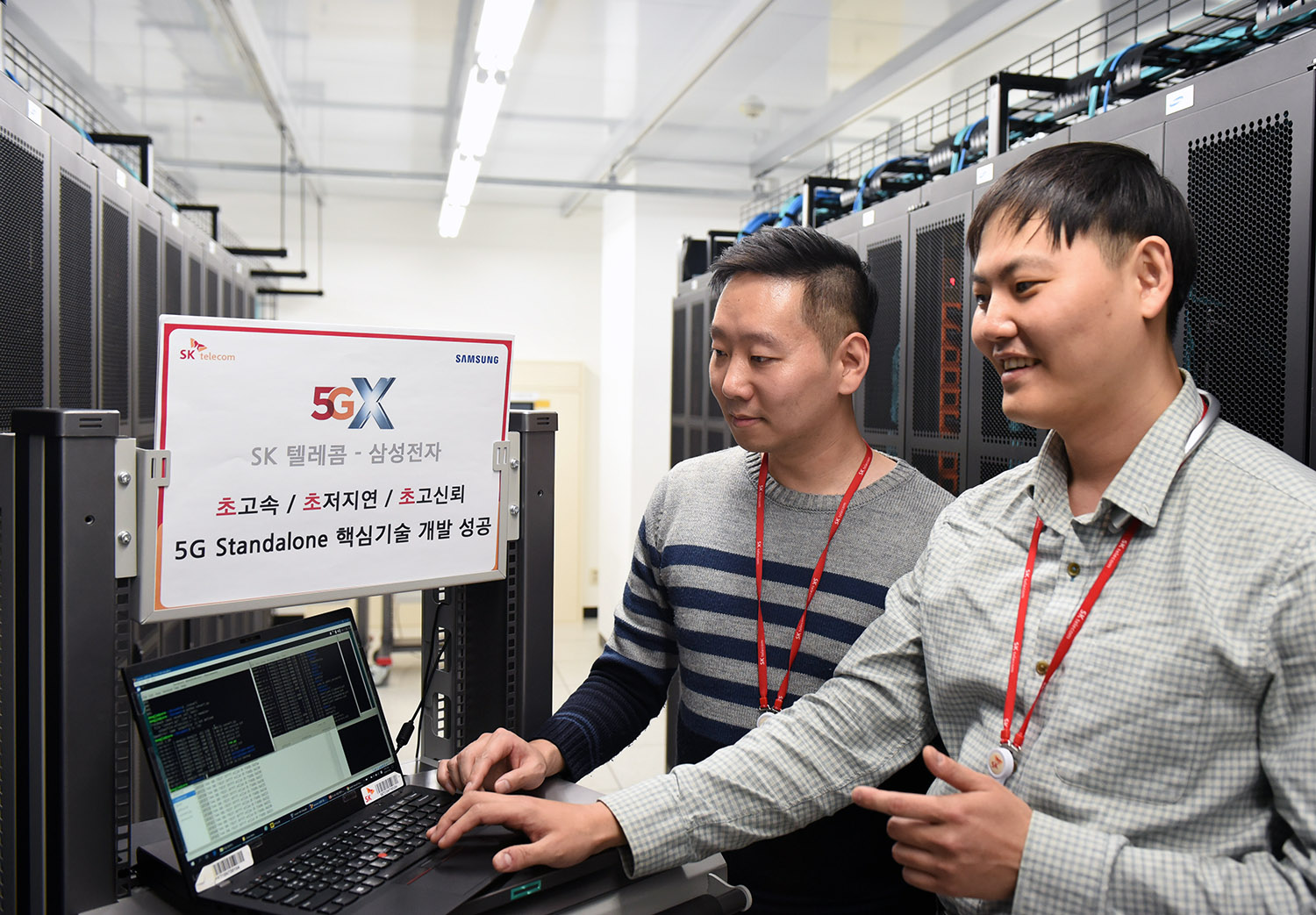
SK Telecom researchers are testing the performance of a 5G SA switch at the Samsung Electronics 5G Research Center.
On the 8th, SK Telecom succeeded in developing core technologies and prototype equipment for a 5G SA-based switch together with Samsung Electronics.
International 5G standards are divided into 5G NSA (Non-standalone; 5G-LTE hybrid), which shares some equipment with LTE, and 5G SA (Standalone; 5G standalone standard), which consists of the entire network entirely of 5G equipment.
Although the SA standard is more difficult to develop technically than the NSA standard, it can provide improved service quality. There is a difference of about one year in the speed of technological development between the two standards.
The '5G SA switch' developed by SK Telecom and Samsung Electronics plays the role of processing data transmission between wireless base stations and the internet network.
For the first time, 5G SA switches are equipped with 'data parallel processing technology' that performs sequential steps such as packet classification, quality checks, billing, and transmission all at once, 'data acceleration technology' that groups similar data and compresses it for transmission, and 'functional modularization' technology that attaches and detaches auxiliary equipment like stacking blocks.
When 5G SA switches and related technologies are applied in the field, approximately double the data processing speed and response speed compared to early 5G can be expected. It is possible to minimize latency during ultra-high-definition video streaming or communication between things, and efficiently control large-scale traffic.
In addition, by applying functional modularization technology, 'quantum security' technology can be added to data channels connecting defense, financial institutions, and research institutes, or 'data high-pass' functions can be added to critical facilities such as autonomous driving control centers and earthquake observation stations where there must be no interruption even for a moment.
SK Telecom is building 5G ahead of schedule while preparing to smoothly upgrade to the next stage, such as 5G SA, in consideration of future performance improvements. To this end, a separate 5G NSA switch capable of freely switching to 5G SA is being developed and deployed in the field.
SK Telecom plans to continue research on improving the performance of 5G SA switches and developing additional functions, and deploy this equipment in the field in time for phased 5G upgrades.
Park Jin-hyo, Head of SK Telecom’s ICT Technology Institute, said, “We were able to achieve results early by quickly starting technology development after the 5G SA standard was announced in June,” adding, “As 5G will be utilized as a core national infrastructure for a long time, we will prepare for commercialization with a mid-to-long-term perspective.”
Jeon Kyung-hoon, Vice President of Samsung Electronics, said, “Securing 5G SA core technology is an important cornerstone for the evolution of 5G networks,” adding, “A more flexible 5G network will become a platform that enables numerous communication services desired by customers.”
Meanwhile, on the 8th (local time), SK Telecom announced its achievements in 5G SA equipment development and introduced its preparations for 5G commercialization to officials from global mobile carriers and manufacturers at the 'IC&E 2018' event hosted by the international standardization organization NGMN (Next Generation Mobile Networks) in Vancouver, Canada.
Comments
Related news
SK Telecom Enters the Endgame of 5G Commercialization
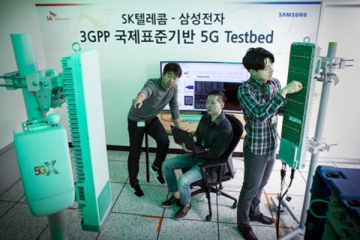
SK Telecom successfully completed the "first call" with Samsung Electronics using 5G commercial equipment in SK Telecom's Bundang headquarters 5G testbed. First call refers to the final verification procedure that confirms data is transmitted and received normally in an environment identical to commercial service. This success was achieved by conducting all processes with 5G commercial equipment at a level deployable on-site. Additionally, SK Telecom received domestic-first approval for a frequency convergence standard that enables simultaneous data transmission over both 5G and LTE frequencies at the 3GPP conference held in Chengdu, China from the 8th to the 12th.
2018.10.15by 이수민 기자
SK Telecom's operating profit fell 22.5% year-on-year
SK Telecom reported on the 30th that for the third quarter of 2018, on a consolidated financial basis, it recorded revenue of 4.1864 trillion won, operating profit of 304.1 billion won, and net profit of 1.0498 trillion won. Revenue and operating profit each decreased by 5.8% and 22.5% respectively compared to the same period of the previous year. Mobile communication business revenue declined due to the impact of increased selective commitment subscribers and a rise in discount rates (increased from 20% to 25%), as well as fee reductions for vulnerable groups. Net profit for the period exceeded 1 trillion won on a quarterly basis for the first time in company history. This reflects the equity method profit impact from SK Hynix's record-breaking performance and increased by 32.4% compared to 2017.
2018.10.30by 이수민 기자

KT to Build Smart Infrastructure in Egypt's Suez Canal Economic Zone
KT has signed an MOU with Egypt's Suez Canal Authority to establish ICT-based smart infrastructure in the Suez Canal. According to the MOU, KT will advance wired and wireless communication infrastructure in Egypt's Suez Canal, promote smart energy businesses, and establish a foundation for supplying security and control solutions. Additionally, KT held an opening ceremony for Giga Wire in Cairo, Egypt. KT jointly developed the Giga Wire solution with partner Ubiquitous and proceeded with overseas exports together. Ubiquitous was responsible for equipment production, technical support, and after-sales service in the Giga Wire Egypt export project.
2018.11.02by 이수민 기자
European Patent Applications Surpass 200,000 for the First Time… South Korea Maintains 5th Place, Led by Batteries and Telecommunications
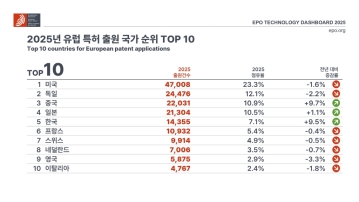
According to the European Patent Office (EPO)'s 'Technology Dashboard 2025', European patent applications last year reached 201,974, surpassing 200,000 for the first time. Korean companies and inventors filed 14,355 applications, representing a 9.5% increase from the previous year and maintaining 5th place by country. Battery, digital communication, and semiconductor technologies led the growth, with Samsung ranking as the top EPO applicant for the second consecutive year and LG reaching 3rd place. The presence of major domestic cities such as Seoul, Suwon, and Yongin was also confirmed. It was also revealed that Korea's European patent strategy is expanding beyond individual technologies to span the entire industry.
2026.03.24by 명세환 기자

SK Telecom First Applies AI-Based Network Operations at Gwanghwamun K-Pop Concert
SK Telecom announced that it applied an AI-based network operation system for the first time at a large-scale K-pop concert held in the Gwanghwamun area of Seoul on March 21st, managing communication quality throughout the event. Mobile data usage during the three hours before and after the concert reached 12.15TB, approximately doubling compared to the same time slot the previous weekend. SK Telecom monitored traffic using the AI system 'A-One' in five-minute and 50-meter units to respond to potential overload situations, while also operating temporary communication facilities and on-site personnel in parallel. This case is interpreted as confirmation of the practical applicability of AI-based autonomous network operation in an environment where demand from dense events and foreign users increases simultaneously.
2026.03.23by 명세환 기자











