


LG Uplus Builds 5G Packet Switch 10 Times Faster than LTE
 Published2018.11.15 09:07
Stable use of services such as UHD video, AR, and VR
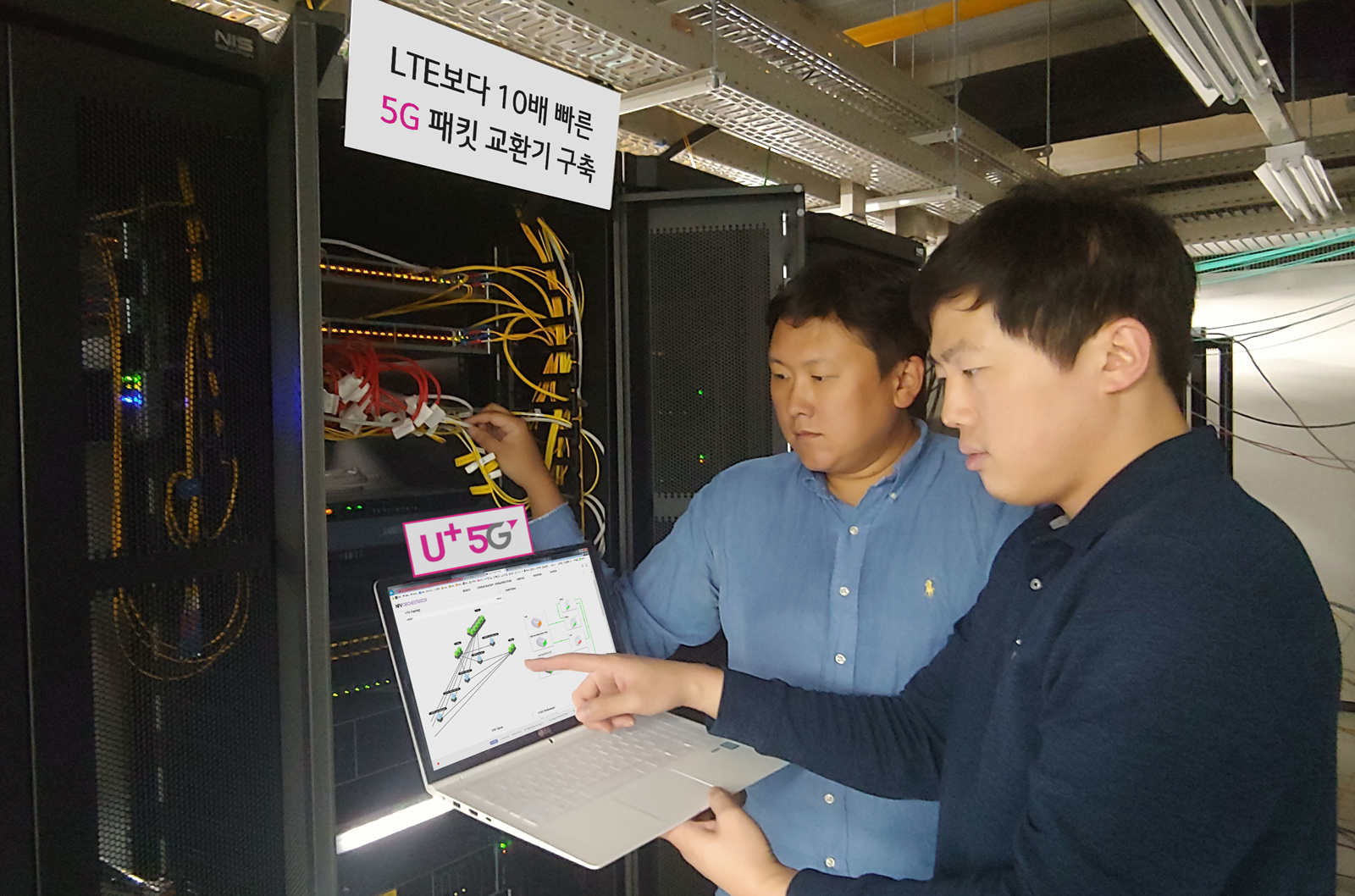
LG Uplus employees are testing the performance of a 5G packet switch.
LG Uplus announced on the 15th that it has completed the development and construction of a 5G packet exchange essential for processing high-speed, large-capacity 5G traffic.
A 5G packet switch is a device that transmits voice and data traffic sent from 5G terminals to the Internet network, and plays a key role in providing 5G services.
LG U+ completed development and has been conducting testing with Samsung Electronics since August. Recently, the company implemented 5G packet switching equipment along with 5G backhaul equipment into its network, with plans to begin providing services once base stations are built and 5G rolls out.
The newly built packet switching system boasts a transmission capacity and processing speed more than tenfold compared to existing LTE switching systems. This allows for more stable and ultra-fast access to high-capacity services, such as UHD video, AR, and VR, which are expected to increase significantly in the 5G era.
Additionally, since it is developed based on virtualization, it can automatically adjust traffic processing capacity even when data traffic suddenly surges. Even if software and hardware failures occur, they are detected and automatically recovered, enabling stable service provision without interruption.
LG Uplus NW Development Manager Lee Sang-heon said, “This 5G packet exchanger was developed in accordance with the NSA (Non-standalone) standard, which is the 5G international standard that uses 5G and LTE base stations together,” and “We also plan to upgrade to the SA (Standalone) standard, which uses 5G base stations independently, in line with the evolution of 5G networks in the future.”
Comments
Related news
LG Uplus Accelerates Preparations for 5G Service
LG Uplus will begin 5G signal transmission starting in December, focusing on Seoul, the metropolitan area, and select major cities, with plans to launch smartphone-based services from March next year onward. LG Uplus stated that it will provide stable 5G services through optimal cell design, and is commencing full-scale work for 5G service delivery, including the establishment of 5G ecosystem building strategies.
2018.11.05by 이수민 기자
.jpg)
LG Uplus Introduces Quality Measurement and Analysis System for Comfortable 5G Service
LG Uplus has adopted an integrated 5G network quality measurement and analysis system for optimal network quality management. The system was developed by InnoWireless, a domestic manufacturer specializing in mobile communication test and measurement equipment. It measures large volumes of traffic quality occurring in 5G networks on a minute-by-minute basis and provides analysis results in real time. Additionally, it supports integrated quality analysis functions even in complex network environments where 5G coexists with LTE networks in the early stage, and can be utilized to maintain and improve existing 4G network performance.
2018.11.09by 이수민 기자
KT, 5G SA-based CUPS technology applied from NSA stage
KT has completed the deployment of 5G NSA core equipment with CUPS technology applied in collaboration with Samsung Electronics and Cisco on commercial networks. CUPS technology is a standard technology defined in the 3GPP international standard that enables independent construction and expansion of devices responsible for signal processing and devices responsible for user traffic processing. This is significant in that CUPS technology, which will be essential for future SA-based 5G commercial networks, has been applied from the NSA stage.
2018.11.15by 이수민 기자
European Patent Applications Surpass 200,000 for the First Time… South Korea Maintains 5th Place, Led by Batteries and Telecommunications
According to the European Patent Office (EPO)'s 'Technology Dashboard 2025', European patent applications last year reached 201,974, surpassing 200,000 for the first time. Korean companies and inventors filed 14,355 applications, representing a 9.5% increase from the previous year and maintaining 5th place by country. Battery, digital communication, and semiconductor technologies led the growth, with Samsung ranking as the top EPO applicant for the second consecutive year and LG reaching 3rd place. The presence of major domestic cities such as Seoul, Suwon, and Yongin was also confirmed. It was also revealed that Korea's European patent strategy is expanding beyond individual technologies to span the entire industry.
2026.03.24by 명세환 기자

SK Telecom First Applies AI-Based Network Operations at Gwanghwamun K-Pop Concert
SK Telecom announced that it applied an AI-based network operation system for the first time at a large-scale K-pop concert held in the Gwanghwamun area of Seoul on March 21st, managing communication quality throughout the event. Mobile data usage during the three hours before and after the concert reached 12.15TB, approximately doubling compared to the same time slot the previous weekend. SK Telecom monitored traffic using the AI system 'A-One' in five-minute and 50-meter units to respond to potential overload situations, while also operating temporary communication facilities and on-site personnel in parallel. This case is interpreted as confirmation of the practical applicability of AI-based autonomous network operation in an environment where demand from dense events and foreign users increases simultaneously.
2026.03.23by 명세환 기자











