



The reason why 48V power replaces 12V power
 Published2018.11.19 16:44
I2R Loss, "Adverse Impact on System Efficiency": Power Flow Obstruction
48V, a safe voltage that ensures both efficiency and stability.
Recently, the requirements for designing application products have become more stringent than before. This is because market expectations for application products have increased.

Data centers are considered typical NIMBY facilities due to their poor power efficiency.
With the advent of the Fourth Industrial Revolution, where data is a resource, and the commercialization of 5G communication, today's application products must fundamentally process massive amounts of data rapidly. They must also take into account ultra-high-speed communication and long-term execution. Not to mention higher torque and brighter lighting.
To provide 'more' of these diverse functions, a 'more' power supply is required. Generally, providing more power to a single product is very limited due to size and weight. Therefore, there is a growing trend of companies switching their existing power distribution from 12V to 48V.
48V replacing 12V with various advantages
Heat generated by I2R losses can adversely affect system efficiency and simultaneously interfere with power flow in cables, connectors, PCBs, etc.
Recently, the processor power of servers has increased to 100W, 200W, and even over 300W. When this increased power is distributed to multiple server processors, more I2R loss occurs than before. In this case, I2R loss can be reduced by distributing a higher voltage.
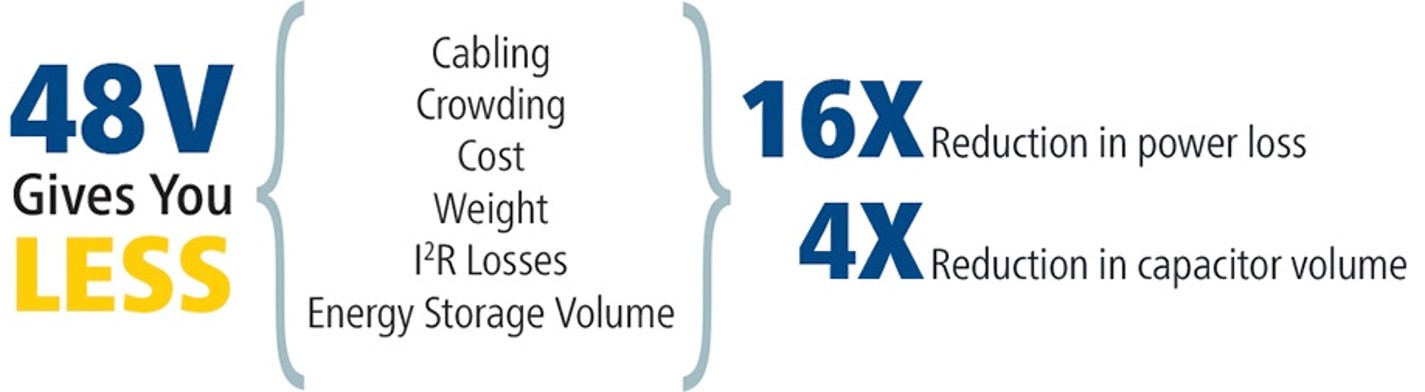
Advantages of 48V
Power loss is proportional to the square of the current and the resistance of the medium. Therefore, 48V distribution is superior in terms of energy efficiency because it has 1/16th less power loss than 12V distribution and can reduce the capacitor volume by 1/4.
Why 48V instead of the higher 60V or 72V?
If 48V has less I²R loss than 12V, wouldn't distributing a voltage higher than 48V further reduce the loss?
That is not the case. Distributing power above 60V is harmful to the human body. Therefore, safety measures must be taken, which reduces efficiency. Considering both efficiency and safety, 48V is the optimal voltage to replace 12V.
"DC power has an input/output conversion range, and the input/output conversion range of 48V reaches up to 60V," explained Vicor Korea Branch Representative Jeong Gi-cheon. "Since various international safety standards define voltages up to 60V as not significantly harmful to the human body, the industry considers 48V to be one of the most efficient and safe voltages."

48V does not cause significant harm to the human body of users and workers.
In other words, 48V is the most efficient voltage when considering safety.
Using a voltage lower than 60V is intended to consider SELV (Safety Extra Low Voltage) while referring to the operational requirements for 12V usage. Therefore, the 48V distribution system minimizes I2R losses without SELV issues.
The telecommunications industry that standardized 48V DC power early on
The beginning of today's telecommunications industry dates back to the commercialization of the wired telephone. Modern telephones and telephone exchanges were the first instances to use 48V. The first wired telephone commercialized by Alexander Graham Bell was 12V, and after considering various requirements, 48V was adopted.
Why does the telecommunications industry use 48V, unlike other industries that use 12V? Stability is the top priority for telecommunications services. No service user wants their communication to be interrupted midway. If communication is frequently cut off, it not only disrupts communication but can also cause massive economic losses.
48V offers high stability. When considering the ratio of operating voltage, 48V has low voltage loss over distance and requires less gauge wire, and battery backup is simple.
The adoption rate of 48V is increasing even outside the telecommunications industry. This is because many engineers are giving positive evaluations due to the lack of requirements for lightning strikes or surges and the input/output conversion range of 30V to 60V.
48V is being adopted in fields such as data centers, automotive, LED lighting, and power tools.
48V is now the new 12V.
<Continued from " Companies Replacing 12V Power with 48V Power ">
Comments 5
5 Comments:
Related news
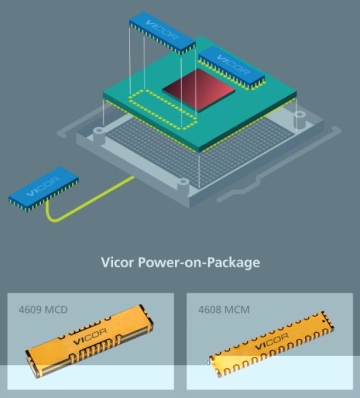
Bycor's 'Power-on-Package' system provides up to 1000A peak current.
Vicor has launched a 'Power-on-Package' (PoP) ChiP set that includes Modular Current Multipliers (MCM) required for XPUs such as high-performance GPUs, CPUs, and ASICs. The 'Power-on-Package' current multiplier modules increase current and distribute voltage close to the XPU from a 48V source, enabling advanced-level XPU performance delivery.
2018.03.06by 김지혜 기자
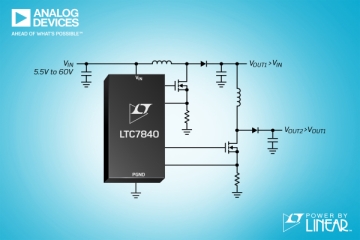
ADI Launches 2-Phase Asynchronous Boost Controller
Analog Devices has launched the LTC7840, a new 2-phase asynchronous boost controller. The LTC7840 boosts a 12V input voltage to 48V on the first channel, and then boosts this 48V to a 240V output voltage with a maximum output current of 700mA on the second channel, making it suitable for automotive, industrial, and medical applications.
2018.10.03by 이수민 기자
Companies replacing 12V power with 48V power
Heat generated from I2R losses adversely affects system efficiency and can impede power flow through cables, connectors, and PCBs. By distributing at higher voltages, I2R losses can be reduced. This is why data centers, which use small nation-level power and place great emphasis on power efficiency, are actively adopting 48V power distribution. The automotive industry is also increasing adoption of 48V systems. Automobiles are now mobile electronic devices. 12V alone is not suitable for operating the various electrical systems within a vehicle. Automotive engineers are using 48V systems to improve power efficiency and reduce the load on internal combustion engines.
2018.11.28by 이수민 기자

Intel Unveils Next-Generation 'Core Ultra Series 3' and vPro Platform for Enterprise PCs
Intel has officially unveiled the "Intel Core Ultra Series 3" for next-generation enterprise PCs and the latest vPro platform, addressing a wide range of demands from enterprise notebooks to high-performance workstations.
2026.03.26by 배종인 기자

ROHM Launches ESD Protection Diode Compatible with High-Speed Interfaces of 10Gbps or Higher
Semiconductor specialist ROHM has developed the 'RESDxVx series' of ESD (electrostatic discharge) protection diodes capable of responding to next-generation high-speed data communication environments exceeding 10Gbps, simultaneously enhancing both signal quality maintenance required in high-speed interfaces and IC protection performance.
2026.03.26by 배종인 기자












12V가 48V로 바뀌면 기존 시스템과 호환은 안 되겠네요?
I2R이군요.. 잘 못 봤네요..ㅠㅠ,,,
I2R이군요.. 잘 못 봤네요..ㅠㅠ,,,
12V와 12R 이라고 표현했는데 '12R'에서 'R'은 무엇을 뜻하나요?
12V와 12R 이라고 표현했는데