


TI Launches Ultra-Small DACs and ADCs Required for the 5G Era
 Published2018.12.07 15:01
Two types of 24-bit ADCs, 2-wire interface adopted
The three major domestic mobile carriers launched the world's first commercial 5G service on the 1st. The 5G service, which is first applied to industrial sites, is scheduled to be made available to consumers next March as 5G devices are officially released into the market.
5G services, which will drive the explosive growth of IoT and IIoT, are already ready to bring winds of change to various fields. Accordingly, market expectations for sensors are also changing.
The use of sensors is increasing at every stage of various fields, including production, operations, and management, and customers want sensors to be smaller, more accurate, and have more functions.

Texas Instruments
Accordingly, Texas Instruments announced on the 7th that it is launching four ultra-small precision data converter IC products. Developers can use these new products to increase functional density and reduce system board space.
The DAC80508 and DAC70508 are 8-channel precision digital-to-analog converters that provide 16-bit and 14-bit resolution, respectively. In addition, the ADS122C04 and ADS122U04 are 24-bit precision analog-to-digital converters that provide a 2-wire I2C compatible interface and a 2-wire UART compatible interface, respectively.
These four new products, added to the precision ADC and DAC portfolio, are suitable for ultra-small, low-power, high-performance applications, including industrial, telecommunications, and personal electronics. These include optical modules, field transmitters, battery-powered systems, building automation, and wearable devices.
The DAC80508 and DAC70508 are small but achieved outstanding performance.
Both DACs integrate an internal 2.5V 5ppm/℃ reference, eliminating the need for an external precision reference. They are available in 2.4mm x 2.4mm DSBGA and WCSP packages, as well as a 3mm x 3mm QFN-16 package, making them up to 36% smaller than competing products. This allows for reduced board size or increased channel density while maintaining high system accuracy.
The two DACs, featuring 1 LSB (least significant bit) INL (integral nonlinearity), offer high accuracy with 16-bit and 14-bit resolutions, providing up to 66% better linearity compared to competing products. They are also highly durable, operating over a temperature range of -40°C to 125°C and providing a CRC (cyclic redundancy interface) function to enhance system reliability.
The same applies to ADS122C04 and ADS122U04.
Two 24-bit ADCs are available in 3mm x 3mm WQFN-16 and 5mm x 4.4mm TSSOP-16 packages. Both products adopt a 2-wire interface, requiring fewer digital isolation channels than the standard 4-wire SPI (serial peripheral interface), which can reduce the overall cost of the isolation system.
Both products can reduce external circuitry by integrating a flexible input multiplexer, a low-noise programmable gain amplifier, two programmable excitation current sources, an oscillator, and a precision temperature sensor. Both also internally incorporate a low-drift 2.048V 5ppm/℃ reference.
In addition, by integrating an internal 2% accuracy oscillator to improve power line cycle noise rejection, high accuracy is achieved even in noisy environments. With a gain of 1 to 128 and low noise of 100 nV, a single ADC can be used to measure both small-signal sensors and a wide input range.
These products, which provide pin-to-pin compatible 16-bit products, offer the flexibility to meet the system requirements desired by developers through performance scaling up or down.
TI provides DAC80508, ADS122C04, and ADS122U04 evaluation modules.
Comments
Related news
.jpg)
Designing Smaller Display Applications with DLP Pico
Texas Instruments' new DLP Pico 0.23-inch chipset enables the design of HD high-resolution displays for portable devices while reducing size and power consumption. With the DLP Pico 0.23-inch chipset, developers can create various next-generation portable displays such as smart home displays, pico projectors, smart speaker displays, and AR and VR wearable device displays. The DLP Pico 0.23-inch product family includes the currently smallest HD display chipset, making it possible to design ultra-low-power pico projectors that fit in a shirt pocket. Brightness efficiency supports 20-inch to 40-inch displays (up to 200 lumens), and the form factor is less than 78mm x 78mm x 15mm (at 100 lumens).
2018.11.25by 이수민 기자
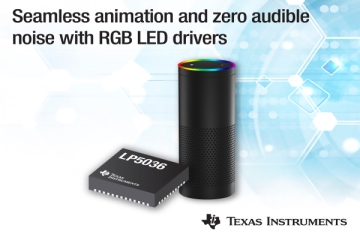
TI Launches Family of RGB LED Drivers with Integrated 12-Bit PWM Generators
Texas Instruments has launched a new LED driver product family that integrates independent color mixing, brightness control, and power-saving modes. The LP5018, LP5024, LP5030, and LP5036 deliver smooth color reproduction and reduce system power consumption. The new product family offers a 29kHz dimming frequency above the audible range, helping to eliminate noise commonly encountered during lighting dimming in applications using HMI such as portable electronics, building automation, and consumer appliances. Additionally, developers can utilize the integrated 12-bit PWM generator in the device to implement smoother color and brightness level adjustment compared to standard PWM solutions.
2018.11.30by 이수민 기자
.jpg)
ST Launches Ultra-small MEMS Pressure Sensor That Doesn't Need Calibration
ST Microelectronics has launched the LPS22HH, an accurate and reliable MEMS piezoelectric absolute barometric pressure sensor that eliminates the need for OPC operations after soldering, thereby enhancing customer productivity and efficiency. The product features noise characteristics equivalent to 5cm, which strengthens control functions such as collision avoidance in unmanned vehicles like drones. Its high accuracy enhances features such as indoor navigation in smartphones and sports watches.
2018.12.03by 이수민 기자
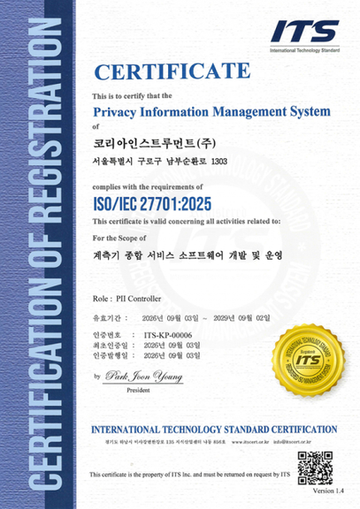
Korea Instrument, KOLAS Accredited Calibration Agency First to Simultaneously Acquire ISO/IEC 27,001·27,701
Korea Instrument has become the first among KOLAS accredited calibration agencies to simultaneously acquire ISO/IEC 27,001 and ISO/IEC 27,701 certifications. Through its proprietary platforms CWIZ Enterprise and CWIZ Partners, the company has embedded information security and personal data protection requirements across all business processes including customer information, equipment data, and calibration reports, with plans to continuously advance its management system through regular audits and security inspections.
2026.10.12by 배종인 기자

TeamViewer One, IT Incident Automation Workflow and Resolution Center Enhanced
TeamViewer has added IT incident automation capabilities and an advanced Resolution Center to its integrated digital workplace management platform 'TeamViewer ONE'. Recurrent service disruptions, configuration errors, and capacity shortages are automatically handled according to preset policies, and device status verification through script deployment can be managed in a unified interface, significantly reducing repetitive tasks for IT teams.
2026.10.12by 배종인 기자











