


Maxim Launches 6 Ultra-Small SIMO PMICs for IoT Devices
 Published2018.12.12 09:05
For high-performance, compact applications
Ultra-compact SIMO power management architecture
Maxim Integrated Korea launched six ultra-small, low-power power management integrated circuits (PMICs) that extend battery life on the 11th.
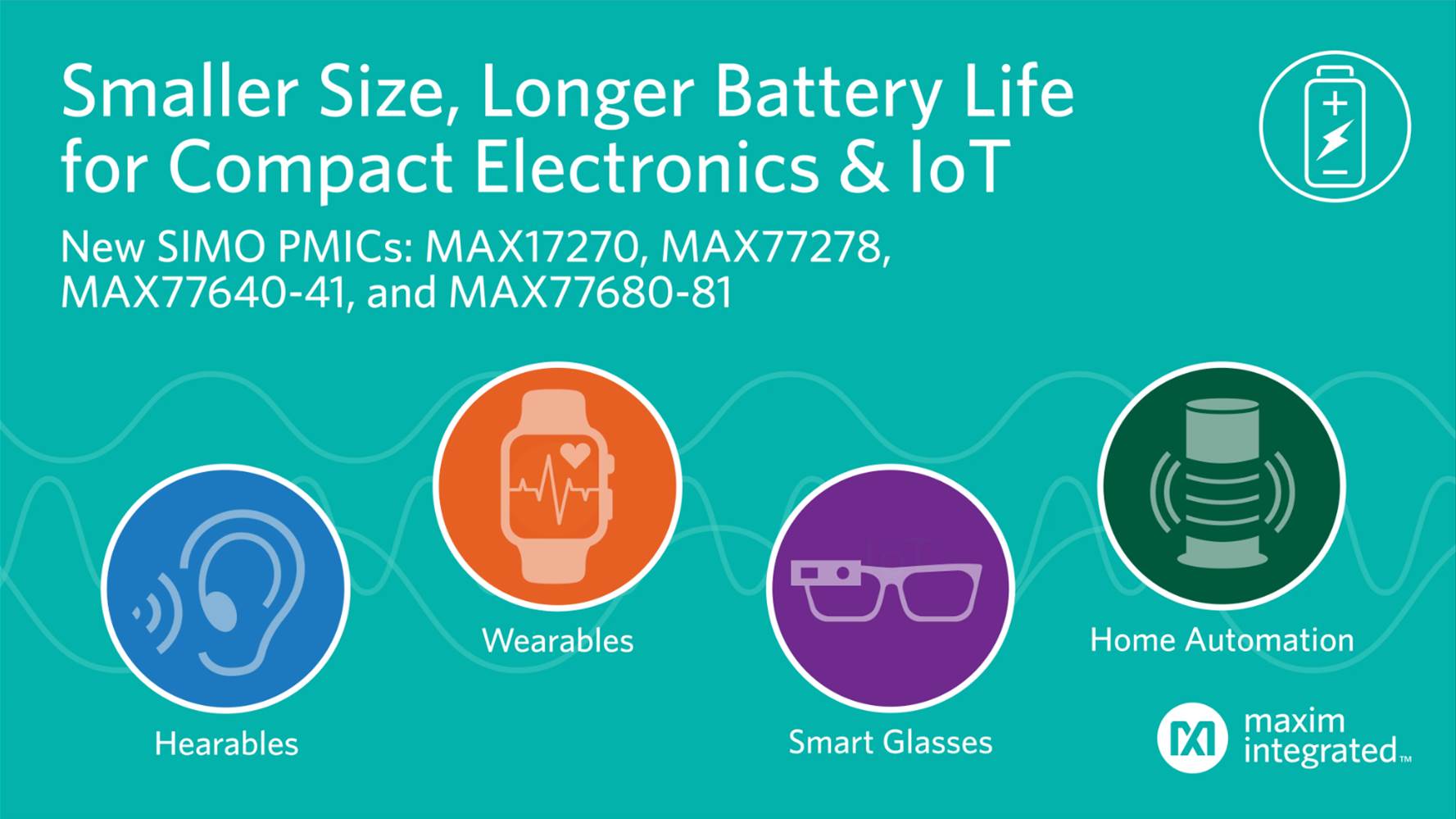
Maxim SIMO PMIC
The MAX17270, MAX77278, MAX77640, MAX77641, MAX77680, and MAX77681 PMICs reduce the power management footprint by up to 50% for size-sensitive products such as wearables, hearables, sensors, smart home automation hubs, and IoT devices. Maxim's new PMICs improve overall system efficiency by 9% compared to competitors and reduce heat dissipation, a critical consideration for wearable products that come into contact with the skin.
To provide consumers with more complete electronic products, designers strive to reduce form factor and heat dissipation, while increasing efficiency and battery life. It is very difficult to provide batteries with many features, low temperature thresholds, and smaller dimensions within a small solution. Maxim supports the continued maintenance of the small size and efficiency provided by the MAX77650 and MAX77651 by expanding its single inductor multi-output (SIMO) PMIC portfolio.
The unique control architecture of the newly released Maxim PMIC enables a single inductor to serve as the essential energy storage device for multiple independent outputs. This allows designers to increase efficiency and reduce form factor and heat dissipation by reducing the number of bulky inductors in the design. The low standby current of the Maxim PMIC plays a crucial role in extending battery life. The power rail operates across the entire battery range using this solution's unique buck-boost mode.
The MAX17270 delivers the lowest quiescent current in the smallest size. 50% smaller than previous generation solutions, the MAX17270 buck-boost converter provides the smallest solution by reducing the number of inductors and ICs required in the power tree. Quiet current consumption is low, at 850nA for a single SIMO channel and 1.3μA for three SIMO channels. This extends the battery life of user devices. Due to low power consumption, it prevents overheating and extends the charging cycles of wearables and hearables. The MAX17270 is available in TQFN and WLP package options.
The MAX77278 is a power path charger for small lithium-ion batteries. As an ultra-low power SIMO PMIC, the MAX77278 provides three buck-boost regulators with independent voltage outputs (0.8 V OUT to 5.25 V OUT), 300 nA shutdown current/16 µA operating standby current, and Flexible Power Sequencing (FPS). This device also serves as a charger for small lithium-ion cells (7.5 mA to 300 mA CC range). It provides a 425mA current sink for adjustable LEDs, 8 General Purpose Input/Output (GPIO) pins, a 3.7125V–5.3V, 50mA low-noise Dropout Regulator (LDO), and fixed headroom control in a solution size of only 24mm². The I2C interface enables application processors to monitor and control power management status. The MAX77278 is suitable for remote control, health monitoring, body cameras, and IoT applications.
The MAX77640 and MAX77641 are highly integrated battery charging and power solutions. These two ultra-low-power SIMO PMICs provide three buck-boost regulators, a low-noise 150mA LDO, GPIO output ports, a current sink for an RGB LED array, and FPS. The operating standby current is 5.6μA, the shutdown current is 300nA, and the solution size is 16mm². The MAX77640/MAX77641 is ideal for applications with built-in chargers in fields such as wearables, health monitoring, and IoT.
The MAX77680 and MAX77681 are small PMICs for always-on low-power applications. The MAX77680 and MAX77681 provide three buck-boost regulators, a 3.0μA operating standby current, a 300nA shutdown current, and FPS, while being only 15.5mm² in size. It is ideal for minimal platforms that require seamless operation in a small size, such as hearables (Bluetooth headsets and earbuds) and small IoT devices (rings, watches, e-pen).
Kevin Anderson, Senior Analyst at IHS Markit’s Power IC Research Division, stated, “As small connected mobile devices become more sophisticated, they require more power rails,” adding, “Any designer looking to reduce the device’s design footprint to offer more attractive products to users will be interested in technologies that enable the simultaneous addition of features, reduction of form factor, and power management.”
Karthi Gopalan, Managing Director of Maxim Integrated’s Mobile Power Business Unit, stated, “Because wearable devices come into contact with the skin, designers must preserve battery life and regulate heat dissipation while adding processors, high-quality audio, near-field communication (NFC), wireless connectivity, and multiple sensors. With the new SIMO PMIC, Maxim will continue its tradition of one-stop power management solutions for a wide range of next-generation low-power designs.”
Comments
Related news
Maxim Go-IO IIoT Platform Sets the Standard for Smart Factories
Maxim Integrated has launched the 'Go-IO Industrial IoT Platform' to support digital factories. Go-IO provides intelligence to Industry 4.0 digital factory machinery and meets the size and power requirements demanded by in-factory PLCs. Additionally, it monitors and communicates equipment status and contextual information to increase throughput and productivity.
2018.11.07by 이수민 기자
Maxim Launches Three Analog ICs, Building Blocks That Boost Electronic System Efficiency
Maxim Integrated has introduced three building block analog ICs. The MAX41464 is a sub-1GHz FSK transmitter with 16dBm output power for various long-range wireless sensor applications such as building automation and security systems. The MAX38888 reversible buck/boost regulator delivers 95% peak efficiency. The MAX16141 is a 36V ORing FET controller with integrated power and voltage circuit breakers that monitor overvoltage, undervoltage, overcurrent, reverse current, and overtemperature conditions.
2018.11.14by 이수민 기자
Infineon and IDEX Create Biometric Cards
Infineon Technologies is entering into a joint collaboration with IDEX Biometrics to expand biometric card technology. The two companies aim to integrate IDEX's biometric technology into Infineon's security chip-enabled platform, and plan to develop a system-on-card demo running on Infineon's dual interface 16-bit security controller. Infineon's security chip supports contactless payment transactions in less than 300ms and offers advantages in implementing biometrics through power consumption characteristics optimized for battery-free contactless systems.
2018.12.10by 이수민 기자
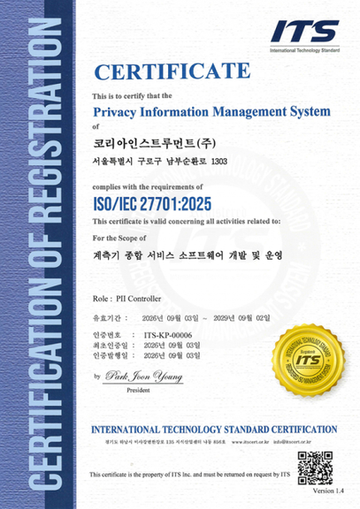
Korea Instrument, KOLAS Accredited Calibration Agency First to Simultaneously Acquire ISO/IEC 27,001·27,701
Korea Instrument has become the first among KOLAS accredited calibration agencies to simultaneously acquire ISO/IEC 27,001 and ISO/IEC 27,701 certifications. Through its proprietary platforms CWIZ Enterprise and CWIZ Partners, the company has embedded information security and personal data protection requirements across all business processes including customer information, equipment data, and calibration reports, with plans to continuously advance its management system through regular audits and security inspections.
2026.10.12by 배종인 기자

TeamViewer One, IT Incident Automation Workflow and Resolution Center Enhanced
TeamViewer has added IT incident automation capabilities and an advanced Resolution Center to its integrated digital workplace management platform 'TeamViewer ONE'. Recurrent service disruptions, configuration errors, and capacity shortages are automatically handled according to preset policies, and device status verification through script deployment can be managed in a unified interface, significantly reducing repetitive tasks for IT teams.
2026.10.12by 배종인 기자











