



Checking on a child asleep in the car with a Bluetooth cushion
 Published2018.12.26 09:04
You can check real-time seating status via smartphone
A method that gives a notification only when the Bluetooth connection is disconnected
Last July, amidst a continuing record-breaking heatwave, a 4-year-old child died of suffocation after being trapped in a daycare center's school bus in Dongducheon, Gyeonggi Province. Unfortunately, this type of safety accident occurs every year.
As part of accident prevention measures, the government has decided to make the installation of 'sleeping child check devices' mandatory starting next year.
The most representative confirmation device is the exit confirmation bell installed at the rear of the vehicle, but since vehicle modifications are required to install the bell, it is time-consuming and expensive.
Furthermore, when using NFC devices, teachers must manually touch each child's NFC tag to the terminal every time they board or alight, which is cumbersome and often causes delays that disrupt vehicle operations.
The method of installing ultrasonic sensors to detect seating status cannot distinguish between people and objects, and there is also controversy regarding the potential harmful effects of ultrasound on the human body.
The Korea Institute of Industrial Technology (KITECH) announced on the 20th that it has jointly developed a child confirmation cushion with partner companies J-Tech and Kids Soft, which allows users to easily check a child's boarding and alighting status using a smartphone.
.jpg)
The child verification cushion is being scanned on a smartphone using a QR code.
The developed cushion has a built-in pressure-sensing sensor that detects whether a child is sitting and automatically connects to a smartphone via Bluetooth. If a teacher installs a dedicated application on a smartphone, they can check seat status in real time, and an alarm sounds immediately if a child is left alone in the vehicle.
Unlike other devices, the child confirmation cushion is practical as it can be used immediately simply by placing it on the seat without any separate installation work. Furthermore, drivers or teachers do not need to look around the vehicle or move their bodies to check if a child has disembarked, and it prevents delays in boarding and alighting.
After purchasing the cushion, you only need to replace the battery every two years without incurring any additional costs.
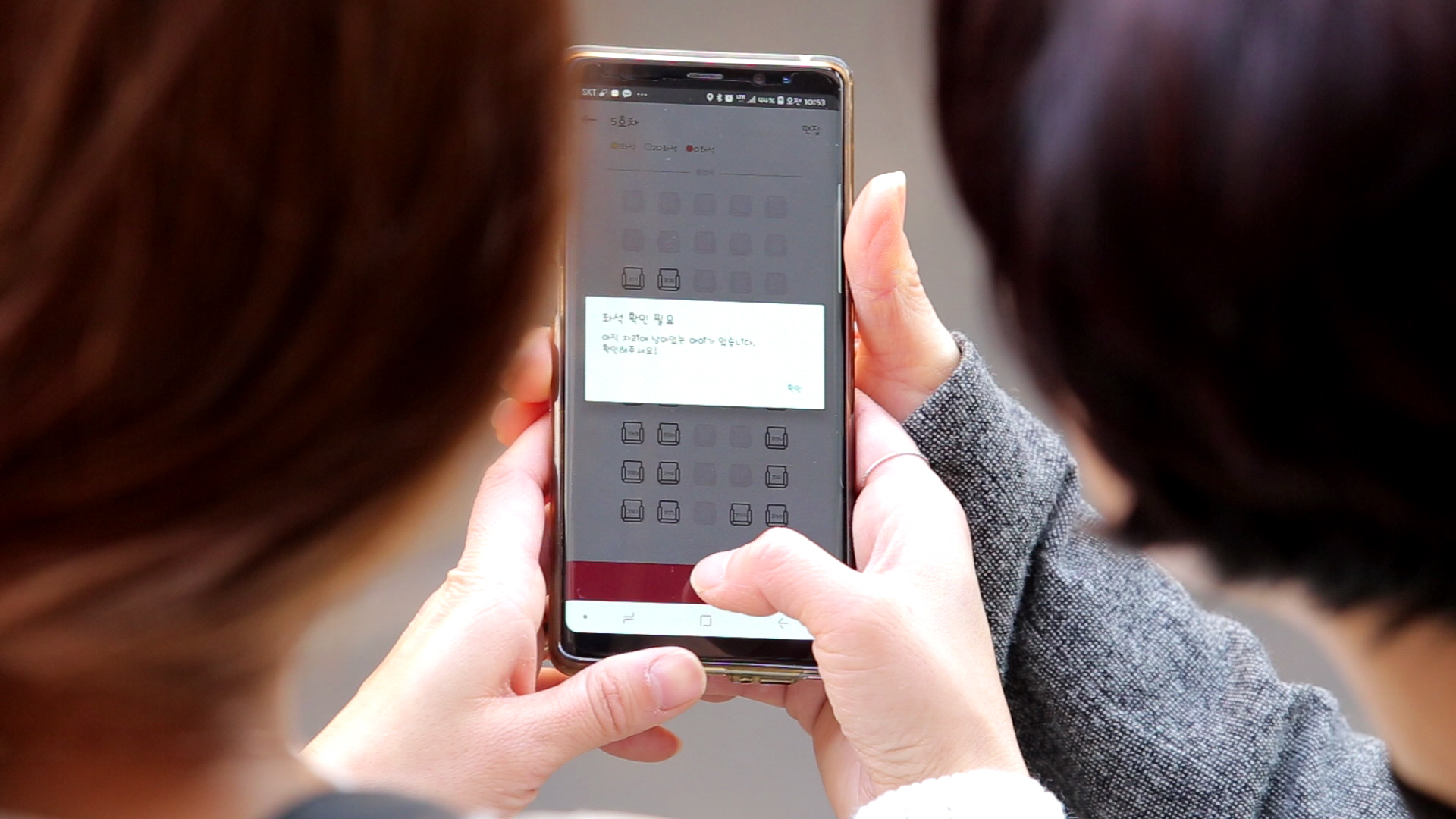
A warning notification is appearing on the smartphone linked to the child cushion check.
The core technology of the child detection cushion is a Bluetooth algorithm independently developed by Senior Researcher Cho Han-cheol of the Precision Machining Control Group at the KITECH Southeast Regional Headquarters. While existing commercial algorithms merely provide a notification that the communication connection is lost when the signal weakens due to distance, the developed algorithm provides an alert only when the connection is actually severed. The principle is that when the cushion sensor detects a child inside the vehicle, if the teacher moves a certain distance away from the vehicle, the Bluetooth connection with the smartphone is disconnected, triggering an alarm.
Meanwhile, the development and production of key components for the cushion were carried out through cooperation and division of roles among KIMM's partner companies.
J-Tech, a company specializing in sensor manufacturing, has developed a pressure-sensing sensor capable of quickly and accurately recognizing seat occupancy status by taking into account a child's weight and seating area. KidsSoft, a company specializing in children's smartwatches, was responsible for developing communication components that transmit sensor signals to smartphones and a dedicated application. J-Tech handles the assembly of the manufactured components and the sales of the final product.
"Senior Researcher Cho Han-cheol said, 'Since it is available for online purchase and easy for anyone to use, we expect it to be rapidly distributed to kindergartens nationwide,' adding, 'The related technology has wide scalability, so it can be integrated into infant car seats or school attendance management systems in the future.'"
The child verification cushion is scheduled to be released to the market early next year after undergoing prototype testing.
Comments
Related news
KITECH Develops Laser Vision Sensor Five Times Cheaper Than Foreign Products
A research team led by Moon Hyung-soon, head of the Precision Machining Control Group at the Korea Institute of Industrial Technology, has developed a laser vision sensor, a key component that serves as the eyes of welding automation equipment. The vision sensor is a non-contact sensor that searches for weld lines on materials or structures using a laser, automatically tracks their movement, and precisely determines the position of the welding torch in real-time. Since there are no domestically commercialized Korean vision sensors in the country, companies have either used contact-type sensors or introduced foreign vision sensors at a cost of up to approximately 100 million won. After more than a year of development, KITECH has developed a sensor module at a level ready for immediate commercialization. The price is approximately one-fifth that of foreign equivalents.
2018.09.19by 이수민 기자
Smart tape measure with Nordic Bluetooth LE SoC, also helps with health.
Nordic Semiconductor announced that Bagel Labs, a Korean company, has adopted Nordic's nRF52832 Bluetooth LE SoC for wireless connectivity in its smart measuring tape 'Pie'. The smart measuring tape Pie enables consumers to check overall health indicators beyond simple weight monitoring, and for business customers such as clothing manufacturers, it provides a fast and efficient method to measure and record body dimensions. Nordic's nRF52832 SoC is a multi-protocol SoC suitable for Bluetooth LE and 2.4GHz ultra-low-power wireless applications.
2018.11.21by 이수민 기자
KITECH Improves Energy Processes Using Computer Simulation
Saenggi-won is implementing a corporate energy process optimization support project targeting energy-intensive companies with support from Ulsan Metropolitan City. This project, which began in 2017, selects six small and medium-sized enterprises in the Ulsan region annually through open recruitment and runs for five years through 2021. Optimization know-how and installed facility assets are transferred to participating companies for each enterprise. Chemical company Neo represents a notable success case of this project, with sales increasing more than 2.5 times since participating in the project.
2018.12.18by 이수민 기자
Korea Instrument, KOLAS Accredited Calibration Agency First to Simultaneously Acquire ISO/IEC 27,001·27,701
Korea Instrument has become the first among KOLAS accredited calibration agencies to simultaneously acquire ISO/IEC 27,001 and ISO/IEC 27,701 certifications. Through its proprietary platforms CWIZ Enterprise and CWIZ Partners, the company has embedded information security and personal data protection requirements across all business processes including customer information, equipment data, and calibration reports, with plans to continuously advance its management system through regular audits and security inspections.
2026.10.12by 배종인 기자
TeamViewer One, IT Incident Automation Workflow and Resolution Center Enhanced
TeamViewer has added IT incident automation capabilities and an advanced Resolution Center to its integrated digital workplace management platform 'TeamViewer ONE'. Recurrent service disruptions, configuration errors, and capacity shortages are automatically handled according to preset policies, and device status verification through script deployment can be managed in a unified interface, significantly reducing repetitive tasks for IT teams.
2026.10.12by 배종인 기자











