



Samsung Electronics Starts Launch of Automotive Semiconductors
 Published2019.01.03 11:01
Scheduled to be applied to next-generation vehicle infotainment systems
Multi-DP support and enhanced stability improve design convenience
Samsung Electronics announced on the 3rd that it will supply the 'Exynos Auto V9' automotive semiconductor for the next-generation in-vehicle infotainment (IVI) system to Audi in 2021.
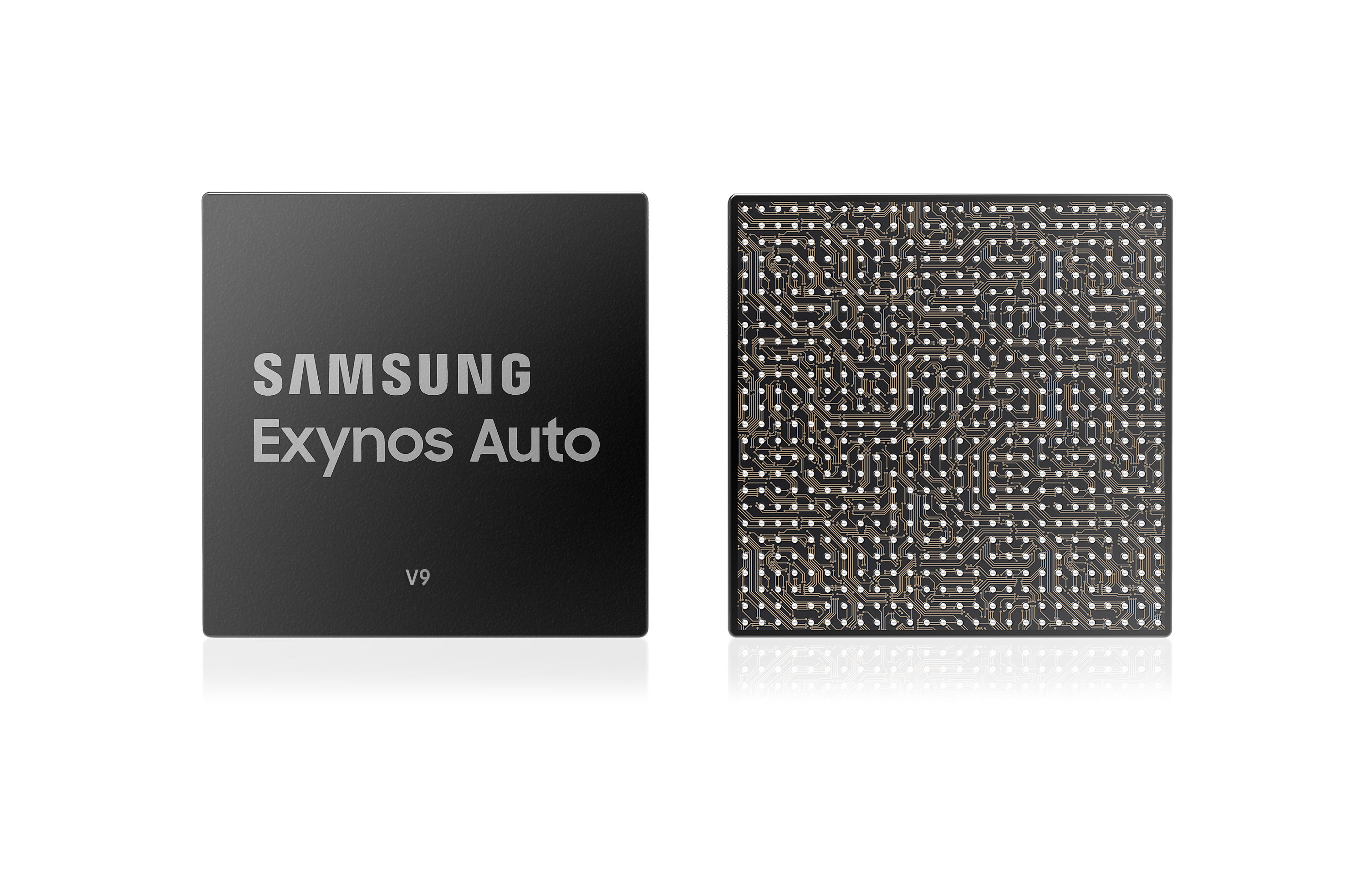
Samsung Electronics Exynos Auto V9
Exynos Auto V9 is a high-performance, low-power processor for premium infotainment systems, the first to be introduced by Samsung Electronics since it unveiled its automotive semiconductor brand, 'Exynos Auto,' in October 2018.
Vehicle infotainment systems are advanced devices that combine information elements, such as driving data and vehicle status, with entertainment elements, such as multimedia playback, to provide various types of information to the driver and passengers in real time.
Exynos Auto V9 is an octa-core processor operating at speeds up to 2.1GHz that controls six display devices simultaneously and supports up to 12 cameras.
In addition, three GPUs are used for the digital instrument cluster, CID (Center Information Display), and HUD (Head Up Display).It was designed so that applications such as y) could operate independently.
Exynos Auto V9 is also equipped with a Neural Processing Unit (NPU) for artificial intelligence computation, enabling it to quickly and accurately process various data such as driver voice, face, and gesture recognition to provide information tailored to the driving situation.
In particular, this product features a separate section that supports the Automotive Safety Integrity Level (ASIL), a safety standard for automotive systems, significantly enhancing safety by preventing potential system malfunctions during vehicle operation.
A-SEAL is classified into four levels (A, B, C, D) based on the likelihood of an accident, its severity, and the driver's control, and generally, premium integrated infotainment systems require a B level.
"Samsung Electronics is developing automotive semiconductors capable of providing a safe and comfortable driving environment," said Han Kyu-han, Senior Vice President of Samsung Electronics' DS Division. "We will introduce a diverse product lineup, starting with the Exynos Auto V9, which features both outstanding performance and the stringent stability standards required by the industry."
"Audi has continuously strived to realize its vision of the most exciting yet safest future cars," said Alfons Pfaller, Head of Design and Platform Development at Audi. "Samsung Electronics has been our important technology partner for many years, and we are pleased to equip our next-generation infotainment platform with Exynos Auto V9."
Meanwhile, Samsung Electronics' 'V Series' for in-vehicle infotainment systems (IVI), advanced driver assistance systemsWe plan to continuously release automotive processors with specialized functions that can satisfy the needs of various customers, such as the 'A Series' for ADAS and the 'T Series' for telematics systems.
Comments
Related news
Microchip Launches Single-Cable Automotive Infotainment Networking Solution
INICnet technology is a synchronous, scalable solution that significantly simplifies the construction of audio and infotainment systems, enabling seamless networking without interruption in vehicles with Ethernet-oriented system architecture. INICnet technology provides high-speed packet data communication by supporting file transfer, OTA software updates, and system diagnostics through standard Ethernet frames. It also supports efficient transmission of stream data as well as seamless integration of IP-based system management and data communication. Since it requires no development or licensing of additional protocols or software stacks, it can reduce development costs, effort, and time.
2018.11.21by 이수민 기자
8 Startups from Samsung Electronics C-Lab to Capture Visitor Attention at CES 2019
Samsung Electronics will showcase numerous outstanding AI-based C-Lab projects at CES 2019. C-Lab is an in-house venture incubation program introduced by Samsung Electronics in December 2012 to foster a creative organizational culture and discover creative ideas from employees.
2018.12.28by 이수민 기자
Samsung Electronics Unveils Remote Access Function for Remotely Connecting TVs and Peripherals
Samsung Electronics will showcase a remote access feature at CES 2019. The newly introduced remote access function enables wireless connection of PCs, smartphones, tablets, and other devices located at remote or close distances to a TV, allowing users to control programs and apps installed on each device from the TV's large screen.
2018.12.31by 이수민 기자

[e4ds Tech Day 2026 ⑨] Sim Sang-gyu, Autocrypt CTO: "In the Physical AI Era, Automotive Security Must Extend Beyond the Vehicle"
At e4ds Tech Day 2026, Sim Sang-gyu, CTO of Autocrypt, explained automotive cybersecurity strategies in the era of Physical AI and SDV (Software-Defined Vehicle). Automobiles are evolving as part of an ecosystem connected to AI, cloud, chargers, IoT, and robots, and he emphasized that the scope of security must expand beyond the vehicle interior to the entire connected environment. In particular, AI model tampering, adversarial attacks, OTA updates, and EV charger hacking were identified as major threats. He explained that response measures require zero trust, AI model integrity protection, intrusion detection, Security by Design and Default, and full lifecycle security management, and that proactive security system establishment beyond regulatory compliance is critical for securing future mobility competitiveness.
2026.10.12by 배종인 기자
Practical HIL Construction Strategy for Automotive and Off-Highway Controller Validation
As vehicle E/E architecture transitions to zonal structures and shifts to software-defined vehicles (SDV), the number of controllers (ECUs) requiring validation and software complexity are surging dramatically. Meanwhile, real vehicle testing cannot provide repeated verification under identical conditions and entails lead time and safety concerns. This white paper explains the principles of HIL (Hardware-in-the-Loop) validation and the structure of the NI platform composed of PXI, SLSC, and VeriStand, and through two actual implementation cases—Camera Record & Replay HIL for In-Cabin Monitoring Controller (ICMU) and Forklift Controller (VCU) HILS—describes how controller-level regression testing becomes possible. Additionally, it explicitly states application boundaries and limitations, such as lack of A2B support.
2026.10.12by 편집부











