



[CES 2019] NVIDIA Accelerates Development of AI-Based Automotive Solutions
 Published2019.01.09 17:51
Mercedes-Benz and NVIDIA Develop Next-Generation AI Cars
The main topic of CES 2019 is undoubtedly automobiles.
NVIDIA, which holds an unrivaled position in the fields of GPUs and AI, also declared to the world that it is ready to demonstrate its capabilities in the automotive sector.
Automotive parts manufacturers Continental and ZF announced a Level 2+ autonomous driving solution based on NVIDIA Drive. This is planned to enter production in 2020.
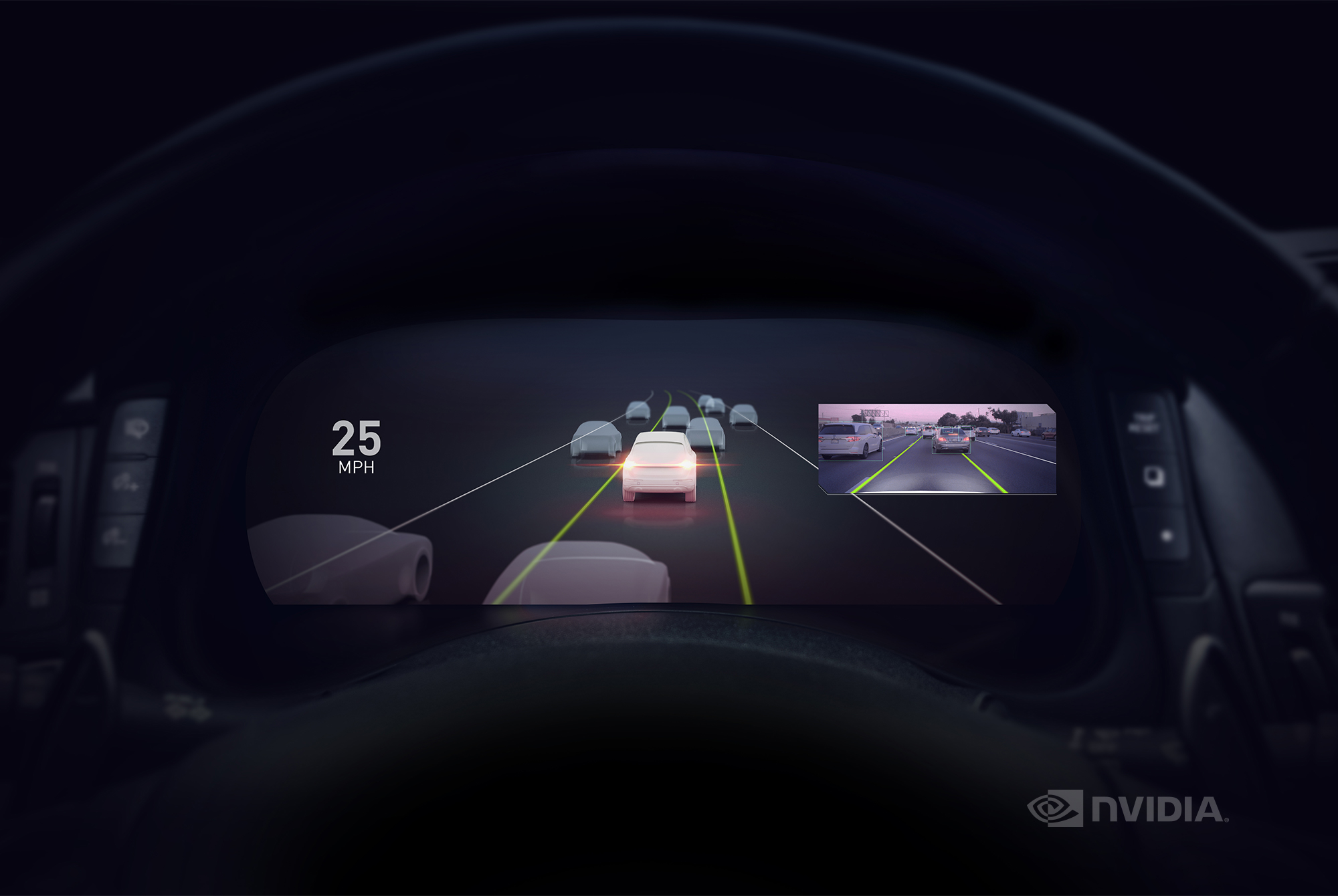
NVIDIA Drive Autopilot
NVIDIA Drive Autopilot is a Level 2+ autonomous driving solution that implements a cockpit providing world-class autonomous driving perception as well as various AI capabilities.
Automotive manufacturers can leverage NVIDIA Drive Autopilot to introduce to the market sophisticated autonomous driving capabilities that surpass existing ADAS products in terms of performance, functionality, and road safety, as well as intelligent cockpit assistance and visualization features.
Rob Csongor, Vice President of Autonomous Machines at NVIDIA, explained, “A full-fledged Level 2+ system requires much more powerful computing power and sophisticated software than systems currently on the market,” adding, “NVIDIA Drive Autopilot provides these capabilities to help automotive manufacturers rapidly deploy advanced autonomous driving solutions by 2020 and quickly achieve even higher levels of system autonomy.”
NVIDIA Drive Autopilot enables a high level of autonomous driving perception by integrating the NVIDIA Xavier SoC processor with the latest NVIDIA Drive software to process many deep neural networks (DNNs).
In addition, it perfectly processes surrounding camera sensor data from inside and outside the vehicle while providing full autonomous driving autopilot functions, including highway merging, lane changing, lane splitting, and personal mapping. The vehicle includes driver monitoring and AI-assisted copilot functions, as well as cockpit visualization capabilities for the vehicle's computer vision system.
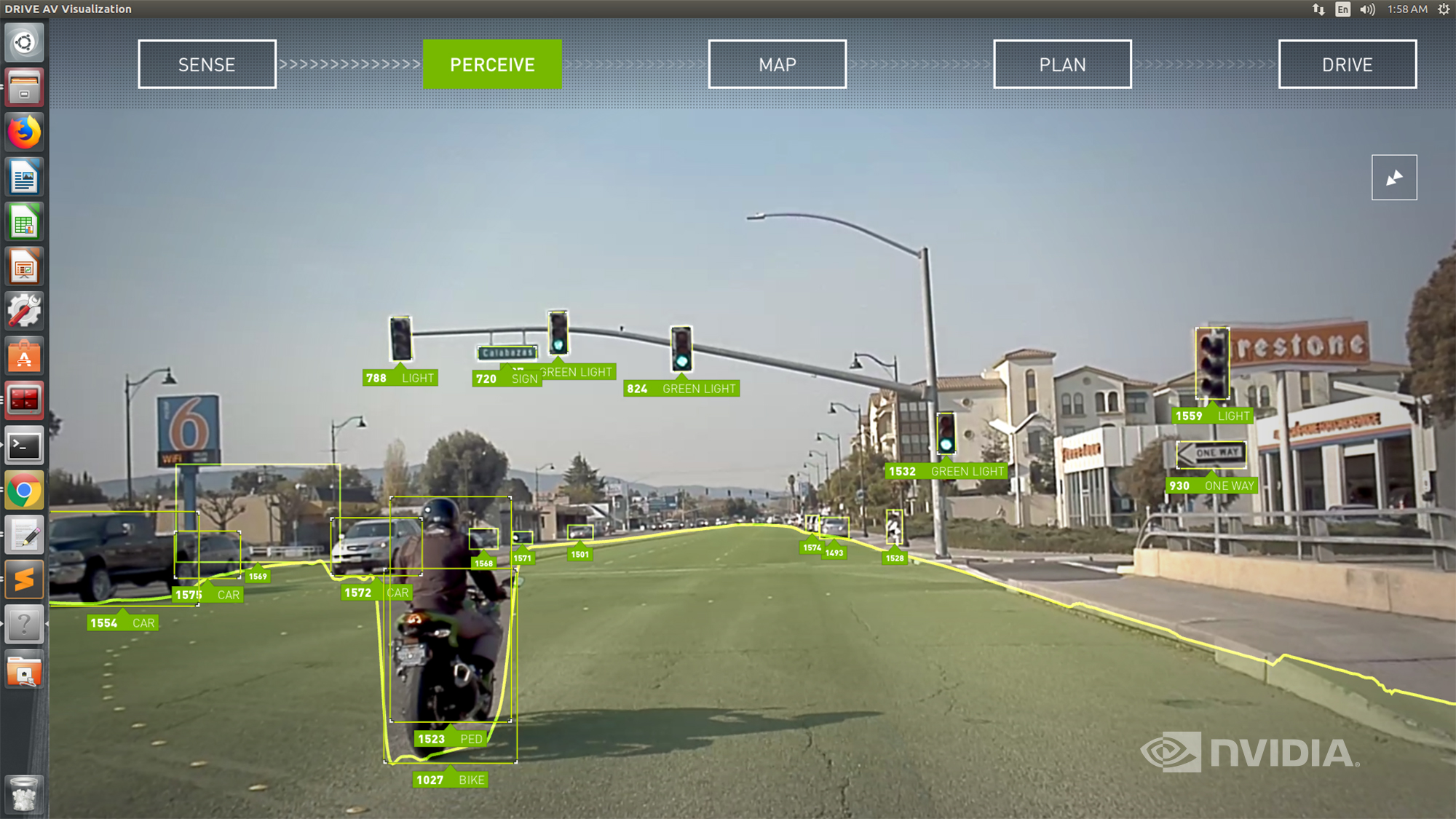
NVIDIA Drive software
NVIDIA Drive Autopilot is part of the open and flexible NVIDIA Drive platform.
The NVIDIA Drive platform is being used by hundreds of companies worldwide to build autonomous driving solutions that improve road safety while reducing driver fatigue and stress caused by long hours of driving or severe traffic congestion.
The new Level 2+ system complements the NVIDIA Drive AGX Pegasus system, which provides Level 5 capabilities for robot taxis.
NVIDIA Drive Autopilot demonstrated its capabilities in a recent study released by the Insurance Institute for Highway Safety.
NVIDIA Drive Autopilot addresses the limitations of existing Level 2 ADAS systems, where inconsistent vehicle detection and lane-keeping capabilities on winding or hilly roads can lead to situations where the driver must suddenly take control.
Dominique Bonte, Vice President of Automotive Research at ABI Research, stated, “Lane keeping and adaptive cruise control systems currently on the market are failing to meet consumer expectations,” adding, “NVIDIA’s “High-performance AI solutions will soon enable safer and more reliable autonomous driving systems,” he said.
Xavier SoC processing 30 teraops per second
At the heart of NVIDIA Drive Autopilot is the Xavier SoC, which delivers 30 trillion operations per second. With a focus on safety, Xavier is designed for redundancy and versatility, utilizing six types of processors and 9 billion transistors to process vast amounts of data in real time.
Xavier is a vehicle processor for autonomous driving that is currently in the production phase. Global safety experts evaluated Xavier's architecture and development process as suitable for designing safe products.
Artificial intelligence that handles internal and external vehicle issues, AI
The NVIDIA Drive Autopilot software stack integrates DRIVE AV software for handling issues outside the vehicle and DRIVE IX software for tasks inside the vehicle.
DRIVE AV uses surround sensors for complete 360-degree awareness and provides accurate positioning and path planning capabilities. These features enable supervised autonomous driving on the highway from the entry lane to the exit lane.
In addition to basic adaptive cruise control, lane keeping, and automatic emergency braking, the surrounding awareness function handles situations where lanes separate or merge, and safely performs lane changes.
In addition, Driven AV includes a diverse set of advanced DNN technologies, including DriveNet, SignNet, LaneNet, OpenRoadNet, and WaitNet, that enable the vehicle to recognize a wide range of objects and driving situations.
This AI software identifies the location of other vehicles, reads lane markings, detects pedestrians and cyclists, and distinguishes various types of lighting and their colors, as well as recognizing traffic signs and understanding complex scenes.
In addition, NVIDIA Drive Autopilot not only provides accurate localization of HD maps worldwide but also offers a new personal mapping feature called 'My Route' that remembers where the driver has driven to generate autonomous driving routes even without HD maps.
Using the DRIVE IX intelligent experience software inside the vehicle allows for occupant monitoring to detect distracted or drowsy drivers, provide warnings, or take corrective action if necessary.
It includes new features for AR and is used to implement intelligent user experiences, enhancing system reliability by visualizing the surrounding environment detected by the vehicle and displaying the planned route.
You can accelerate natural language processing, eye tracking, or gesture recognition to realize next-generation user experiences by leveraging the AI capabilities of DRIVE IX.
NVIDIA Drive Companies that have adopted the platform
Continental is developing a scalable and cost-effective autonomous driving architecture ranging from Premium Assist to automation functions. This utilizes a portfolio of autonomous driving control unit technologies powered by radar, lidar, cameras, and NVIDIA Drive.
Karl Haupt, General Manager of Continental’s Advanced Driver Assistance Systems business unit, stated, “Today’s driving experience will evolve to a new level through advanced driver assistance systems, enabling a seamless transition from assisted driving to automated driving and defining new standards,” adding, “Driving will become an active journey, allowing drivers to maintain their responsibilities while reducing driving challenges.”
ZF ProAI utilizes NVIDIA Drive Xavier processors and Drive software to provide a unique modular hardware concept and an open software architecture.
“Our goal is to provide the widest possible range of capabilities in the field of autonomous driving,” said Torsten Gollewski, ZF’s General Manager of Advanced Engineering. “The ZF ProAI product family provides an open platform for the custom integration of software algorithms that encompass existing capabilities and AI algorithms and software running on NVIDIA Drive.”

Sayad Khan, Vice President of Digital Automotive and Mobility at Mercedes-Benz, and Jensen Huang, Founder and CEO of NVIDIA
Meanwhile, NVIDIA is expanding its collaboration with Mercedes-Benz to develop next-generation AI cars. At CES 2019, Sajjad Khan, Vice President of Digital Automotive and Mobility at Mercedes-Benz, and Jensen Huang, Founder and CEO of NVIDIA, announced plans for next-generation AI vehicles and new mobility solutions that the two companies will implement.
NVIDIA CEO Jensen Huang explained, “The two companies have announced a new partnership to develop a computer that will define the future of autonomous vehicles, AI, and mobility,” and introduced a single system that provides autonomous driving and smart cockpit capabilities to replace the dozens of small processors currently installed in vehicles.
CEO Jensen Huang continued, “NVIDIA and Mercedes-Benz share the view that future automobiles must be ‘software-defined.’” He added, “We will start by developing software that meets current requirements, then anticipate software for future needs, and build the computing architecture to implement it.”
Comments
Related news
.jpg)
[KES 2018 Hidden Technology Search] Visionin “Embedded Vehicle License Plate Recognition Technology”
The 2018 Korea Electronics Show held at COEX in Samseong-dong, Seoul from October 24 to 27 saw numerous companies showcasing their technological capabilities. The technology of all participating companies was compelling enough to capture the attention of visitors. The same was true of VisionIn's embedded vehicle license plate recognition technology. VisionIn's embedded vehicle license plate recognition technology detects vehicles and recognizes license plates using CNN, and has embedded implementation cases with NVIDIA TK1, TX1, and other platforms.
2018.11.15by 이수민 기자
Arm, which launched the first multi-threaded processor to promote the spread of autonomous driving
According to the American Automobile Association, 73% of drivers are afraid of riding in fully autonomous vehicles, and 63% of adults report feeling uneasy being on the road alongside autonomous vehicles. For humans to accept ADAS and autonomous driving technologies, they must be confident that these technologies are safe. Automotive manufacturers must strike the right balance between innovation and safety to provide customers with a reliable autonomous driving experience. Additionally, they need to develop solutions that are implementable, scalable, and ready for mass production. In response, Arm has unveiled the Cortex-A65AE product.
2018.12.26by 이수민 기자
'Malware' Infiltrates Google Play Store on High Alert; Huawei Unveils Next-Generation Server Chipset
[US Weekly IT Issues] [1] Malware Crisis Penetrates Google Play Store [2] BlackBerry's 'Security Feature Pack' Draws Attention [3] Huawei Unveils Next-Generation Server Chipset [4] NVIDIA Releases Midrange Turing GPU [5] "Global Semiconductor Sales Growth of 13.4%…Samsung Electronics Maintains Lead"
2019.01.09by 류아연 외신
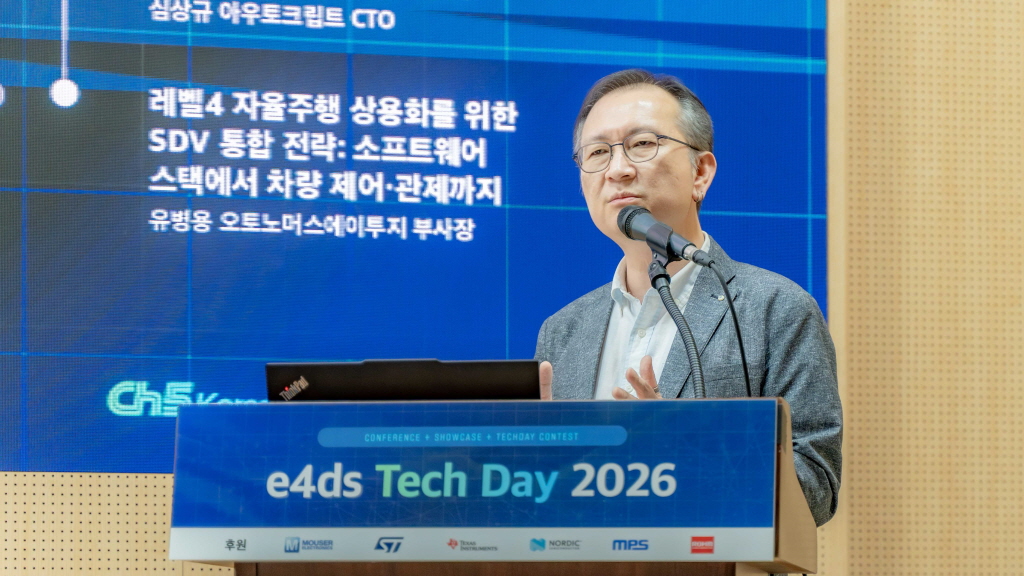
[e4ds Tech Day 2026 ⑨] Sim Sang-gyu, Autocrypt CTO: "In the Physical AI Era, Automotive Security Must Extend Beyond the Vehicle"
At e4ds Tech Day 2026, Sim Sang-gyu, CTO of Autocrypt, explained automotive cybersecurity strategies in the era of Physical AI and SDV (Software-Defined Vehicle). Automobiles are evolving as part of an ecosystem connected to AI, cloud, chargers, IoT, and robots, and he emphasized that the scope of security must expand beyond the vehicle interior to the entire connected environment. In particular, AI model tampering, adversarial attacks, OTA updates, and EV charger hacking were identified as major threats. He explained that response measures require zero trust, AI model integrity protection, intrusion detection, Security by Design and Default, and full lifecycle security management, and that proactive security system establishment beyond regulatory compliance is critical for securing future mobility competitiveness.
2026.10.12by 배종인 기자

Practical HIL Construction Strategy for Automotive and Off-Highway Controller Validation
As vehicle E/E architecture transitions to zonal structures and shifts to software-defined vehicles (SDV), the number of controllers (ECUs) requiring validation and software complexity are surging dramatically. Meanwhile, real vehicle testing cannot provide repeated verification under identical conditions and entails lead time and safety concerns. This white paper explains the principles of HIL (Hardware-in-the-Loop) validation and the structure of the NI platform composed of PXI, SLSC, and VeriStand, and through two actual implementation cases—Camera Record & Replay HIL for In-Cabin Monitoring Controller (ICMU) and Forklift Controller (VCU) HILS—describes how controller-level regression testing becomes possible. Additionally, it explicitly states application boundaries and limitations, such as lack of A2B support.
2026.10.12by 편집부











