



[CES 2019] CTA Unveils 16 Innovation Champion Countries: “Korea Is Not On the List”
 Published2019.01.14 09:02
Korea, Leader Rank below Innovation Champion
R&D Investment A+, Car Sharing F

CTA
The Consumer Technology Association (CTA) announced the 16 countries with the best innovation environments out of 61 countries in a keynote speech at 'CES 2019'.
According to the '2019 International Innovation Scorecard' released by the CTA, 16 countries, including Australia, Canada, Denmark, Estonia, Finland, Germany, Israel, Luxembourg, the Netherlands, New Zealand, Norway, Singapore, Sweden, Switzerland, the United Kingdom, and the United States, were named '2019 Innovation Champions'.
At the awards ceremony, which was held alongside the keynote speech, CTA President and CEO Gary Shapiro attended as Mona Keijzer, Minister of State for Economy and Climate Policy of the Netherlands, Liam Fox, Minister for International Trade of the United Kingdom, and Mailis Reps, Minister of Education and Research of Estonia, received the Innovation Champion Award on behalf of their respective countries.
CEO Shapiro said, “The 16 countries that became innovation champions are innovation worldwide. He assessed that “it is leading growth,” adding that “it places importance on ‘disruptive innovators’ in terms of technology and policy.” He further emphasized, “To become a leader in innovation, protectionist policies and barriers must be abolished,” stating, “Otherwise, the next generation of startups that will bring positive change to the world cannot be born.”
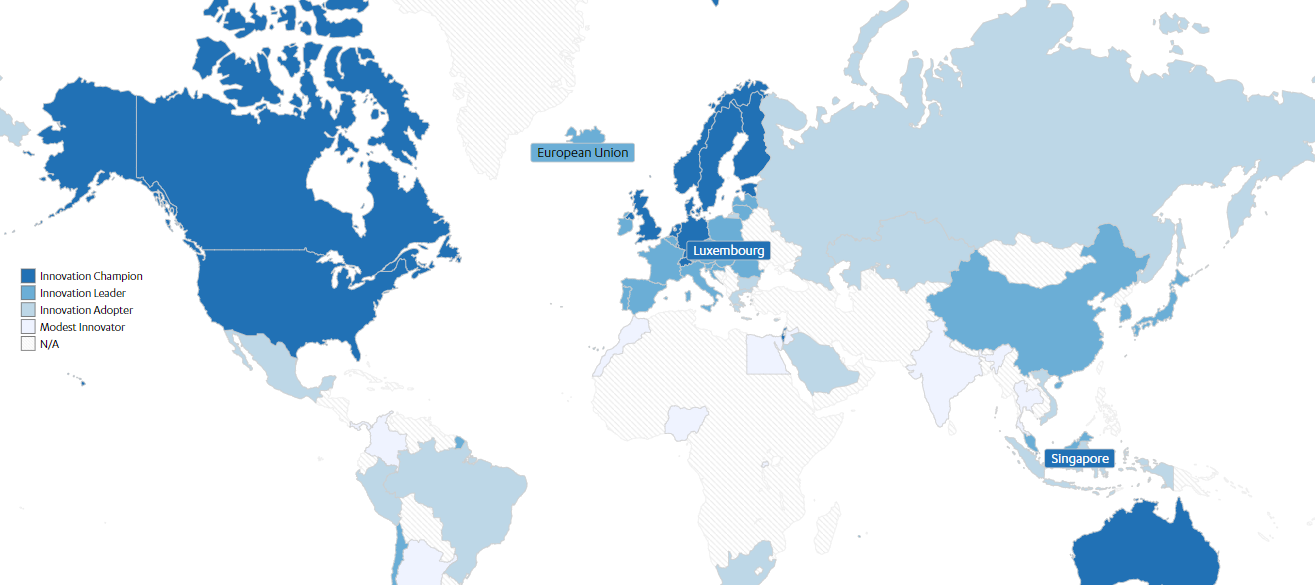
16 countries selected as Innovation Champions (dark blue)
Meanwhile, Germany and Israel drew attention by being named innovation champions for the first time.
Germany received the highest score, driven by the growth of new businesses and the expansion of telecommunications and online services. Israel was highly rated for having more than half of its workforce (51.5%) in highly skilled occupations and nearly half of its university students (46.8%) holding degrees in STEM fields. This level is comparable to that of Singapore.
Israel invests 4.3% of its Gross Domestic Product (GDP) in research and development (R&D), a figure higher than that of any other country on the scoreboard.
Overall, the 16 innovation champion countries outperformed other countries in terms of freedom, broadband, entrepreneurship, resilience, and autonomous vehicles. For reference, resilience is a newly added criterion to quantify the degree of sustainability of government and society.
Meanwhile, Austria, the Czech Republic, and Portugal, which were named innovation champions last year, dropped out of the list. Austria was hampered by tax rates reaching up to 55%, the Czech Republic by a 15% decrease in R&D investment compared to the previous year, and Portugal by government regulations on short-term rental websites that hinder innovation.
Other innovation trends of 2019 are as follows.
Small countries had high R&D investment ratios. Israel invested more than 4.3% of its GDP in R&D, followed by South Korea at 4.2%, Switzerland at 3.4%, Sweden at 3.3%, and Austria at 3.1%.
Countries or continents with an average download speed of 18 Mbps or higher received high ratings overall.
Eight of the top 10 most resilient countries were European nations. The criteria for evaluating resilience include supply chain visibility and digital and physical infrastructure capabilities.
Among the existing 38 countries, no nation saw its autonomous vehicle rating drop. Many countries are accelerating the development of autonomous vehicles. They are deploying autonomous public transportation vehicles or preparing to establish international test routes. The survey results revealed that more countries have adopted legislation allowing the testing of autonomous vehicles compared to last year.
The United States and China held the lead in the category of unicorns, which refer to startups with a valuation of over $1 billion. Over the past decade, the U.S. had the highest number of companies growing into unicorns with 133, followed by China and the United Kingdom with 120 and 12, respectively.
The 2019 International Innovation Scoreboard covers a total of 61 countries, including 23 countries added this year, as well as the European Union (EU). The evaluation consists of 14 categories, including average broadband speed, economic policy sharing, adoption of autonomous vehicles, drone regulations, and a country's disaster resilience and durability.
Our country recorded a total of 2.76 points and failed to become the Innovation Champion. Ranked as an Innovation Leader—following France, Belgium, Portugal, Spain, the Czech Republic, the European Union, and Lithuania—South Korea invested 4.2% of its GDP in R&D, earning an A+. This ranks second only to Israel. Conversely, the country received low scores in areas such as diversity, unicorns, and short-term rentals.
It received a failing grade of F in car sharing. This is the same as Luxembourg, Norway, Iceland, Slovenia, Hungary, Cyprus, Slovakia, and Greece.
Comments
Related news

The Ministry of Science and ICT will spend 486.7 billion won more on national informatization next year than this year.
The Ministry of Science and ICT announced the comprehensive analysis results of the 2019 National Informatization Implementation Plan established by national agencies and local governments. Next year's national informatization budget will be 5 trillion 783.8 billion won, a 9.2% increase compared to this year, with national agencies investing 4 trillion 678.4 billion won and local governments investing 1 trillion 105.4 billion won. Looking at the scale of information technology projects by type in national agencies, information system construction and operation projects accounted for the largest share, followed by informatization R&D and informatization support projects. From next year onward, in response to the Fourth Industrial Revolution, a full-scale transition to intelligent conversion of national informatization projects is expected to take place.
2018.12.12by 이수민 기자
"Heart of Korean Manufacturing Industry" Manufacturing Startups to See Significantly Reduced Burden from This Year
As the revised 'Small and Medium Enterprise Startup Support Act' deliberated at the State Council by the Ministry of SMEs and Startups takes effect from December 31st, the financial burden on manufacturing startups will be substantially reduced. The expansion of burden fee exemptions for manufacturing startups is part of a national agenda to create "an entrepreneurial nation that supports innovation." The revised law taking effect targets manufacturing startups within three years to expand burden fee exemptions, and also exempts some fees for manufacturing startups in their sixth to seventh year of operation.
2019.01.01by 이수민 기자
[Quantum Exploration] 12. Are Quantum Computers the Future of Computers?
Major government agencies and global IT companies around the world are pouring astronomical sums of money into quantum computer development. However, the fact that significant capital is flowing into a field does not always guarantee a bright future for that field. It could be bright or it could be dark. Gill Kalai, a mathematician at the Hebrew University of Jerusalem in Israel, is a representative skeptic of quantum computers. Errors occur in qubits at every processing step of a quantum computer, and additional qubits are needed to correct these errors. For this process to be maintained properly, noise levels must be kept low, but Kalai believes that achieving the required noise level is fundamentally impossible. Nevertheless, quantum computer researchers continue to conduct research on quantum computers. The fact that many challenges remain in the commercialization of quantum computers suggests that opportunities still exist for Korea as well. However, it cannot be denied that there are areas in which Korea lags behind the United States, China, and Japan. To catch up with the gap that has already formed, selective focus and concentration of efforts are necessary.
2019.01.08by 이수민 기자
Nvidia invests $5 billion in Intel
NVIDIA and Intel, leaders in global AI computing technology, are now forging ahead in providing cutting-edge solutions through NVLink-based architecture integration. NVIDIA and Intel have officially announced a strategic partnership and stated that they will jointly develop customized data center and personal computing products to accelerate diverse applications and workloads ranging from hyperscale to enterprise and consumer markets, thereby laying the foundation for the next generation computing era.
2025.09.22by 배종인 기자
.jpg)
Applied Materials Launches Environmental Protection Campaign to Mark World Cleanup Day
Applied Materials Korea (CEO Park Kwang-seon) is carrying out environmental cleanup activities with employees and their families around the Dongtan Sinricheon area on the occasion of World Cleanup Day, evolving into a company that engages with the local community beyond technological innovation.
2025.09.22by 명세환 기자











