


Global PC shipments in the fourth quarter of 2018 reached 68.6 million units, due to CPU shortages and economic uncertainty.
 Published2019.01.17 09:01
Insufficient CPU supply and economic uncertainty are factors.
Business PCs Grow with Windows 10 Upgrades

Gartner
On the 11th, Gartner announced the preliminary results of its survey on global personal computer (PC) shipments in the fourth quarter of 2018.
Global PC shipments in the fourth quarter of 2018 totaled 68.6 million units, a 4.3% decrease year-over-year. Total PC shipments in 2018 exceeded 259.4 million units, a 1.3% decrease compared to 2017.
Gartner analysts said there were optimistic signs in 2018, but two key trends were impacting the industry.
“The CPU shortage created supply problems just as PC market demand was starting to show positive results,” said Mikako Kitagawa, senior research analyst at Gartner. “After growing in the second and third quarters of 2018, PC shipments declined in the fourth quarter.”
“The impact of the CPU shortage has impacted companies’ ability to meet demand driven by business PC upgrades,” he continued. “If the CPU supply problem improves, this demand will expand into 2019.”
“In some countries, PC demand has slowed due to political and economic uncertainty,” Kitagawa said. “Even in the U.S., which has maintained an overall strong economy, there has been uncertainty among vulnerable buyer segments such as small and medium-sized businesses.”
In particular, he emphasized that “consumer demand was weak during the last holiday season, and now year-end specials are no longer the main factor driving consumer PC demand.”
.png)
The top three vendors, Lenovo, HP, and Dell, increased their share of the global PC market in the fourth quarter of 2018, with PC shipments increasing to 63% from 59% in the same period last year.
Lenovo in 2018 Lenovo overtook HP to take the top spot in the global PC market in the fourth quarter. A key factor in Lenovo's market share gains was the establishment of a joint venture with Fujitsu in May 2018. Lenovo also delivered strong quarterly results in the US, achieving double-digit year-over-year shipment growth for the third consecutive quarter despite the overall market downturn.
HP struggled in the fourth quarter of 2018. After four consecutive quarters of growth, HP's shipments declined in the fourth quarter, with shipments declining in most major regions except Asia Pacific and Japan. Dell saw positive growth, with strong performance in Europe, the Middle East, Africa, and Japan, but declines in Asia Pacific and Latin America.
In the fourth quarter of 2018, US PC shipments reached 14.2 million units, a 4.5% increase year-over-year. In the US PC market, four of the top six vendors experienced shipment declines in the fourth quarter of 2018.
Lenovo's growth far exceeded the U.S. average, but Dell's shipments increased slightly year over year. The overall decline in the U.S. market was due to slowing demand from small businesses and consumers, despite year-end specials.
“The fourth quarter in the U.S. is typically a special buying season for small offices (SOHOs) and small businesses looking to work through their remaining budgets before the end of the tax year,” Kitagawa said. “Early indicators suggest that small office and small business buyers are holding off on new PC purchases due to uncertainty surrounding political and economic conditions.”
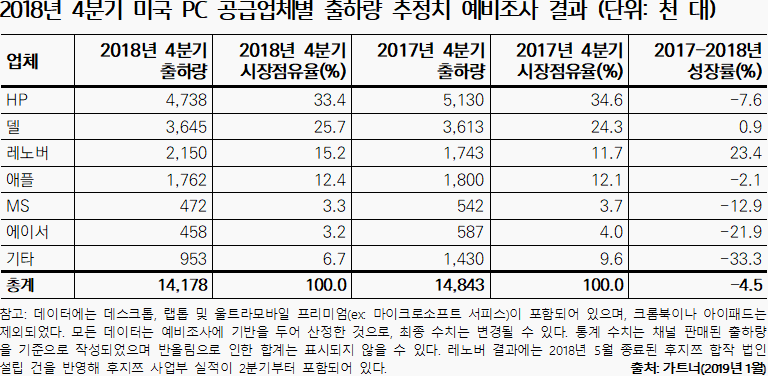
PC shipments in Europe, the Middle East, and Africa in the fourth quarter of 2018 totaled 20.9 million units, a 3.8% year-over-year decline.
There were positive signs in Western Europe, with demand for desktops and ultramobiles boosting shipments to small and medium-sized businesses, while government revenue also grew, driven by additional Windows 10 updates.
Demand continues to recover in some Eastern European regions, including Russia, the Czech Republic, and Hungary. However, demand has not been sufficient to offset the decline in consumer shipments.
In the fourth quarter of 2018, Asia-Pacific PC market shipments totaled 24.2 million units, a 4.6% decrease year-over-year.
Uncertainty over US-China trade relations and stock market volatility have led to cautious demand, particularly among consumers and small and medium-sized enterprises (SMEs). In the fourth quarter of 2018, PC shipments in China declined 2.5% year-over-year, but annual shipments increased 5.6 times year-over-year.
Global PC shipments decline for 7 consecutive years
Global PC shipments in 2018 totaled 259.4 million units, a 1.3% decrease from 2017.
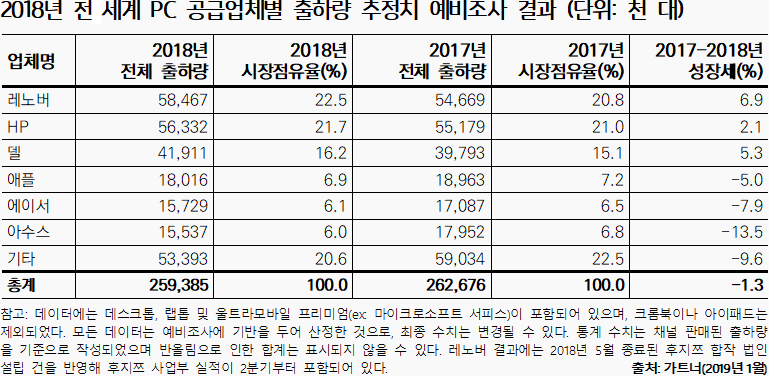
Global PC shipments have been declining for seven consecutive years, but the decline has been milder than in the past three years.
“Most of the decline in PC shipments in 2018 was due to a slowdown in consumer PC shipments,” Kitagawa said. “Consumer shipments fell from 49% in 2014 to 40% in 2018.”
He continued, “The market stabilization in 2018 was due to the continued growth of business PCs driven by the Windows 10 upgrade.”
These results are preliminary and final statistics will be available soon to clients of Gartner's Worldwide Quarterly PC Statistics program in each region.
Comments
Related news

Global PC shipments in Q3 2018 showed weak growth for the second consecutive quarter.
Gartner announced preliminary survey results on global PC shipments for the third quarter of 2018. According to Gartner's survey, global PC shipments in the third quarter of 2018 totaled 67.2 million units, representing a 0.1% increase year-over-year and reversing six years of decline while showing modest growth for the second consecutive quarter. Steady demand for enterprise PCs, driven by Windows 10 PC hardware upgrades, appears to be leading the PC market. However, continued weak consumer PC demand offset the strong sales performance in the enterprise PC market.
2018.10.15by 이수민 기자

10 ICT Trends for Businesses to Watch in 2019
IT consulting firm Gartner has announced the key strategic technology trends that enterprises should focus on in 2019. Over the past two years, "intelligence, digital, and mesh" have consistently been identified as major growth drivers for enterprises. The trends corresponding to these three factors are core elements that drive continuous innovation processes. Additionally, these trends are characterized by converging with each other and exerting mutual influence, thereby creating new opportunities and inducing new innovations.
2018.10.23by 이수민 기자
Global Semiconductor Sales Forecast: 2018 "Sunny," 2019 "Damp"
Gartner announced preliminary results for global semiconductor revenue in 2018. Global semiconductor revenue in 2018 reached $476.7 billion, representing 13.4% growth compared to 2017. In particular, memory's share of total semiconductor revenue increased from 31% in 2017 to 34.8% in 2018, establishing itself as the largest semiconductor segment. However, uncertainty in the semiconductor market is intensifying due to the memory market downturn that began in the second half of 2018 and the U.S.-China trade conflict.
2019.01.07by 이수민 기자

ESP32 Development Environment Selection and GPS Application Implementation
The ESP32 is a microcontroller that integrates Wi-Fi, Bluetooth, 12-bit ADC, capacitive touch, PWM, DAC, and UART in a single SoC. However, the abundance of features does not by itself solve the designer's problems. The real challenges lie in selecting the appropriate development environment, determining which pins can be used and which must be avoided, and converting raw data from modules into usable information. This document addresses ESP32 peripheral constraints (ADC2 and Wi-Fi coexistence limitation, UART1 occupancy, ADC non-linear regions), the trade-offs between Arduino IDE and ESP-IDF, and the process from connecting NEO-6M/NEO-M8N GPS modules to UART2, parsing NMEA sentences, and visualizing routes in Google Earth, all organized based on documented references.
2026.10.12by 편집부

MIPI CSI-2, DSI-2, C-PHY, D-PHY Test Solution Technical White Paper
The MIPI interface adopts a burst mode that transitions between low-power (LP) and high-speed (HS) states for low-power consumption, and in return, strict timing rules are imposed on state transitions. Additionally, the high-speed section operates as a packet-based protocol with headers, ECC, and CRC, so verification engineers must handle waveforms and protocols simultaneously. Traditional configurations combining general-purpose oscilloscopes and AWGs reveal limitations in setup complexity, measurement uncertainty, and lack of reproducibility when faced with these requirements. This white paper, based on webinar materials, organizes the structure of this problem and describes how the SV5C-DPTXCPTX generator for receiver testing and SV5C-DPRXCPRX analyzer for transmitter testing integrate state transition testing, stressed eye testing, and protocol analysis into a single bench, along with their application boundaries.
2026.10.12by 편집부











