


How to Realize Safe Autonomous Driving Functions? A Compromise Between Cost, Technology, and Strategy Is Necessary
 Published2019.03.13 10:25
Autonomous driving could potentially be the most innovative invention of our time for saving lives.
According to the World Health Organization, more than 1.25 million people lose their lives in traffic accidents every year, and prevention and recovery costs amount to about 3% of GDP.
Advanced Driver-Assistance Systems (ADAS) integrate sensors, processors, and software to enhance driving safety while ultimately providing autonomous driving capabilities.
Most of these systems use a single sensor, such as radar or cameras, and are already exerting a significant influence. According to a 2016 IIHS study, automatic braking systems reduced rear-end collisions by approximately 40%, while collision warning systems reduced them by up to 23%. The National Highway Traffic Safety Administration (NHTSA) reported that 94% of serious vehicle crashes are still caused by human error.
To realize Level 4 or Level 5 autonomous driving in driver assistance functions, the automotive industry faces far more complex challenges than before. Sensor fusion, which combines measurement data from numerous sensors to produce results, is required, along with synchronization, high-power processing, and the continuous advancement of the sensors themselves. Consequently, automotive manufacturers must find the right balance between three critical trade-offs: cost, technology, and strategy.
Cost: Comparison of Redundant Sensors and Complementary Sensors
In Level 3 autonomous driving, when the vehicle remains within a predefined situation, the driver does not need to pay active attention. The 2019 Audi A8 becomes the world's first mass-produced car to offer Level 3 autonomous driving capabilities. It is equipped with six cameras, five radar units, one lidar unit, and twelve ultrasonic sensors. Why are so many sensors installed? It is because each sensor has its own strengths and weaknesses.
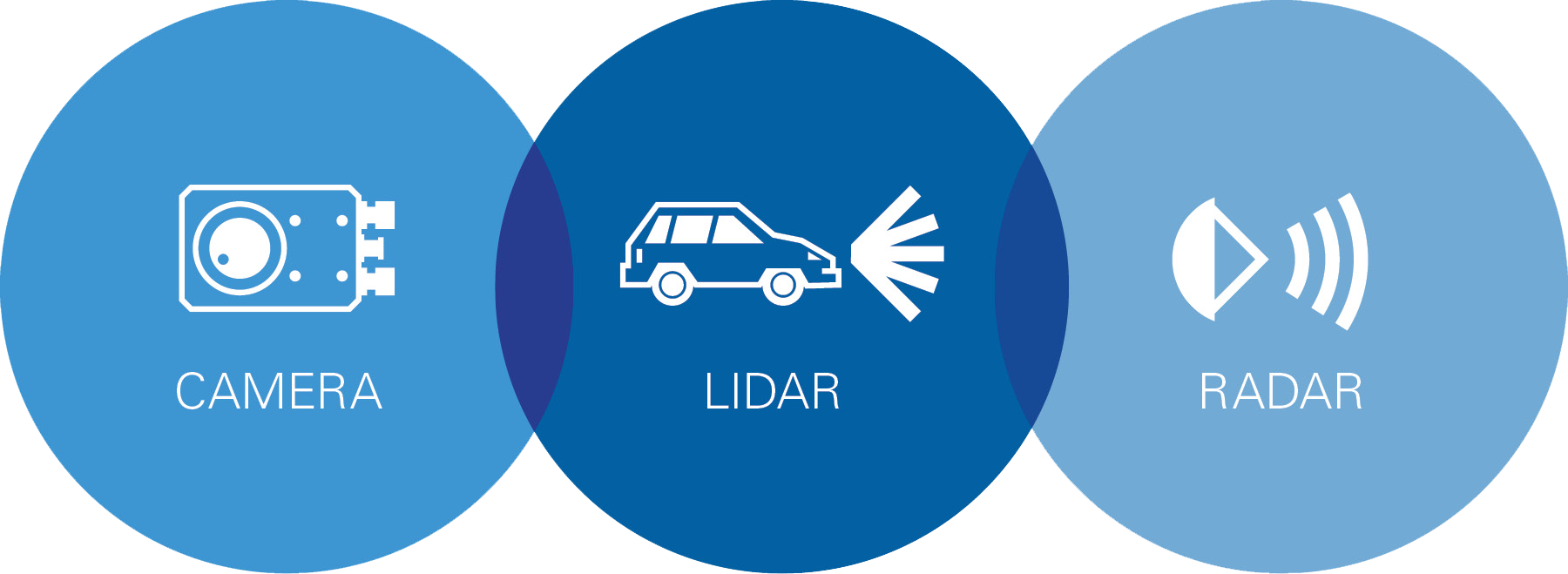
Three core sensors for autonomous vehicles: Camera, LiDAR, and Radar
For example, radar shows how fast an object is moving, but it does not show what the object is. Sensor fusion is necessary because redundancy is required to overcome the weaknesses of each sensor and predict the movement of objects.
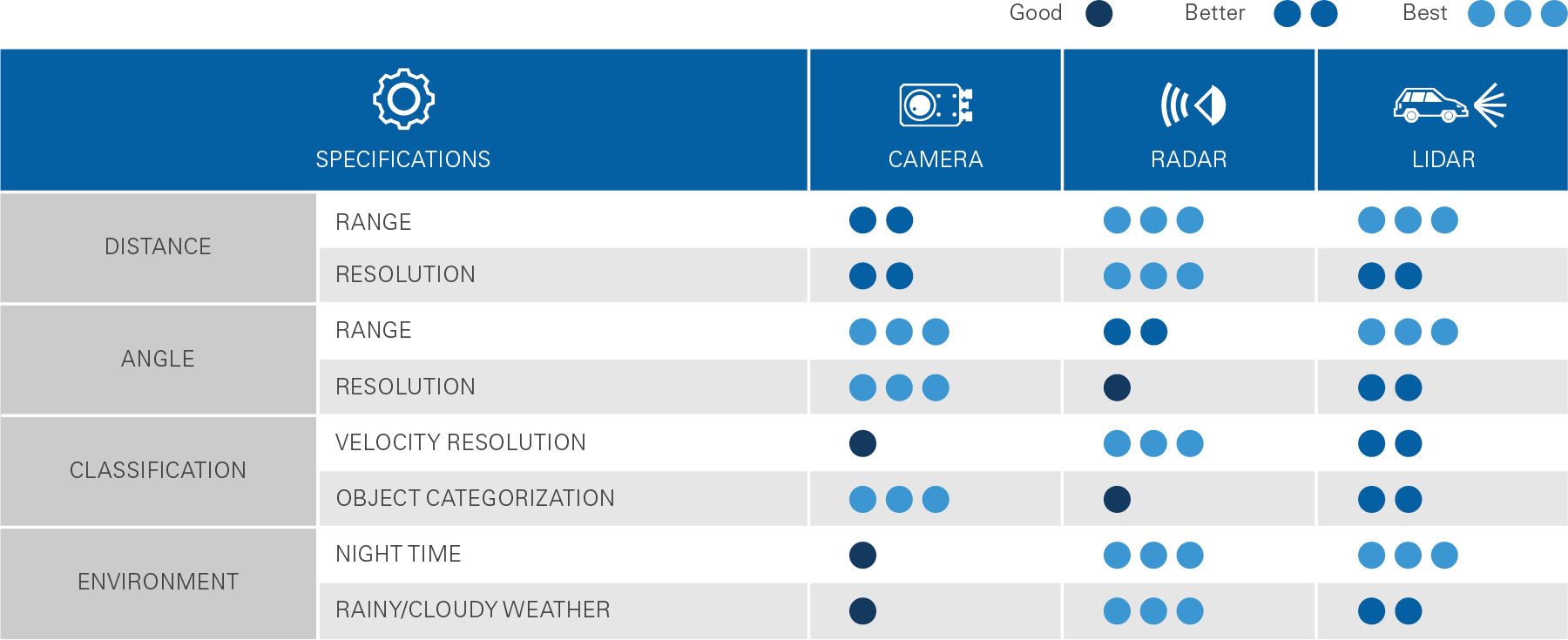
Features and disadvantages of each sensor
Ultimately, the goal of sensor data processing is to generate automatic safety indications for the vehicle's surrounding environment in a way that can be used in decision-making algorithms, thereby enabling cost reduction to maintain the profitability of the final product.
One of the most critical tasks in achieving this is selecting the appropriate software. Let us consider three examples: tightly synchronizing measurements, maintaining data traceability, and testing software against an infinite number of real-world scenarios. Each of these presents its own challenge. In other words, while all three are necessary for autonomous driving, one must determine the cost involved.
Technology: Comparison of Distributed and Centralized Architectures
ADAS functions are based on multiple separate control units. However, sensor fusion is establishing itself as a single centralized processor.
Let's take the Audi A8 as an example. In the 2019 model, Audi combined essential sensors, a portfolio of functions, electronic hardware, and software architecture into a single central system. This central driver assistance controller calculates the entire model of the vehicle's surroundings and operates all assistance systems. It provides more processing performance than all systems combined in previous Audi A8 models.
The primary concern with a centralized architecture is the cost associated with processing large volumes of data. This is exacerbated because the auxiliary sensor fusion controller must be located elsewhere in the vehicle to serve as a safety-critical backup. As controllers and processing capabilities evolve, configurations are likely to shift between distributed and centralized architecture designs over time. This implies that software-defined tester design is crucial for keeping up with that evolution.
Strategy: Comparison of In-house Technology and Existing Technology
To achieve Level 5 autonomous driving, microprocessors for autonomous vehicles require 2,000 times more processing power than current microprocessors. Consequently, prices are rising much faster than RF components for mmWave radar sensor systems.
Historically, high-demand, high-priced features have attracted the attention of adjacent market leaders, and such leaders have driven market competition to date. UBS estimates that the Chevrolet Volt electric powertrain will have 6 to 10 times more semiconductor content than comparable engine cars.
Semiconductor content will continue to grow, and market proximity will provide significant advancements in off-the-shelf technology. For example, NVIDIA has adopted the Tegra platform, originally developed for consumer electronics, for ADAS applications in automotive systems. Additionally, Denso has begun designing and manufacturing its own AI microprocessors to reduce costs and energy consumption, and Denso's subsidiary, NSITEXE, plans to launch a dataflow processor, a next-generation processor IP called DFP, in 2022. The competition has already begun.
Compromise optimization
Decisions regarding these trade-offs impact time-to-market and differentiated capabilities across the entire supply chain. Since the ability to rapidly reconfigure testers is critical to minimizing the cost and time of verification and production testing, flexibility through software becomes key.
In an interview, Dr. James Kuffner, CEO of Toyota Research, said, “Our budget is growing by about four times, not two,” adding, “We have a budget of about $4 billion that will allow Toyota to grow into a new, world-class automotive company in the software field.”
He continued, “Such changes are not uncommon in the automotive industry,” and explained, “While there is no clear solution to this trade-off yet, just as past industrial revolutions empowered people to provide new technologies through higher productivity gains, increased efficiency in software development will be an essential element of the autonomous driving revolution.”
This article is based on a contribution by Jeff Phillips, NI’s Head of Automotive Marketing.

Comments
Related news
Mouser to Supply ADI Industrial Mini IMUs to Enhance Navigation Performance in IoT Applications
Mouser Electronics supplies Analog Devices' ADIS1647x precision industrial inertial measurement unit. The ADIS1647x IMU, newly added to ADI's MEMS IMU product family, improves navigation performance and stability in IIoT and IoT applications, unmanned aerial vehicles, smart agriculture, and autonomous vehicles. The device can also be used in devices being developed in the growing VR and AR markets.
2019.01.25by 이수민 기자
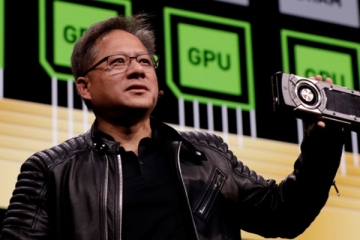
NVIDIA CEO Jensen Huang to Keynote at the 10th GPU Technology Conference
Nvidia CEO Jensen Huang will serve as a keynote speaker at the 10th GTC, which will be held in San Jose, California from March 17 to 21. The event is expected to draw up to approximately 10,000 developers, data scientists, and industry professionals. More than 800 speakers and approximately 200 exhibitors representing various sectors including AI, data centers, cloud computing, healthcare, finance, telecommunications, autonomous vehicles, robotics, and IoT will participate in the conference.
2019.02.08by 이수민 기자
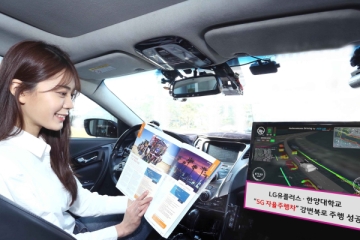
LG Uplus and Hanyang University's 5G autonomous vehicle travels 8km through downtown Seoul... "Commercialization is still a long way off."
Hanyang University's Automotive Electronics Control Laboratory ACE Lab and LG Uplus held a press conference on the 11th at Hanyang University's Seoul Campus and conducted a public demonstration of Level 4 autonomous driving technology on urban roads based on 5G mobile communication. The 5G autonomous vehicle unveiled this time, A1, comes close to Level 4 'Highly Automated Driving' according to the classification standards of the Society of Automotive Engineers (SAE). This refers to a stage where the vehicle can operate independently without driver intervention. Level 5 'Full Autonomous Driving' refers to an unmanned vehicle that operates without any passengers. In the demonstration, A1 autonomously drove approximately 8 km over 25 minutes, traveling via Gangbyeon-bukro—Yeongdong Bridge—Olympic-daero—Seongsu Bridge—and arriving at Seoul Forest public parking lot.
2019.03.12by 이수민 기자
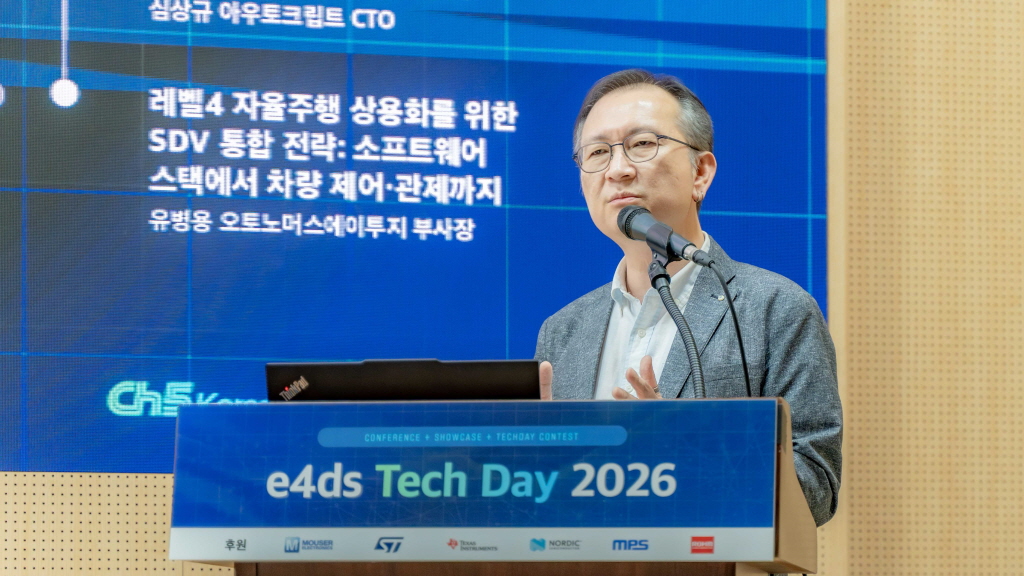
[e4ds Tech Day 2026 ⑨] Sim Sang-gyu, Autocrypt CTO: "In the Physical AI Era, Automotive Security Must Extend Beyond the Vehicle"
At e4ds Tech Day 2026, Sim Sang-gyu, CTO of Autocrypt, explained automotive cybersecurity strategies in the era of Physical AI and SDV (Software-Defined Vehicle). Automobiles are evolving as part of an ecosystem connected to AI, cloud, chargers, IoT, and robots, and he emphasized that the scope of security must expand beyond the vehicle interior to the entire connected environment. In particular, AI model tampering, adversarial attacks, OTA updates, and EV charger hacking were identified as major threats. He explained that response measures require zero trust, AI model integrity protection, intrusion detection, Security by Design and Default, and full lifecycle security management, and that proactive security system establishment beyond regulatory compliance is critical for securing future mobility competitiveness.
2026.10.12by 배종인 기자

Practical HIL Construction Strategy for Automotive and Off-Highway Controller Validation
As vehicle E/E architecture transitions to zonal structures and shifts to software-defined vehicles (SDV), the number of controllers (ECUs) requiring validation and software complexity are surging dramatically. Meanwhile, real vehicle testing cannot provide repeated verification under identical conditions and entails lead time and safety concerns. This white paper explains the principles of HIL (Hardware-in-the-Loop) validation and the structure of the NI platform composed of PXI, SLSC, and VeriStand, and through two actual implementation cases—Camera Record & Replay HIL for In-Cabin Monitoring Controller (ICMU) and Forklift Controller (VCU) HILS—describes how controller-level regression testing becomes possible. Additionally, it explicitly states application boundaries and limitations, such as lack of A2B support.
2026.10.12by 편집부











