



Wind River conquers the market with a virtualization-based edge computing integration strategy!
 Published2019.04.15 19:05
On April 11, Wind River announced Wind River Helix, a virtualization platform capable of multi-OS operation synchronization based on system multi-partitioning partitioning, in Samseong-dong.
This has the advantage of integrating and transferring the various operating systems currently used in each edge system into a single system platform, thereby integrating the divided systems into one, and managing the individual operating systems in a synchronized manner, thereby moving away from hardware-dependent system advancement and enabling cost-effective software-based system advancement.
Gareth Noyce, Vice President of Strategy at Wind River, who gave the presentation that day, mentioned the rapidly growing smart car and smart manufacturing industries, saying, “Countless edge devices are forming systems based on their own OS within a single complete entity,” and in today’s rapidly changing market, frequent advancements in complete entities require numerous edge system advancements and integration processes, which incur enormous maintenance and upgrade costs and time.
.jpg)
Applications of Wind River Virtualization Platform "Helix"
The actual modernized digital vehicle instrument panel, unlike the past, is a dashboard for driving itself, and an infotainment system.We are in the process of integrating various functions, including the air conditioning system.
Wind River explains that if various systems requiring 70 to as many as 100 ECUs are operated with Wind River's ECU virtualization system capable of multi-partitioning, the long-term maintenance costs required for system integration operation can be drastically reduced.
Even if it is a single digital instrument panel, if it is operated based on various ECUs, each part's heterogeneous system OS must be individually advanced. On the other hand, if it is configured with a virtualization platform based on multi-partition partitioning provided by Wind River, OS synchronization and automated code debugging tailored to various certification levels are possible through the modular open architecture provided by Wind River.
Additionally, it is said that this integrated automation code debugging function can reduce TCO (total cost of ownership) by eliminating the need for individual certification and testing for connectivity when changing some functions.
Wind River also said it is designed to comply with Airborne Systems' DO-178C software requirements, the industrial functional safety international standard IEC 61508, and the automotive functional safety standard ISO26262, indicating that it has the certification support requirements needed for future advancements.
Wind River plans to help customers more effectively leverage the benefits of IoT by simplifying the rapidly changing and increasingly complex IoT development environment through this virtualization platform.
Park Joo-dong, CEO of Wind River Korea, said, “In order to accelerate digital innovation and strengthen market competitiveness, we need to secure a reliable technology partner.” He added, “Wind River ensures safety and security for the entire path from the edge to the cloud, enabling us to operate existing infrastructure while applying the latest technologies.”“We aim to broadly share our technological know-how and global market expertise with domestic customers to help them achieve innovation at the optimal cost and time,” he said.

Comments
Related news

Expanding the Industrial Internet of Things (IIoT) market with Telit and Wind River
Telit announced that it is partnering with Wind River, an Intel subsidiary, to expand its presence in the Industrial Internet of Things (IIoT) market. Telit and Wind River plan to help enterprises realize the benefits of IIoT solutions quickly and securely by reducing the complexity of IoT device management. Wind River is utilizing Telit's IoT platform technology in its device management platform. Enterprise customers can use the latest version of Wind River Helix Device Cloud (HDC) to more easily manage data on-premise or in the cloud, and enhance system analysis and remote device management capabilities. HDC supports users in performing computing tasks in an integrated manner, thereby protecting enterprise investments in information management operations, utilizing infrastructure, improving processes, and helping to create new revenue streams.
2017.10.24by 김지혜 기자

Wind River and Vector Support AUTOSAR-Compliant OTA Solution with Helix Edge Sync
Wind River today announced its collaboration with Vector, a specialist in automotive embedded systems development, to support Over-the-Air (OTA) updates compliant with the AUTOSAR standard through Wind River Helix Edge Sync, its automotive software lifecycle management solution. Wind River Helix Edge Sync is provided through pre-certification with Vector's Flash Bootloader. The Flash Bootloader is a lightweight solution that enables efficient and secure reprogramming of flash memory in electronic control units (ECUs) that comply with AUTOSAR specifications. Through pre-certification work by both companies, automotive manufacturers can secure new competitive advantages, and individual vehicle owners can also benefit from OTA updates. As software in next-generation connected vehicles becomes increasingly complex, ranging from infotainment to safety-critical systems, the potential for new types of software bugs, security attacks, and intellectual property infringement has increased. The automotive industry now faces new challenges in maintaining software currency, safety, and security.
2018.05.21by 김지혜 기자
LG U+, First Telecom Operator to Acquire OVP Certification for Virtualization Platform
LG U+ has become the first telecom operator to acquire OVP certification for a network virtualization platform essential to 5G network construction.
2018.08.15by 이수민 기자
Samsung SDS and VMware Jointly Promote Digital Work Environment Innovation Project
Digital workplace transformation innovation enables enterprises to perform tasks anytime and anywhere using PCs and mobile devices by leveraging IT technologies such as cloud computing and virtualization, thereby improving work efficiency. Accordingly, Samsung SDS has established a strategic partnership with VMware to jointly develop digital workplace transformation projects. VMware is leading digital workplace transformation innovation with its Workspace ONE solution, which enables secure and flexible management of various mobile devices.
2019.02.26by 이수민 기자
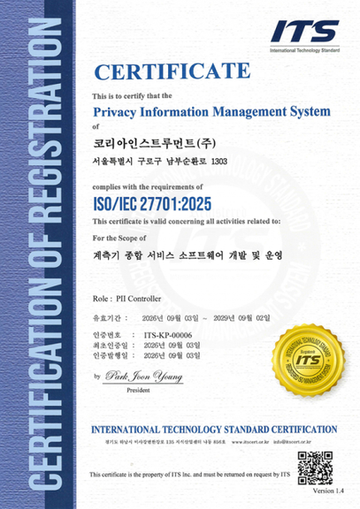
Korea Instrument, KOLAS Accredited Calibration Agency First to Simultaneously Acquire ISO/IEC 27,001·27,701
Korea Instrument has become the first among KOLAS accredited calibration agencies to simultaneously acquire ISO/IEC 27,001 and ISO/IEC 27,701 certifications. Through its proprietary platforms CWIZ Enterprise and CWIZ Partners, the company has embedded information security and personal data protection requirements across all business processes including customer information, equipment data, and calibration reports, with plans to continuously advance its management system through regular audits and security inspections.
2026.10.12by 배종인 기자











