



Implementing "vertical communication" for IT and OP convergence
 Published2019.04.29 19:39
Contribution: Hilscher Gesellschaft für System Automation mbH
– Hans-Jürgen Hilscher, CEO / Armin Pühringer –
The Fourth Industrial Revolution isn't just about massive amounts of data and broad bandwidth. Industry 4.0 and the Internet of Things (IoT) also require vertical communication from individual field devices to the cloud. While this may sound like a new technology and a completely different communications infrastructure, there are ways to add functionality while maintaining existing methods. And the solution lies in OPC UA and TSN.
Industrial communications largely coexist and operate on two levels. Information Technologies (IT) connects servers, desktop computers, and laptops in offices via Ethernet-based LAN and WLAN networks.
On the other hand, Operational Technology (OT) uses fieldbus and Real-Time Ethernet systems to connect field devices to controllers, which in turn communicate with SCADA and process control systems via Industrial Ethernet.
However, to implement Industry 4.0, IT and OT environments need to be integrated. In this case, RAMI 4.0 (Reference Architectural Model Industry 4.0) serves as the foundation for a future industrial communication architecture, integrating IT and OT into a complete model. The communication layer plays a crucial role here, acting as a link between the physical field layer and the higher-level information layer.
One of the goals of this reference architecture is to build a comprehensive communications infrastructure that extends from individual field devices to the cloud. This is where the Internet of Things (IoT) enters the industrial world. With the integration of IT and OT, the system also becomes spatially unconstrained.
OPC Unified Architecture (OPC UA) and Time Sensitive Networking (TSN) are emerging as future standard technologies to achieve this. These technologies enable vertical communication, seamlessly integrating with existing communication infrastructure and enabling new applications.
Proven technology with new features
Future industrial communications will require significantly higher bandwidth, necessitating the use of Gigabit Ethernet. Furthermore, to realize Industry 4.0, communications infrastructure must also provide a high level of service quality.
OPC UA TSN meets these very needs. TSN optimizes existing Ethernet standards to achieve low latency, guaranteed cycle times, and improved reliability. OPC UA implements end-to-end semantics for field devices through virtual descriptions.
Additionally, the IEC 62948 standard is being further enhanced in the industrial WLAN area to ensure wireless transmission delay and reliability. Because both require real-time communication at the front-line machine and production cell level.
OPC UA solves the problem of interpreting bits and bytes per device by adding an information model, and provides a communication infrastructure for information exchange and retrieval, as well as a security system according to the latest standards such as IEC 62443.
Integration of existing communications environments and new technologies
Combining TSN and OPC UA enables seamless integration with existing TCP/IP-based communication networks such as PROFINET, EtherNet/IP, or EtherCAT. Ultimately, TSN-enabled OPC UA becomes compatible with the robust Ethernet technology already proven globally across various hardware and software ecosystems.
By building a Real-Time Ethernet system with TSN capabilities, direct and synchronized horizontal communication between controllers of various machines and production units is possible, and additional vertical communication is also possible for the first time thanks to TCP/IP Internet communication using these functions. It can provide information about individual components of a production system through existing local, regional, or global corporate networks.
By implementing OPC UA TSN, vertical or horizontal flow of information is enabled through existing network structures, which ensures minimal latency, maximum bandwidth, high quality of service, and overall robust functionality.
Cloud Connectivity: Lighting the Future Through Current Standardization
Hilscher Gesellschaft für Systemautomation (Hattersheim, Germany) recognized the approach and core of the Fourth Industrial Revolution early on and applied its netIOT integrated solution to develop the technology required for industrial cloud communication across all essential communication scenarios. These three key scenarios include:
Brownfield Connectivity: A key challenge for many production facilities is the parallel transmission of additional vertical information to the cloud/IT without impacting other Real-Time Ethernet data within the manufacturing environment. This can be achieved via non-real-time transmission channels provided by PROFINET or EtherNet/IP. OPC UA communication is a prime example, and edge gateways are ideal for this purpose. The OPC UA server in the edge gateway can understand the system topology and generate an information model that can be transmitted to higher-level IT/cloud.
The netIOT edge gateway can connect manufacturing and IT networks, and then connect them to the cloud. Additional features, such as role management, which allows you to restrict administrative privileges and predefined functions for individual user groups, are also available. Another special feature, passive mode, allows the edge gateway to read data without any negative impact on the data, such as from a packet sniffer, i.e. without changing the PLC.
The embedded edge server understands Real-Time Ethernet system protocols, enabling it to identify devices through aperiodic services and register them with the cloud for asset management. Hilscher pursues a multi-cloud strategy and supports SAP Cloud Platform, which is partnered with IBM's Bluemix and Microsoft Azure.
The collected information can be used via LAN or IT/cloud, as well as applications on smartphones, tablets, and laptops via the edge gateway's Bluetooth and WLAN interfaces.
Heterogeneous Production Facilities: The second scenario involves production facilities comprised of automated machines configured with various controllers and Ethernet systems. These controllers typically communicate with field devices via one of the established real-time systems (PROFINET, EtherNet/IP, or EtherCAT). If these controllers already have an OPC UA server and firewall capabilities, connecting to the cloud is virtually trouble-free.
However, these PLC-based controllers may not be suitable for large-scale data transmission, and changes to the sequence programming may be required to provide additional information to the cloud. However, this scenario (PLC with OPC UA server and cloud connectivity) is particularly suitable for machines and production facilities where operator reprogramming is possible, as this approach is not always possible and is often not permitted by the system operator.
Machinery suppliers pre-define and adjust the range of information that can be transmitted before delivery, and this is where the interplay of PLCs and real-time communication systems proven for Industry 4.0 applications comes into play.
Greenfield without limits: The third scenario involves directly transmitting data from field devices such as sensors and actuators using OPC UA TSN, with no PLC involved. Device data is available directly via the TCP/IP Ethernet infrastructure, requiring the field devices to have OPC UA TSN built-in. Device suppliers should always keep this in mind when developing next-generation devices. Standards such as IO-Link enable cost-sensitive field devices to be connected while still leveraging the benefits of semantic descriptions.
This is where OPC UA TSN truly shines: vertical communication across IT and the cloud allows device manufacturers to develop new applications and business models using a single technology stack.
The netIOT Edge Gateway can address not only the scenarios described above, but also new installation requirements, such as using a Real-time Ethernet system on existing controllers. It can also integrate all IoT communications in the field and map them to a higher-level Ethernet network. This allows for direct use of device data within a company's MES or ERP systems for analysis and system maintenance. Furthermore, device data can be directly accessed from mobile devices.
Ensuring system coexistence until Industry 4.0
Hilscher has extensive experience in connectivity solutions for all standard protocols in the manufacturing industry, and this expertise is culminated in the netX chip. By clearly separating communication and firmware applications on the chip, netX chips enable easy integration into any device's existing system environment, eliminating the need for hardware manufacturers to worry about implementing other technologies. Only the necessary protocols need to be embedded within the device.
Existing solutions can be upgraded to OPC UA TSN using software, as long as they have sufficient memory and corresponding features. While transmission speeds are limited to 100 Mb/s, this is sufficient for transmitting non-time-sensitive information.
It is possible to access devices through a TCP/IP environment without loading the controller, and this method, which allows for direct data management through existing infrastructure or the cloud for automation systems, is what is required in the future Industry 4.0.
In-house retention of data through a gateway that supports cloud services
One of the most critical requirements for manufacturing facilities is maximizing the operation of all devices, machines, and systems. Preventive maintenance is crucial for achieving this. By integrating with an asset management system, business processes such as spare parts requests and service orders can be directly managed. Furthermore, proactively addressing potential issues through regular maintenance can lead to higher productivity and minimized system downtime. This will form the foundation for a vertical, end-to-end semantic description, from field bus standardization and the OPC UA information model for field devices to standardization of the administration shell.
Additionally, specific algorithms capable of detecting defects in advance can directly access data through the built-in Docker framework, enabling fault prediction directly at the edge gateway. Another advantage is that there's no need to build expensive, separate infrastructure to evaluate the data, and key process data remains within the system.
Meeting the Challenges of Industry 4.0
OPC UA TSN provides a migration path that implements fieldbus technology that has been proven in the field for many years, while enabling the implementation of entirely new applications in vertical communication.

Comments
Related news
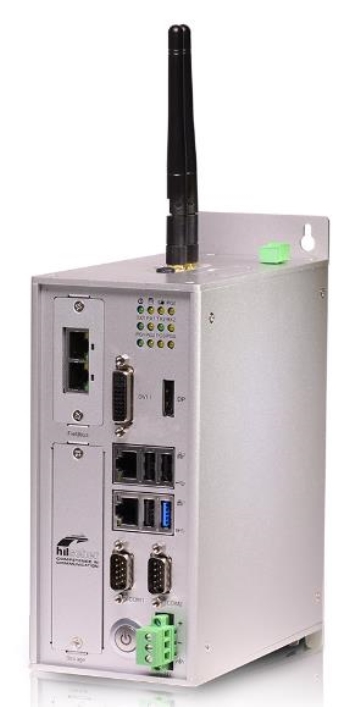
Hilscher Provides Central Link Connecting IT and OT Networks
Hilscher stated that it is supplying a technology and service package with its netIOT product line that enables data exchange from automation system components to cloud or IoT-based applications. The recently launched netIOT Edge Gateway NIOT-E-TIJCX-GB-RE is available for purchase on the market and provides a central link connecting IT and OT networks. Since the gateway device itself is integrated as an I/O subscriber in a PROFINET or Ethernet/IP network, it can be positioned to periodically exchange with the PLC while communicating directly with IoT-enabled field devices via OPC UA/MQTT.
2017.09.06by 김지혜 기자
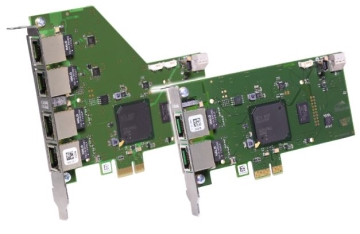
Hillscher CIFX 4000 surpasses multi-protocol support capabilities.
Hilscher is developing a cifX PC card based on the new netX 4000 automation controller to provide solutions to the market. The netX 4000 is a new product in the netX controller family. It is equipped with up to 4 ports for industrial Ethernet, 2 gigabit Ethernet ports, an embedded PCI Express core, and an additional ARM Cortex A9 processor for Linux-based applications. It is an encrypted unit with security functions as well as various features. With a Cortex®-R7 dedicated communication processor and the xC subsystem mounted beneath it, the netX 4000 also supports all existing fieldbus technologies as well as Real-Time Ethernet and TSN. In addition to the netX 4000, the CIFX 4000 PC card is also a product suitable for applications in automation and Industry 4.0 fields. From the start of development, Hilscher introduced a 4-channel PCI Express card for the combination of all Real-Time Ethernet protocols as master or slave, and also provides standard and low-profile PCI Express cards that integrate Real-Time Ethernet communication and OPC-UA in a single device. The CIFX 4000 is integrated into Hilscher's platform strategy, through which it provides applications with the same user interface as the existing cifX product family.
2018.03.09by 김학준 기자
Catch the Ethernet protocol standard 'OPC UA'
No matter how advanced the technology, it becomes useless without established standards for protocols. The core of the Fourth Industrial Revolution is convergence. Interoperability among factories, equipment, and objects must be secured to leverage the characteristics of smart factories, such as improving productivity and reducing defect rates, thereby achieving price and quality competitiveness. The government-led "Smart Manufacturing Innovation Vision 2025" to construct 50,000 smart factories by 2025 and the "Smart Factory Standardization Promotion Strategy" to establish a standardization support system underscore the importance by preparing national standards. However, to resolve difficulties in system design and maintenance caused by different protocols between equipment, support for adopting OPC UA, a common standard protocol between equipment, has begun. OPC UA is a vendor-independent communication protocol for industrial automation applications. It is based on the client-server principle and allows communication from individual sensors and actuators to ERP systems or the cloud. Additionally, OPC UA bridges the gap between the IP-based world of IT and the production floor. Between machines and between machines and cloud databases, all production data is transmitted through a single protocol. OPC is characterized by eliminating the requirements of traditional factory-level fieldbus systems.
2018.04.02by 김학준 기자
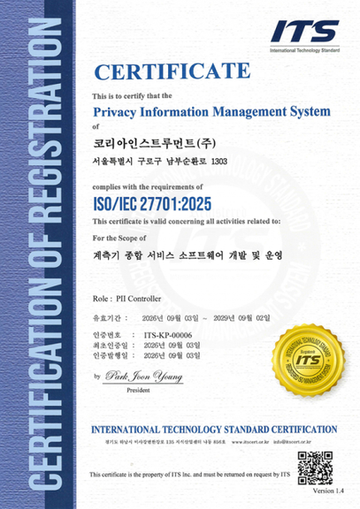
Korea Instrument, KOLAS Accredited Calibration Agency First to Simultaneously Acquire ISO/IEC 27,001·27,701
Korea Instrument has become the first among KOLAS accredited calibration agencies to simultaneously acquire ISO/IEC 27,001 and ISO/IEC 27,701 certifications. Through its proprietary platforms CWIZ Enterprise and CWIZ Partners, the company has embedded information security and personal data protection requirements across all business processes including customer information, equipment data, and calibration reports, with plans to continuously advance its management system through regular audits and security inspections.
2026.10.12by 배종인 기자
TeamViewer One, IT Incident Automation Workflow and Resolution Center Enhanced
TeamViewer has added IT incident automation capabilities and an advanced Resolution Center to its integrated digital workplace management platform 'TeamViewer ONE'. Recurrent service disruptions, configuration errors, and capacity shortages are automatically handled according to preset policies, and device status verification through script deployment can be managed in a unified interface, significantly reducing repetitive tasks for IT teams.
2026.10.12by 배종인 기자











