



"Becoming a Comprehensive Semiconductor Powerhouse by 2030" Government Announces Fostering System Semiconductor Ecosystem
 Published2019.05.02 11:10
| Supporting corporate investment with tax and financial support
| Preempting promising markets and promoting next-generation technology development
The government announced on April 30 that it would actively support domestic companies' entry into the system semiconductor market.
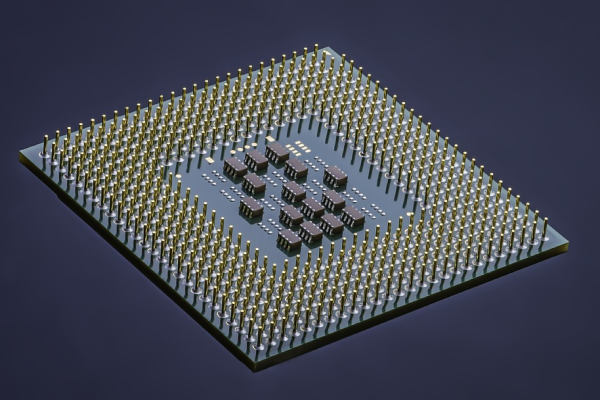
As we enter the era of the 4th industrial revolution, the demand for semiconductors is expanding from PCs and mobile devices to all industries, including automobiles, robots, energy, and bio, and the demand for system semiconductors is increasing.
As of 2018, Korea has a low market share of 3.1% due to a lack of professional manpower, lack of competitiveness in the ecosystem, and lack of connection with demand industries. In addition, its technological prowess is at 80% of that of the United States, and only one domestic company is among the top 50 global fabless companies.
Unlike memory semiconductors, system semiconductors are competitive in terms of design technology and advanced manpower that meet the needs of set manufacturers, as well as a variety of customized products. In addition, they have differentiated characteristics such as a division of labor between design and manufacturing, so the possibility of success increases when the industry's investment is accompanied by infrastructure support required throughout the ecosystem.
The domestic industry is seeking a change in direction by announcing aggressive investments to foster system semiconductors and move away from the memory semiconductor-centered structure. Samsung Electronics, which announced plans to invest 133 trillion won by 2030, is a representative example.
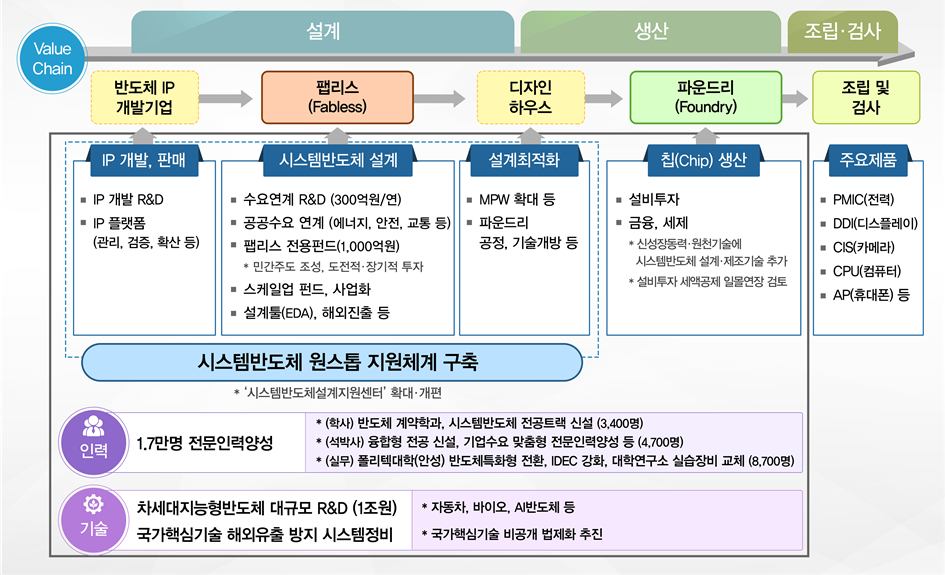
Accordingly, the government has established five key measures to foster the system semiconductor industry and become a comprehensive semiconductor powerhouse by 2030.
There have been related measures in the past, but they were insufficient in creating an ecosystem and did not meet corporate demand. This measure focuses on creating a self-sustaining ecosystem for the system semiconductor industry.
Human resource development will also be introduced as a systematic human resource development program, including bachelor's, master's, and doctoral degrees, and practical training, rather than the indirect human resource development through R&D in the past. In addition, private facility and R&D investment will be supported through taxation and finance.
Five key measures to become a comprehensive semiconductor powerhouse
First, we select and focus on key areas to secure global competitiveness in the fabless industry. To this end, we will build a cooperation platform, Alliance 2.0, between fabless and demand companies in fields such as automobiles, bio, energy, IoT home appliances, machinery and robots, where there is high demand for system semiconductors or where domestic companies can secure competitiveness in a short period of time, and jointly promote ‘demand discovery → technology planning → R&D.’
Alliance 2.0 was launched on April 30th through a business agreement between 25 organizations including the government, semiconductor demand and supply companies, and research institutes. Promising technologies discovered by the alliance will be given priority for reflection in government R&D.
It also creates public demand. It establishes a cooperative system between demand organizations and fabless in promising public markets such as energy, safety, national defense, and transportation infrastructure, and promotes a linkage of 'demand discovery → project planning → technology development → public procurement'. Through this, it creates a market of 26 million units and over 240 billion won by 2030.
Linkage with 5G is also in progress. We will build a linkage system with fabless companies and support joint R&D for each 5G industry, including network equipment, devices, and unmanned vehicles.
We are also providing a system that can be jointly used by domestic fabless companies for design automation software (EDA Tools), which are essential programs for semiconductor design, and by expanding and reorganizing the 'System Semiconductor Design Support Center', we are providing one-stop services to fabless companies, including startup and technology consulting, semiconductor design and development (MPW, etc.), IP management and verification, and commercialization support.
We will create a new 100 billion won private-sector-led fabless fund and support the scale-up of fabless companies with a growth foundation by utilizing scale-up funds, etc.
In order to support the technological capabilities of small and medium-sized fabless companies, university and research institute personnel with original technologies will be dispatched to promote joint R&D projects, and an industry-academia-research forum will also be held to share mid- to long-term trends and discuss development plans.
Second, we will simultaneously target the cutting-edge and niche markets of the foundry industry. Large companies will target the high-tech cutting-edge fields, while mid-sized companies will target the mid-level middle-tech niche markets, and the government plans to effectively support corporate investment. System semiconductor technologies such as 5G, AI, and bio will be reflected in the 'new growth engine and source technology', and tax deductions for large-scale corporate investment and new technology development will be promoted. In addition, we will support facility investment financing for mid-sized foundries by utilizing business structure advancement support programs to enter niche markets such as power semiconductors and analog semiconductors, thereby improving productivity.
Third, we will create a win-win cooperation ecosystem between fabless and foundries. In the industry, we will improve quantity restrictions and shuttle operations when using MPW (Multi Project Wafer) to expand the number of times it can be applied per process to 2-3 times. The government supports design optimization service infrastructure for design houses that serve as a bridge between fabless and foundries.
Fourth, we will train 17,000 highly specialized human resources needed by the market and companies by 2030. To this end, we will establish a semiconductor contract department and a system semiconductor major track at Yonsei University and Korea University by 2021. In addition, we will supply master's and doctoral degree holders through corporate demand-based R&D projects, and promote convergence-type highly specialized human resources and industry-academia-type master's and doctoral degree holder training programs. In addition, we will convert Polytechnic University (Anseong) to a semiconductor-specialized one and expand support for the Semiconductor Design Education Center (IDEC). In addition, we will improve the quality of practical training by upgrading the university's aging equipment.
Fifth, we will invest more than 1 trillion won in the development of next-generation semiconductors over the next 10 years and prevent technology leaks overseas. Through this, we plan to secure competitiveness from original technology to applied technology. In addition, we will promote the nondisclosure of information containing national core technologies and reorganize the system by newly including 5G communication modem chip design technology as national core technologies.
The five major policies have three main points: ▲Upgrade the overall level of the ecosystem through support for the growth of fabless and foundries, which are the main fields of system semiconductors, and organic linkage by sector. ▲Support corporate investment through tax and financial support, and establish a virtuous cycle structure for fostering human resources and creating jobs needed by the market. ▲Promote next-generation technology development that changes the industrial paradigm to preempt promising markets for system semiconductors and strengthen competitiveness in manufacturing such as future automobiles and bio.
Through this, the government plans to ▲become the world's number one foundry ▲achieve a 10% fabless market share ▲create 27,000 new jobs by 2030.
Comments
Related news
.jpg)
Samsung Electronics Successfully Develops EUV-Based 5nm Foundry Process
Samsung Electronics has successfully developed a 5-nanometer process based on EUV technology. Additionally, the company plans to ship 7-nanometer products by this month and complete design of 6-nanometer products with mass production targets by the end of this year. Samsung Electronics' strategy is to strengthen foundry technology leadership and competitiveness in the system semiconductor business that will lead the fourth industrial revolution through expanding its ultra-fine process portfolio. Samsung Electronics plans to expand its MPW service to the latest 5-nanometer process, enabling customers to manufacture advanced semiconductors more conveniently. Additionally, through SAFE, a foundry support program, the company provides design infrastructure including PDK, DM, and EDA to assist with 5-nanometer process-based product design beyond design assets. Fabless customers can leverage these offerings to design products more easily and quickly, and accelerate new product launch timelines.
2019.04.17by 이수민 기자
[Weekly IT Asia] Arm China to Introduce Mentor Questa / LG Electronics to Focus Smartphone Production Lines in Vietnam
Mentor announced that Arm China has adopted Questa Simulation, a semiconductor design defect and error verification solution, for the development of next-generation low-power MCU cores. LG Electronics is consolidating and relocating its smartphone production line in Pyeongtaek, Gyeonggi Province to the 'LG Hi-Pont Campus,' and reassigning the Pyeongtaek smartphone production workforce to its life appliance manufacturing plant in Changwon. POSTECH, an optical communication specialist based in Ansan, signed an MOU with a local partner to establish a joint venture in Saudi Arabia. TWTC, which organizes the global ICT exhibition Computex Taipei, held a press briefing at its Seoul Sogong-dong office and introduced key details about Computex 2019. Huawei announced its strategy in the automotive sector. Huawei stated that it will not manufacture automobiles but will focus on ICT, and will support automotive OEMs in manufacturing better vehicles.
2019.04.29by 이수민 기자

KAIST-Apple FinFET Semiconductor Patent Infringement Investigation Concluded
The Trade Commission under the Ministry of Trade, Industry and Energy has decided to conclude the FinFET semiconductor patent infringement investigation. The FinFET semiconductor patent infringement investigation began in December 2017 when KIP, a subsidiary of KAIST (Korea Advanced Institute of Science and Technology) that manages intellectual property rights, filed an application for investigation of unfair trade practices with the Trade Commission, claiming patent infringement against Apple Korea Limited. While the Trade Commission had been conducting the investigation through written exchanges between the parties and technical briefing sessions to examine the validity and infringement of the patents, on March 29, KIP submitted a withdrawal letter of the investigation application to the Trade Commission citing a settlement between the parties. The Trade Commission decided to conclude the investigation in respect of the parties' wishes, and following the Trade Commission's decision to conclude the investigation, all related patent disputes pending before the Patent Trial and Appeal Board and civil courts are expected to be withdrawn.
2019.04.26by 이수민 기자

Intel Unveils Next-Generation 'Core Ultra Series 3' and vPro Platform for Enterprise PCs
Intel has officially unveiled the "Intel Core Ultra Series 3" for next-generation enterprise PCs and the latest vPro platform, addressing a wide range of demands from enterprise notebooks to high-performance workstations.
2026.03.26by 배종인 기자

ROHM Launches ESD Protection Diode Compatible with High-Speed Interfaces of 10Gbps or Higher
Semiconductor specialist ROHM has developed the 'RESDxVx series' of ESD (electrostatic discharge) protection diodes capable of responding to next-generation high-speed data communication environments exceeding 10Gbps, simultaneously enhancing both signal quality maintenance required in high-speed interfaces and IC protection performance.
2026.03.26by 배종인 기자











