



Global smartphone sales fell 2.7% in Q1 2019.
 Published2019.05.30 07:01
| A major blow is a foregone conclusion if global sanctions are fully implemented.
Samsung Maintains Global No. 1 Rank in Q1 2019
Gartner announced global smartphone sales for the first quarter of 2019 on the 29th.
According to Gartner, global smartphone sales to end users totaled 373 million units in the first quarter of 2019, a 2.7% decrease year-over-year.
Despite its lack of sales in the US, Huawei maintained its second-place position and continues to narrow the gap with Samsung.
“Demand for premium smartphones is lower than for mainstream smartphones,” said Anshul Gupta, research director at Gartner. “This has impacted brands like Samsung and Apple, which focus on high-end smartphones.”
He continued, “As 4G feature phones offer consumers significant advantages at lower prices, the pace of upgrading from feature phones to smartphones has slowed, which has also reduced demand for utility smartphones.”
As innovation in flagship smartphones slows and prices rise, smartphone replacement cycles continue to lengthen. In the US and China, which have the highest smartphone sales, sales decreased by 15.8% and 3.2%, respectively, in the first quarter of 2019.
In the first quarter of 2019, Samsung maintained its top spot in global smartphone sales, achieving a 19.2% market share. Huawei achieved the highest year-over-year growth rate among the top five global smartphone vendors, selling 58.4 million units, a 44.5% increase year-over-year.
Sales of Huawei smartphones increased across all regions. “Huawei performed particularly well in Europe and Greater China, where sales grew by 69% and 33%, respectively,” said Anshul Gupta, senior research analyst.
Huawei maintained its second-place position in the global smartphone market in the first quarter of 2019, continuing its dominance in Greater China with a 29.5% market share.
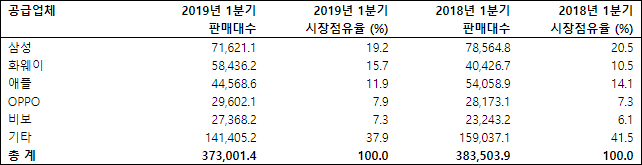
Smartphone sales to end users (unit: 1,000 units)
“If Google really does stop providing emergency apps and services to Huawei smartphones, it will have a major impact on Huawei’s international smartphone business, which accounts for half of its revenue,” said Anshul Gupta, senior research analyst at Huawei. “This will not only raise concerns among customers but will also hinder Huawei’s growth in the short term.”
Samsung and Apple's annual growth rates decline
Samsung's smartphone sales fell 8.8% year-over-year in the first quarter of 2019, but the company still held the top spot globally.
“Samsung’s flagship smartphone, the Galaxy S10, received a good response,” said Anshul Gupta, senior research analyst. “However, the product was only shipped at the end of the first quarter, so only a small portion of the sales were recorded.”
He added, "Samsung has strengthened its mid- to low-priced smartphone lineup by reorganizing the A and J series and introducing the new M series, but it has not been able to make a significant impact due to aggressive competition from Chinese manufacturers."
Apple iPhone sales in the first quarter of 2019 amounted to 44.6 million units, a 17.6% decrease year-over-year.
“While lower iPhone prices in the market helped boost demand, they weren’t enough to restore growth in the first quarter,” said Anshul Gupta, senior research analyst at Logic. “Apple is facing a long replacement cycle as users are not finding enough value in replacing their existing iPhones.”
The competition for 5th place continues
Vivo sold 27.4 million smartphones in the first quarter of 2019, beating Xiaomi, which sold 27.2 million units, to take fifth place.
Vivo achieved double-digit growth in the smartphone market in the first quarter of 2019, fueled by cutting-edge features such as in-display fingerprint recognition, a slider camera, fast charging, and a near-bezel-less display.
“We expect Vivo to perform better if it expands its range of low-cost smartphones and sells these products in emerging Asia Pacific,” said Anshul Gupta, senior research analyst.
Comments
Related news
The era of 5G mobile communications opens in Korea for the first time in the world
The Ministry of Science and ICT announced that on the 3rd at 11 PM, the three mobile carriers simultaneously activated 5G mobile communication smartphones for their first subscriber in each company, officially launching the 5G service. Since December 1st of last year, Korea initially launched 5G service targeting corporate customers through dongle terminals by the three carriers simultaneously with 5G spectrum transmission. With the launch of 5G smartphones ahead of any other country in the world this time, Korea has achieved the world's first smartphone-based 5G commercialization. The industry had anticipated that 5G service would begin on the 5th; however, commercialization preparations including 5G smartphone launch and preparation of service terms and conditions were completed ahead of schedule, allowing the launch to be accelerated by two days from the original plan. Similar to the early 4G rollout, the three mobile carriers are initially launching 5G service primarily in densely populated areas of major cities including Seoul, the Seoul metropolitan area, and some metropolitan cities. Subsequently, the carriers plan to continuously expand 5G network construction so that 5G service can be provided in densely populated areas of 85 cities nationwide by the end of this year.
2019.04.04by 이수민 기자
Evolving AI Trends… The Path Forward for Smartphone AI in 2019: "Personalization and Edge AI"
AI in the vision and voice domains, including AI cameras and AI speakers, has now become part of everyday life. Recently, AI has been evolving from performing commands to proactively providing necessary information. Services and manufacturers now offer customized features based on individual customer usage information and current situations. Platform companies have also begun providing tools that enable personalized services. Edge AI, which performs AI processing directly on user-facing devices, is increasingly being emphasized. As concerns about personal data privacy have grown significantly, users have become uncomfortable with their data being processed in the cloud. Platform companies are responding by proposing dedicated hardware acceleration technologies for edge AI.
2019.04.09by 이수민 기자

Global PC and smartphone shipment forecast for 2019: Similar to previous years.
Global shipments of devices including PCs, tablets, and mobile phones in 2019 are expected to reach 2.21 billion units, maintaining a level similar to the previous year. While the PC market continues to show decline, the mobile phone market is expected to recover growth in 2020. The PC market has been in stagnation for eight consecutive years. PC shipments in 2019 are projected to decline 0.6% compared to 2018, reaching 258 million units. Mobile phone shipments in 2019 are estimated to reach 1.8 billion units, declining 0.5% year-over-year. By 2023, foldable smartphones are projected to account for 5% of the premium mobile phone market, reaching approximately 30 million units in scale.
2019.04.10by 이수민 기자
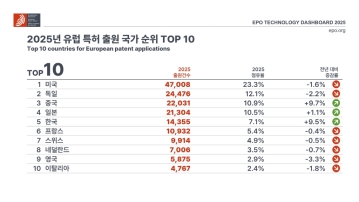
European Patent Applications Surpass 200,000 for the First Time… South Korea Maintains 5th Place, Led by Batteries and Telecommunications
According to the European Patent Office (EPO)'s 'Technology Dashboard 2025', European patent applications last year reached 201,974, surpassing 200,000 for the first time. Korean companies and inventors filed 14,355 applications, representing a 9.5% increase from the previous year and maintaining 5th place by country. Battery, digital communication, and semiconductor technologies led the growth, with Samsung ranking as the top EPO applicant for the second consecutive year and LG reaching 3rd place. The presence of major domestic cities such as Seoul, Suwon, and Yongin was also confirmed. It was also revealed that Korea's European patent strategy is expanding beyond individual technologies to span the entire industry.
2026.03.24by 명세환 기자

SK Telecom First Applies AI-Based Network Operations at Gwanghwamun K-Pop Concert
SK Telecom announced that it applied an AI-based network operation system for the first time at a large-scale K-pop concert held in the Gwanghwamun area of Seoul on March 21st, managing communication quality throughout the event. Mobile data usage during the three hours before and after the concert reached 12.15TB, approximately doubling compared to the same time slot the previous weekend. SK Telecom monitored traffic using the AI system 'A-One' in five-minute and 50-meter units to respond to potential overload situations, while also operating temporary communication facilities and on-site personnel in parallel. This case is interpreted as confirmation of the practical applicability of AI-based autonomous network operation in an environment where demand from dense events and foreign users increases simultaneously.
2026.03.23by 명세환 기자











