


NVIDIA Launches EGX to Accelerate AI Computing at the Edge
 Published2019.06.03 17:23
Accelerated computing platform performing real-time AI at the edge
Edge Stack connects with major cloud IoT services
NVIDIA announced NVIDIA EGX, an accelerated computing platform capable of performing real-time AI at the edge, on May 28.
NVIDIA EGX helps enterprises detect, understand, and respond in real time to continuous streaming data generated in 5G base stations, warehouses, retail, factories, and more.
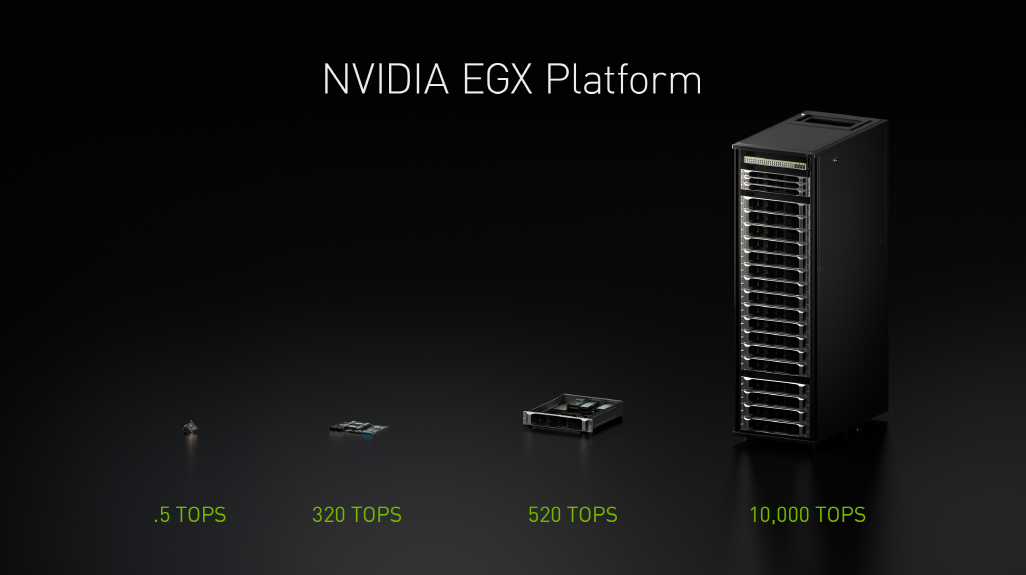
NVIDIA EGX was developed to meet the demand for performing immediate, high-throughput AI at the edge where data is generated, while reducing the amount of data that needs to be transmitted to the cloud.
According to IDC, by 2025, over 150 billion machine sensors and IoT devices are expected to stream continuous data that needs to be processed. This is a larger amount than the data generated by individuals using smartphones.
Edge servers such as the NVIDIA EGX platform can be used to process data coming from these sensors in real time across the globe.
“Enterprises need more powerful computing at the edge to process the vast amount of raw data streaming from countless interactions between customers and devices,” said Bob Pette, Vice President and General Manager of Enterprise and Edge Computing at NVIDIA. “Scalable platforms like NVIDIA EGX can meet enterprise requirements by easily deploying systems in both on-premises and cloud environments.”
High scalability and enterprise-grade performance
NVIDIA EGX can be started with the NVIDIA Jetson Nano, a small AI computer capable of performing 500 billion operations per second with low power consumption of just a few watts to handle tasks such as image recognition.
It is also connected to an entire rack of NVIDIA T4 servers that provide up to 10,000 tera-operations per second (TeraOPS; TOPS) of performance for real-time voice recognition and other real-time AI tasks.
NVIDIA has partnered with Red Hat to integrate and optimize OpenShift, an enterprise-grade Kubernetes container orchestration platform, and NVIDIA Edge Stack.
" />
The NVIDIA Edge Stack is optimized for software including NVIDIA drivers, the CUDA Kubernetes plugin, the CUDA container runtime, CUDA-X libraries, TensorRT, the TensorRT Inference Server, and containerized AI frameworks and applications including DeepStream.
The NVIDIA Edge Stack can be downloaded from the NVIDIA NGC registry.
Chris Wright, Chief Technology Officer at Red Hat, said, “Red Hat is committed to providing a consistent experience across all workloads, footprints, and locations, from the hybrid cloud to the edge,” adding, “By combining Red Hat OpenShift with NVIDIA EGX-enabled platforms, customers can further optimize distributed operations in high-performance, container-centric environments.”
Rapid AI infrastructure construction
NVIDIA EGX combines all of NVIDIA's AI computing technologies, as well as Red Hat OpenShift and the NVIDIA Edge Stack, with security, networking, and storage technologies from Mellanox and Cisco. This enables companies in major industries, including telecommunications, manufacturing, retail, healthcare, and transportation, to rapidly and securely build state-of-the-art enterprise-grade AI infrastructure.
“Mellanox Smart NICs and switches provide ideal I/O connectivity for data access extending from the edge to hyperscale data centers,” said Michael Kagan, Chief Technology Officer at Mellanox. “The combination of high performance, low latency, and accelerated networking provides a new infrastructure tier essential for effectively accessing and delivering the data required to implement next-generation AI solutions on edge platforms such as NVIDIA EGS.”
"Kaustubh Das, Vice President of Cisco Computing Systems, said, 'We are pleased to be able to provide edge-to-core full-stack solutions for customers by leveraging Cisco compute, fabric, storage, and management software, as well as our industry-leading Ethernet and IP-based networking technologies and EGX-enabled platforms.'"
Hybrid cloud and multi-cloud IoT support
NVIDIA AI computing is provided by major cloud services and is structurally compatible with NVIDIA EGX.
AI applications developed in the cloud can run on NVIDIA EGX, and vice versa.
NVIDIA Edge Stack connects to major cloud IoT services, and customers can remotely manage services on AWS IoT Greengrass and Microsoft Azure IoT Edge.
Sam George, General Manager of Azure IoT Edge, said, “Azure IoT Edge helps customers quickly and securely deploy cloud services to IoT devices. By supporting the NVIDIA EGX Edge Platform on Azure IoT Edge devices, we look forward to enabling customers to deploy AI workloads on EGX-compatible hardware.”
broad ecosystem
NVIDIA EGX is optimizing AI for the growth of the software solution ecosystem. This includes video analytics applications ideal for large-scale retail chains and smart cities from software vendors such as AnyVision, DeepVision, IronYun, and Malong Technologies, as well as medical-related software products such as 12 Sigma, Infervision, Qunatib, and Subtle Medical.
EGX servers are available from global enterprise computing vendors such as ATOS, Cisco, Dell EMC, Fujitsu, Hewlett Packard Enterprise, Inspur, and Lenovo.
Major server and IoT system manufacturers such as Abaco, Acer, ADLINK, Advantech, ASRock Rack, ASUS, AverMedia, Cloudian, Connect Tech, Curtiss-Wright, GIGABYTE, Leetop, MiiVii, Musashi Seimitsu, QCT, Sugon, Supermicro, Tyan, WiBase, and Wiwynn also support EGX servers.
NVIDIA EGX Server is optimized for the proven NGC-Ready for the NVIDIA Edge Stack and CUDA-accelerated containers.
Currently, more than 40 companies and organizations are using NVIDIA EGX servers.
Among these, BMW Group Logistics is Through NVIDIA’s EGX edge computing and Isaac robot platform, AI is being directly utilized in logistics processes to handle increasingly complex logistics in real-time and efficiently.
In addition, Foxconn PC, GE Healthcare, Seagate, and others are utilizing NVIDIA EGX servers for PC component inspection, precision medicine, and hard disk quality inspection.
Comments
Related news

Mossa hosts Asia IIoT Solution Partner Forum in Seoul, unveiling IIoT cloud and security solutions.
Moxa held an Asia IIoT Solutions Partner Forum in Seoul on the 16th. Moxa's solutions and Asia-Pacific regional channel partners gathered at the event to share their IIoT implementation and application experiences. At Moxa's Asia IIoT Solutions Partner Forum this time, numerous Moxa solution partners from Korea, Taiwan, Russia, Australia, Japan and other regions came together to share success cases and insights regarding IIoT applications. At this meeting, Moxa announced edge-to-cloud connectivity solutions and industrial cybersecurity solutions for IIoT applications.
2019.05.21by 이수민 기자
Limelight Announces Content Delivery Network Strategy for the Era of High-Capacity Content Streaming
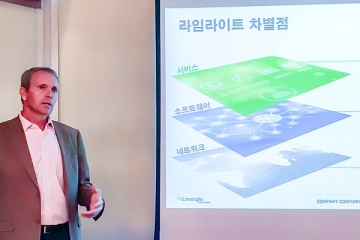
Limelight Networks announced its strategy to commemorate the visit to Korea by Chairman Robert A. Lento. Limelight will expand its customer base in domestic media, broadcasting, gaming, mobile, software, and device manufacturing sectors based on edge services that minimize content delivery latency and 'Limelight Realtime Streaming,' a sub-second ultra-low latency live video streaming solution. In 2019, Limelight plans to increase its global CDN capacity from the current 39Tbps to 55Tbps in line with the exponential growth trend of online traffic. Additionally, the company plans to expand its PoPs from the current 82 locations worldwide to 215 locations and will establish presence in 57 countries.
2019.05.21by 이수민 기자
Lattice Strengthens sensAI Solution Stack for Low-Power Smart IoT Devices Running at the Edge
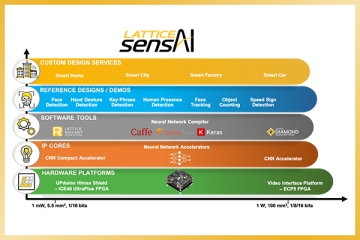
IHS forecasted that 40 billion devices will operate at the network edge by 2025. OEMs designing always-on edge devices seek to minimize the frequency of transmitting data to the cloud for data analytics for various reasons including latency, network bandwidth limitations, and data privacy. Lattice announced that it is enhancing key performance characteristics and design flows of its sensAI solution stack. The Lattice sensAI stack provides comprehensive hardware and software solutions for implementing low-power characteristics and always-on AI functionality in smart devices operating at the network edge.
2019.05.24by 이수민 기자

[e4ds Tech Day 2026 ⑨] Sim Sang-gyu, Autocrypt CTO: "In the Physical AI Era, Automotive Security Must Extend Beyond the Vehicle"
At e4ds Tech Day 2026, Sim Sang-gyu, CTO of Autocrypt, explained automotive cybersecurity strategies in the era of Physical AI and SDV (Software-Defined Vehicle). Automobiles are evolving as part of an ecosystem connected to AI, cloud, chargers, IoT, and robots, and he emphasized that the scope of security must expand beyond the vehicle interior to the entire connected environment. In particular, AI model tampering, adversarial attacks, OTA updates, and EV charger hacking were identified as major threats. He explained that response measures require zero trust, AI model integrity protection, intrusion detection, Security by Design and Default, and full lifecycle security management, and that proactive security system establishment beyond regulatory compliance is critical for securing future mobility competitiveness.
2026.10.12by 배종인 기자
NVIDIA to Invest $1 Billion in U.S. Science Over Next Five Years
NVIDIA has announced plans to invest $1 billion over the next five years to strengthen U.S. scientific and technological competitiveness. The company will enhance cutting-edge artificial intelligence research and development capabilities in key areas including quantum computing, healthcare, and energy security, while expanding support for higher education research institutions and cloud service providers. NVIDIA is participating as a major industry partner in the White House Office of Science and Technology Policy's Genesis Mission, and is promoting supercomputer construction in collaboration with national laboratories including Argonne and Los Alamos.
2026.10.12by 배종인 기자











