



Launch of a photoacoustic spectroscopy-based carbon dioxide measurement sensor
 Published2019.07.07 07:01
| Using MEMS microphones as detectors
| Suitable for IoT devices measuring indoor air quality
A miniature sensor that measures carbon dioxide ( CO2 ) concentration has been released.
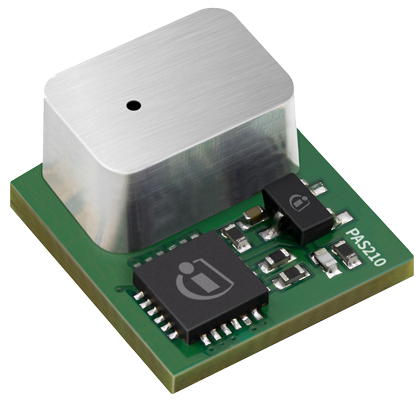
Infineon Technologies announced on the 4th that it has launched the XENSIV PAS210, an ultra-small CO2 sensor.
City dwellers spend a significant amount of time indoors, whether in offices, schools, or at home. Because urban spaces are well-insulated for energy efficiency, air can easily become trapped indoors, leading to poor air quality.
CO2 concentration is one indicator of poor air quality. Solutions used today to detect this colorless and odorless gas are bulky, expensive or poorly performing.
To address this challenge, Infineon Technologies has developed an innovative CO2 sensor technology based on photoacoustic spectroscopy (PAS).
The Sensive PAS210 is an extremely miniaturized CO2 sensor that uses a high-sensitivity MEMS microphone as a detector.
The new sensor is suitable for use in a variety of indoor air quality measurement IoT devices, such as ventilation control in smart home applications or building automation, air purifiers, thermostats, weather stations, and personal assistants.
This sensor can be used to improve indoor air quality in a quick and energy-efficient manner.
Based on numerous PAS-related technology patents, the PAS210 not only enables low-cost mass production of CO2 sensing applications, but also opens the way to detecting other gases in the future.
The CO2 sensor integrates a photoacoustic transducer, including a detector, an infrared source, and an optical filter, onto a single PCB. It also includes a microcontroller for signal processing and algorithms, and a MOSFET for driving the infrared source.
The Sensive PAS210 uses the Sensive IM69D130, a high signal-to-noise ratio (SNR) MEMS microphone, as a detector.
The PAS210 utilizes a unique PAS detection principle, enabling an unprecedentedly compact form factor. Compared to other CO2 sensors on the market, it saves over 75 percent of the mounting space. Featuring direct ppm reading, surface mount, and a simple design, it allows for easy and fast integration in both low-volume and high-volume applications.
An internal microcontroller converts the MEMS microphone output to a ppm output value, which is available via a serial I2C, UART, or PWM interface.
The CO2 measurement capability of the Sensive PAS210 is from 0 ppm to 10000 ppm with an accuracy of ±30 ppm or ±3 percent.
When operated in pulse mode, the Sensive PAS210 CO 2 sensor has a lifespan of approximately 10 years.

Comments
Related news
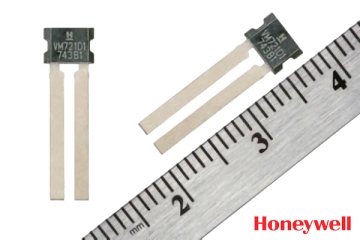
Honeywell Launches 2-Pin Anisotropic Magnetoresistance Sensor IC
Honeywell's Sensing & IoT division has launched a 2-pin AMR (anisotropic magnetoresistance) sensor IC capable of detecting the speed and direction of a ring magnet encoder target. Honeywell's 2-pin AMR sensor IC features an AMR bridge structure, providing higher sensitivity compared to Hall sensors. It delivers more accurate performance and faster response speed while offering design flexibility with a larger air gap and enabling improved assembly tolerance. Since it is not affected by magnetic field strength, a single sensor can be paired and used with different ring magnets.
2019.06.26by 이수민 기자

ADI-First Sensors Commit to Mass Supply of LiDAR Solutions
Analog Devices will collaborate with First Sensor AG to develop autonomous sensing products for unmanned vehicles, aerial and underwater transportation systems used across various industrial sectors including transportation, agriculture, and manufacturing. As part of this collaboration, the two companies will develop products that reduce the lidar signal chain. Through this product, manufacturers seeking to incorporate sensing and recognition technologies into autonomous safety systems will be able to achieve superior system performance while reducing system size, weight, power consumption, and cost. The two companies also plan to develop additional lidar products for automotive and industrial manufacturing applications.
2019.07.05by 이수민 기자
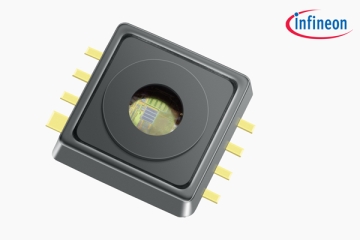
Infineon Launches High-Precision Digital Turbo MAP Sensor
Manifold absolute pressure information is an important parameter for calculating the air-fuel ratio supplied to the engine. Infineon Technologies has launched the KP276, a new sensitive absolute pressure sensor series product. The new sensor is a high-precision digital turbo MAP sensor suitable for measuring manifold air pressure in naturally aspirated or turbocharged diesel engines and gasoline engines. It supports a pressure range from 10 kPa to 400 kPa, provides optimal accuracy, and features fast measurement and communication.
2019.07.05by 이수민 기자
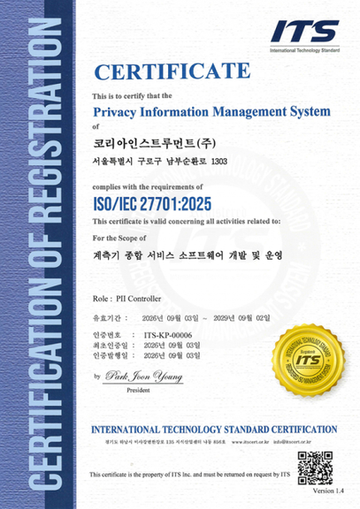
Korea Instrument, KOLAS Accredited Calibration Agency First to Simultaneously Acquire ISO/IEC 27,001·27,701
Korea Instrument has become the first among KOLAS accredited calibration agencies to simultaneously acquire ISO/IEC 27,001 and ISO/IEC 27,701 certifications. Through its proprietary platforms CWIZ Enterprise and CWIZ Partners, the company has embedded information security and personal data protection requirements across all business processes including customer information, equipment data, and calibration reports, with plans to continuously advance its management system through regular audits and security inspections.
2026.10.12by 배종인 기자

TeamViewer One, IT Incident Automation Workflow and Resolution Center Enhanced
TeamViewer has added IT incident automation capabilities and an advanced Resolution Center to its integrated digital workplace management platform 'TeamViewer ONE'. Recurrent service disruptions, configuration errors, and capacity shortages are automatically handled according to preset policies, and device status verification through script deployment can be managed in a unified interface, significantly reducing repetitive tasks for IT teams.
2026.10.12by 배종인 기자











