



ETRI Successfully Develops Graphene Composite Material with Excellent Electromagnetic Shielding Capabilities
 Published2019.07.26 06:01
| Overcoming limitations by adding titanium carbide to graphene
Suitable for electronic devices in environments with high electromagnetic radiation exposure
Domestic researchers have succeeded in developing an electromagnetic shielding material using a graphene composite.
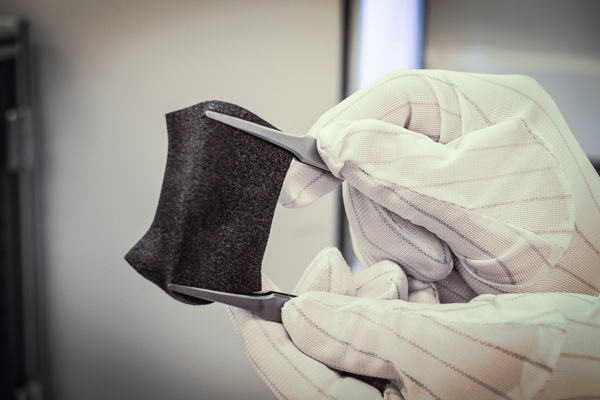
The Electronics and Telecommunications Research Institute (ETRI) announced on the 24th that it has developed a lightweight electromagnetic shielding material with high electrical conductivity by adding 'MXene' to a graphene composite material.
With the recent surge in electronic devices around us, the demand for electromagnetic shielding technology is increasing. The shielding material developed by ETRI has achieved the world's highest electromagnetic shielding rate (99.9999994%) among nanocomposite materials. It can also function as a pressure sensor by detecting changes in resistance with high performance as pressure varies.
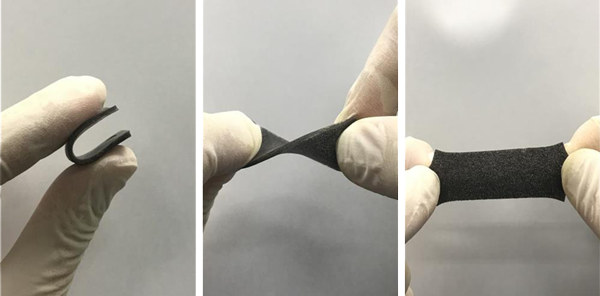
Graphene-polymer composite-based electromagnetic shielding material
The new material can be applied to various fields aimed at electromagnetic shielding. The research team predicted that it would be widely used in electronic and medical devices with high electromagnetic exposure or high density, automotive electronic components, wearable smart products, and robots.
Previously, electromagnetic shielding materials were primarily developed using metals such as copper. However, metal materials are heavy and difficult to process. Although there have been studies attempting to block electromagnetic waves using graphene, there were limitations due to its lower electrical conductivity compared to metals.
The research team overcame the limitations by adding titanium carbide ( Ti₃C₂ ) , a type of MXene, to the graphene-polymer composite material. It is not only flexible and inexpensive but also easier to manufacture than metal materials, making it advantageous for mass production of commercial products as films or coatings.
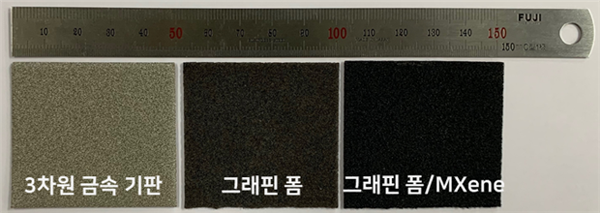
Furthermore, the potential for application as a pressure sensor was confirmed by measuring the change in resistance caused by structural deformation under external pressure using a graphene/polymer composite material having a porous structure. In particular, when two-dimensional transition metal carbides are incorporated, the sensitivity, which indicates the performance of the pressure sensor, is enhanced due to the increase in specific surface area.
Transition metal carbides are materials that have a two-dimensional plate-like layered structure in which a transition metal (titanium) and carbon are bonded. They have high electrical conductivity and many hydrophilic functional groups formed on their surface, so unlike graphene, they can be evenly dispersed using water as a solvent. Thanks to this, it has the advantage of being easy to manufacture films or coat onto various materials.
Dr. Choi Chun-ki of the New Materials Research Laboratory at ETRI's ICT Creative Research Institute stated, "As a nanocomposite, this technology possesses world-class electromagnetic shielding performance while simultaneously enabling multi-functional capabilities, such as sensor functions that respond sensitively to even small external pressures and planar heating elements."
In addition, the research team explained that since it can be manufactured into films or coated, it can be applied in various ways as a shielding material suitable for environments exposed to harmful electromagnetic waves, such as electronic and medical devices, automotive electronic components, wearable smart devices, and robot skins.
This technology is currently undergoing related domestic and international patent applications and registrations, and it is expected to be commercialized within two years as it can be immediately transferred to companies related to electronic devices, electronic materials, and electromagnetic shielding.
Meanwhile, the research team plans to develop film manufacturing and coating technologies for large-area material production and conduct future research to achieve a high shielding rate of over 90dB in the ultra-high frequency millimeter wave (30–300GHz) band.
Comments
Related news
Institute for Basic Science Successfully Synthesizes 2D White Graphene "Path Opened to Commercialization of Rollable Displays"
The Feng Ding Group Leader team at the Institute for Basic Science's Multidimensional Carbon Materials Research Unit has developed key technology for commercializing low-power, high-performance rollable displays that roll up like newspapers, in collaboration with research teams from China and Switzerland. The research team has successfully manufactured single-crystal 2D white graphene, which previously had a manufacturing limit of just a few square millimeters, at a large area of up to 100 cm². This is a size that can be directly applied to semiconductor manufacturing processes. 2D white graphene is a 2D material with a thickness of 1-2 atomic layers in which boron and nitrogen atoms are arranged in a triangular form. Unlike graphene, it possesses insulating properties and can be applied as a 2D insulator. The Ministry of Science and ICT and the Institute for Basic Science announced that the research results were published online in Nature, the world's most prestigious academic journal, on May 23.
2019.05.23by 이수민 기자
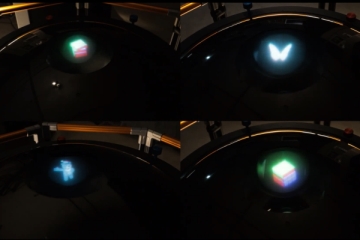
ETRI Develops Hologram 250 Times Sharper Than 8K
Hologram display primarily uses spatial light modulation technology based on liquid crystals. This method creates images by applying voltage to liquid crystals to change the phase of light. To enhance the image quality and viewing angle of hologram displays, the key is to reduce the pixel pitch in the liquid crystal devices. The Electronics and Telecommunications Research Institute announced on the 23rd that it has developed a new pixel structure technology that significantly reduces both pixel size and pixel pitch to the micrometer level, enabling a 30-degree viewing angle and substantially improved image quality. With this technology, it is expected that panel development implementing 72K resolution using the world's smallest 1㎛ pixel pitch device will become possible.
2019.05.26by 이수민 기자

ETRI Unveils "Covert," a Korean Language Model for AI Applications
The Electronics and Telecommunications Research Institute (ETRI) has released its cutting-edge Korean language model 'KoBERT' through its homepage. The research team unveiled two types of models: a language model created by incorporating more Korean language data based on Google's language representation methodology, and a language model that also reflects the agglutinative characteristics of Korean. To develop deep learning technology for natural language processing, words described in text must be represented as numerical values. For this purpose, organizations developing services utilizing language have primarily used Google's multilingual language model BERT. The research team explained that the language model optimized for Korean distinguishes itself from Google's offering through morphological analysis in the preprocessing stage, learning parameters optimized for Korean, and a foundation of massive data.
2019.06.11by 이수민 기자
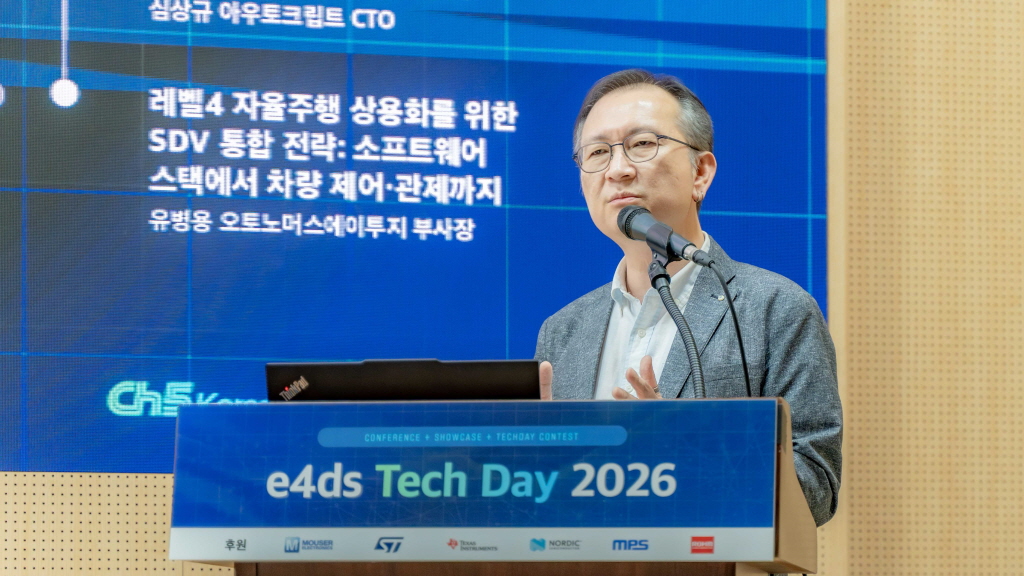
[e4ds Tech Day 2026 ⑨] Sim Sang-gyu, Autocrypt CTO: "In the Physical AI Era, Automotive Security Must Extend Beyond the Vehicle"
At e4ds Tech Day 2026, Sim Sang-gyu, CTO of Autocrypt, explained automotive cybersecurity strategies in the era of Physical AI and SDV (Software-Defined Vehicle). Automobiles are evolving as part of an ecosystem connected to AI, cloud, chargers, IoT, and robots, and he emphasized that the scope of security must expand beyond the vehicle interior to the entire connected environment. In particular, AI model tampering, adversarial attacks, OTA updates, and EV charger hacking were identified as major threats. He explained that response measures require zero trust, AI model integrity protection, intrusion detection, Security by Design and Default, and full lifecycle security management, and that proactive security system establishment beyond regulatory compliance is critical for securing future mobility competitiveness.
2026.10.12by 배종인 기자

Practical HIL Construction Strategy for Automotive and Off-Highway Controller Validation
As vehicle E/E architecture transitions to zonal structures and shifts to software-defined vehicles (SDV), the number of controllers (ECUs) requiring validation and software complexity are surging dramatically. Meanwhile, real vehicle testing cannot provide repeated verification under identical conditions and entails lead time and safety concerns. This white paper explains the principles of HIL (Hardware-in-the-Loop) validation and the structure of the NI platform composed of PXI, SLSC, and VeriStand, and through two actual implementation cases—Camera Record & Replay HIL for In-Cabin Monitoring Controller (ICMU) and Forklift Controller (VCU) HILS—describes how controller-level regression testing becomes possible. Additionally, it explicitly states application boundaries and limitations, such as lack of A2B support.
2026.10.12by 편집부











