


Korean researchers successfully develop technology for continuous charging of implantable medical device batteries.
 Published2019.08.02 11:31
| Successfully Charged a 4.7mF Capacitor Using a Triboelectric Generator
A New Milestone in the Implantable Medical Systems Industry
Batteries for implantable medical devices become unnecessary.
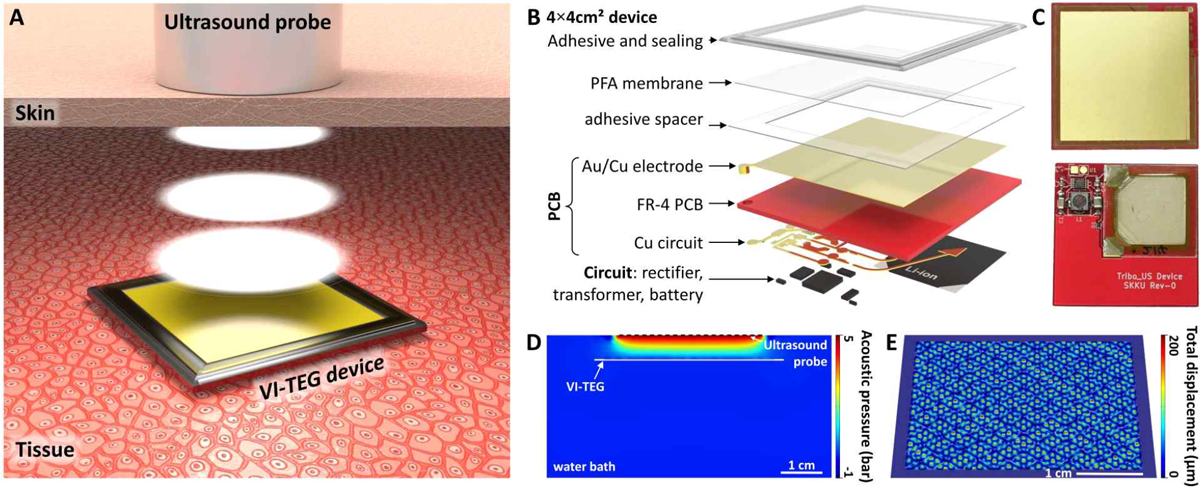
Schematic diagram of a friction electric power plant
Calculation of theoretical vibration generation levels by ultrasonic waves
Professor Kim Sang-woo's research team at Sungkyunkwan University announced on the 2nd that they have developed a new energy harvesting technology that continuously charges implantable medical devices using frictional electricity generated within the body without periodic procedures for battery replacement.
The results of this study, which was carried out as a support project for mid-career researchers by the Ministry of Science and ICT, were published in the international academic journal 'Science' on the 2nd under the title 'Transcutaneous ultrasound energy harvesting using capacitive triboelectric technology'.
In order to wirelessly transmit a significant amount of external power into the body to power implantable medical devices such as pacemakers and insulin pumps, the bio-influence aspect had to be taken into consideration.
/> Research on energy harvesting to convert mechanical energy within the body, such as heartbeat, blood flow, and muscle movement, into electrical energy has continued, but it has been difficult to achieve sufficient power generation effect because the mechanical energy generated within the body is small.
The research team found hints in harmless ultrasound used in actual examinations and treatments.
It has been demonstrated that external ultrasound can cause deformation of specific materials inserted into the body, and that high levels of electrical energy can be generated by using the frictional electricity induced by the vibrations resulting from the deformation.
There have been cases where frictional electricity was used to convert the heartbeats of rats or pigs into electrical energy, but the amount of power generated was so small that it was difficult to use it as an actual power source.
In this study, ultrasound, which can penetrate living organisms, was used as an external mechanical energy source to increase the output current by more than a thousand times.
The research team actually demonstrated that power generation through energy harvesting is possible in a real biological environment by inserting a triboelectric generator into the skin of a rat and a pig and inducing triboelectricity from the outside using ultrasound.
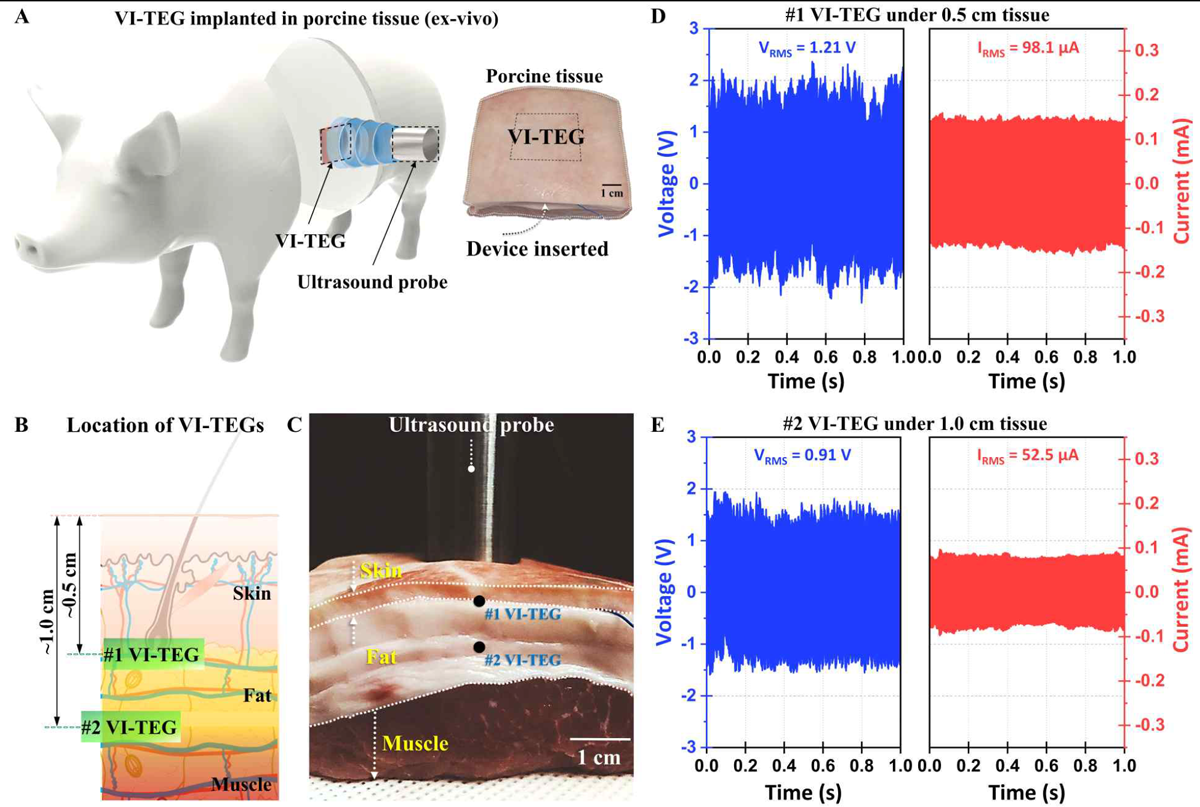
The output power (voltage of 0.91 V, 52.5 μm) from the power plant inserted into the 1 cm deep layer of pig fat can drive a pacemaker or a neurostimulator.A) was obtained.
The developed triboelectric generator was also successful in charging a thin-film lithium-ion battery (0.7 mAh, a capacity that can continuously operate a wireless temperature sensor for IoT) and a commercial capacitor (4.7 mF) under optimal conditions.
Professor Kim Sang-woo said, “We have presented a new concept of energy harvesting in the body using frictional electricity generated by ultrasound passing through the skin layer,” and added, “We expect this to set a new milestone in the implantable medical system industry.”
Comments
Related news
Microchip Launches Low-Power FPGA Image Processing Solution
As vision-based systems that are computationally intensive become integrated at the network edge, FPGAs are positioning themselves as flexible platforms for next-generation designs. Microchip Technology, through its subsidiary Microsemi, has announced the Smart Embedded Vision Initiative to assist developers with rapid design by providing solutions for intelligent machine vision system design through Microchip's low-power PolarFire FPGAs. The Smart Embedded Vision Initiative offers an FPGA product family that includes IP, hardware, and tools for low-power, small form factor machine vision designs in industrial, medical, broadcast, automotive, aerospace, and defense markets.
2019.07.16by 이수민 기자

DigiKey Supplyes Vox Power 'User-Configurable Power Supplies' Worldwide
Digi-Key Electronics announced on the 18th that it has entered into a distribution agreement with Vicor. Vicor's portfolio includes the VCCM600 series, which achieves reliability and low audio noise with a 600W fanless architecture, and the NEVO+ high-density modular products that offer configurable power ranges from 600W (NEVO+ 600 series) to 1200W (NEVO+ 1200 series) with superior performance and flexibility. These power solutions are commonly used in medical equipment, lasers, robotics, automation, and various other application areas.
2019.07.23by 이수민 기자

Maxim Launches Two Low-Power Medical Sensors for Next-Generation Wearables
The influence of wearable devices on the market continues to grow. Global wearable device sales are projected to grow at an average annual rate of 13% from $56.4 billion in 2019 to $78.3 billion in 2022. The primary growth drivers of the wearable market include smartwatch and earwear device growth and development leading to enhanced value, as well as the adoption of dedicated wearable devices in major medical fields. Wearable medical and fitness monitors must accurately measure human biometric information such as body temperature and heart rate. Until now, battery-powered compact wearable devices have faced significant constraints due to sensor accuracy. In response, Maxim announced the launch of the MAXM86161, an in-ear heart rate monitor, and the MAX30208, a medical-grade digital temperature sensor.
2019.07.26by 이수민 기자

Korea Instrument, KOLAS Accredited Calibration Agency First to Simultaneously Acquire ISO/IEC 27,001·27,701
Korea Instrument has become the first among KOLAS accredited calibration agencies to simultaneously acquire ISO/IEC 27,001 and ISO/IEC 27,701 certifications. Through its proprietary platforms CWIZ Enterprise and CWIZ Partners, the company has embedded information security and personal data protection requirements across all business processes including customer information, equipment data, and calibration reports, with plans to continuously advance its management system through regular audits and security inspections.
2026.10.12by 배종인 기자

TeamViewer One, IT Incident Automation Workflow and Resolution Center Enhanced
TeamViewer has added IT incident automation capabilities and an advanced Resolution Center to its integrated digital workplace management platform 'TeamViewer ONE'. Recurrent service disruptions, configuration errors, and capacity shortages are automatically handled according to preset policies, and device status verification through script deployment can be managed in a unified interface, significantly reducing repetitive tasks for IT teams.
2026.10.12by 배종인 기자











