



Human-Machine Partnership: Transforming the 2030 Corporate Landscape
 Published2019.08.20 14:41
| A look at future jobs and work environments, including AI fluency
Selecting the three major dilemmas that countries and businesses must address
How will our jobs and work environments change in the future?
Accordingly, Dell Technologies released the 'Future of Work' report on the 20th.
The report presents a future reshaped by new technologies, such as AI and deep learning, that strengthen the "human-machine partnership," and the resulting social dilemmas.
The survey was conducted by the Institute of the Future (IFTF), a non-profit think tank in the United States.
The report is based on interviews with over 4,600 business leaders from over 40 countries around the world and workshops with futurists and experts.
Looking at the content, the report first predicted that collaboration between humans and machines, led by AI, will rapidly spread across all industries in the future and have a huge impact on the work environment of future workers.
In fact, the World Economic Forum compared the working hours of humans and machines (AI) in its 2018 report, “The Future of Jobs.” As a result, the share of machine labor time in total working hours is expected to increase rapidly from 29% in 2018 to 42% in 2022.
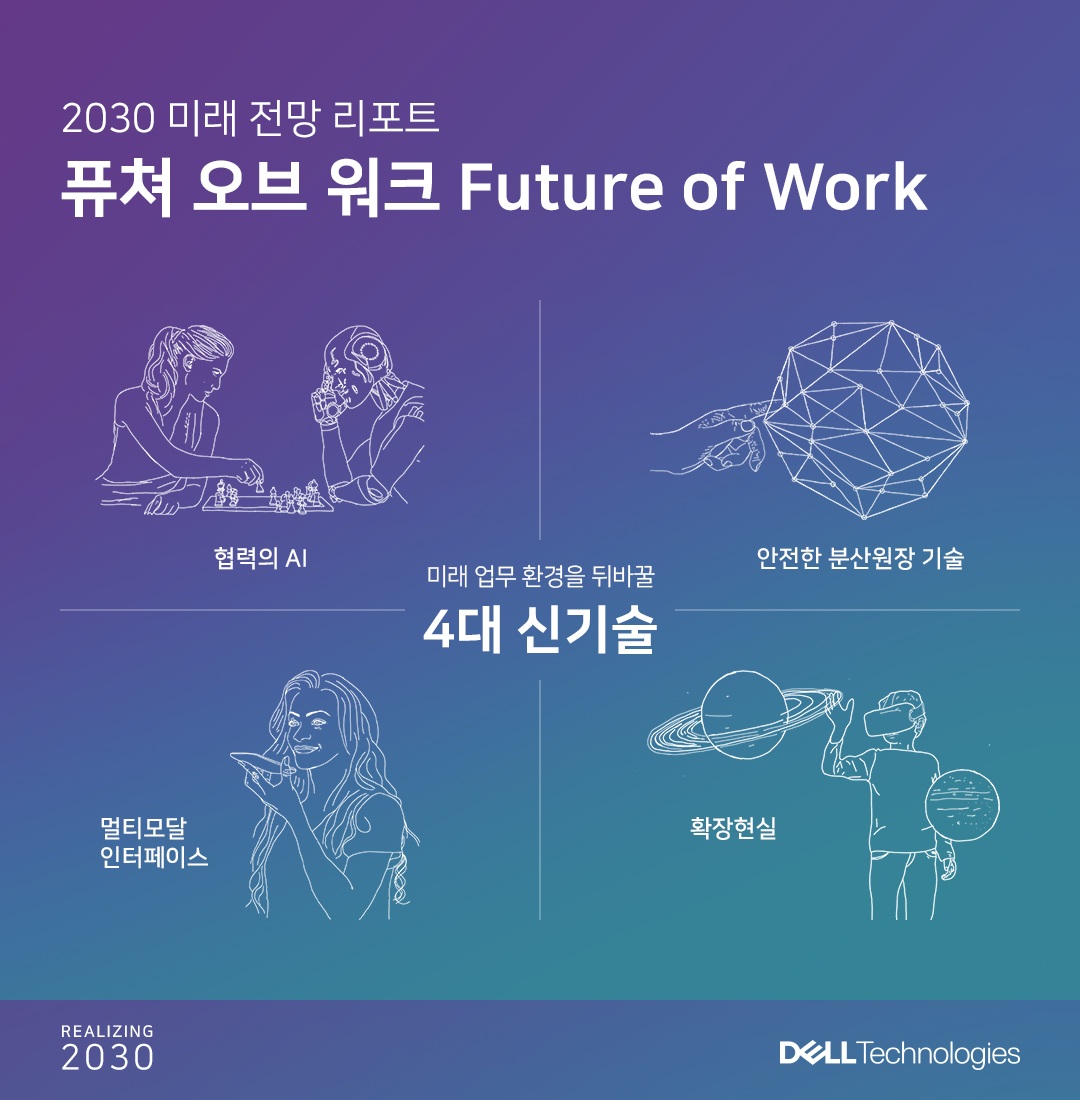
Dell Technologies, in its 'Future of Economy' report released in early July, identified four new technologies that will strengthen the cooperative relationship between humans and machines: ▲Collaborative AI ▲Multimodal Interfaces ▲Extended Reality (XR) ▲Secure Distributed Ledgers.
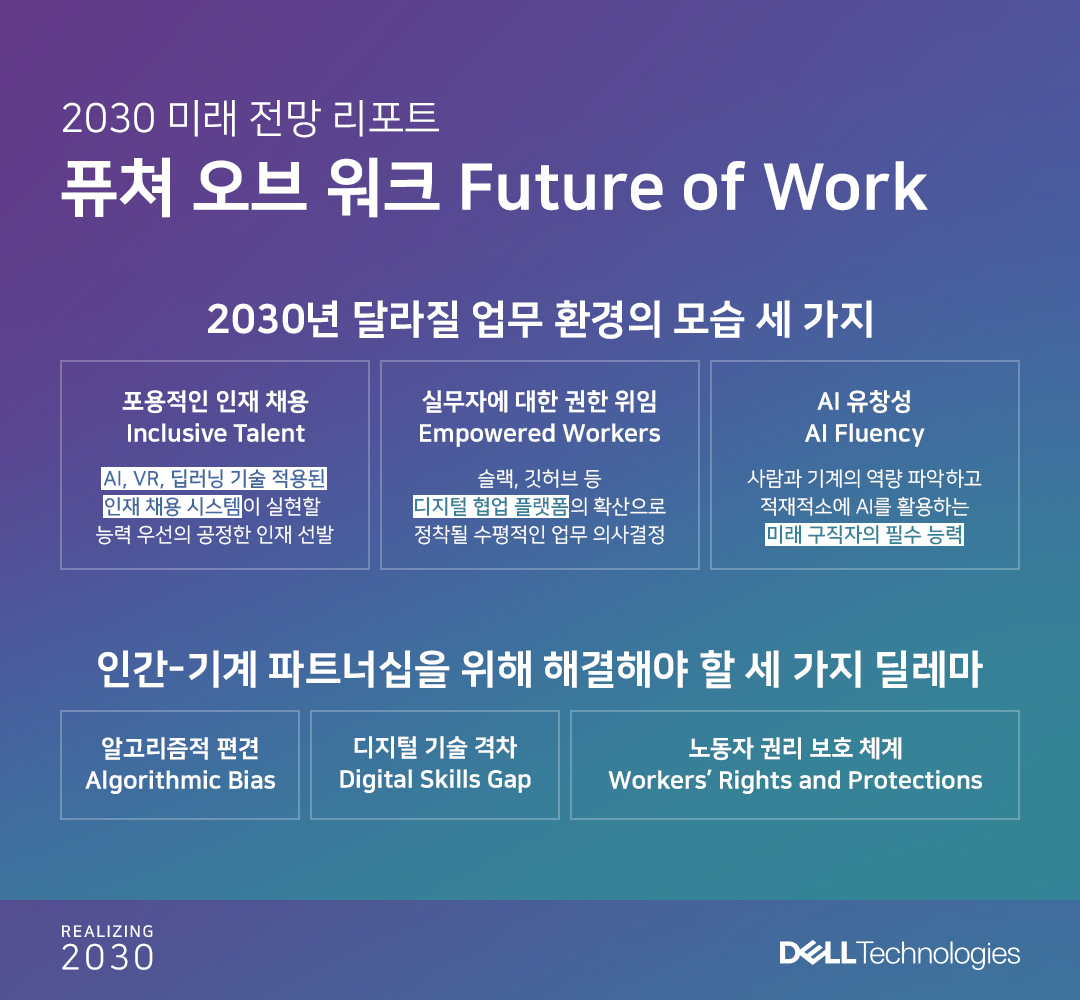
The Future of Work report predicted that these four new technologies would bring about the following three changes:
The first change: inclusive recruitment
By applying AI technology to talent recruitment, we will eliminate interviewer bias and establish a fair, competency-based hiring process.
For example, by conducting interviews in virtual reality (VR), interviewers can observe how applicants perform their duties and collaborate with other employees on virtual projects without knowing anything about the applicant's race, gender, age, or region of origin, thereby gaining insight into the applicant's expertise and personality.
Thanks to deep learning technology, applicants' personal experiences, hobbies, and possessions can be By securing richer information, including data not included in resumes such as technical skills, more information is provided, and as more information is entered, more insights are provided to determine the applicant's suitability for the job.
There are also increasing instances of introducing games familiar to millennials into the hiring process. Knack, a US startup, is showcasing technology that combines behavioral science and AI to engage applicants in a video game that can assess not only their current job performance but also their future potential.
Second Change: Delegating Authority to Practitioners
Digital work platforms that incorporate technologies like extended reality (XR) and distributed ledger technology not only facilitate collaboration among geographically distant employees, but also encourage greater employee participation based on the platform's robust openness.
As decision-making, previously held by a few executives, becomes more widely distributed, more authority is delegated to individual employees, and a horizontal decision-making culture takes hold.
Slack, a business messenger, allows you to quickly share messages with team members, as well as work files and various tools, while Discord, a gaming chat application, allows over 130 million gamers around the world to connect with other gamers and develop strategies through text, voice, and video chat.
GitHub, an open source community, was once thought of as a tool for managing and reviewing code, but has now evolved into a home for diverse developers around the world to collaborate on a wide range of projects.
As seen in the cases of British startups Colony and Etch, blockchain-based work platforms are increasingly being used to assign tasks to employees, make decisions, and share profits in real time.
Third Shift: AI Fluency
It seems likely that AI-related content will be a staple of countless training programs for job seekers and re-employment over the next decade.
The core of AI education is to understand the strengths and capabilities of both humans and machines, including what machines can and cannot do, and to improve the ability to judge what is right and wrong for machines to do.
The report calls this ability "AI Fluency," and says it allows people to have greater control over AI while also enabling them to collaborate more effectively with it.
In 2017, the MIT Sloan Management Review, published by MIT Sloan, a leading business school in the United States, introduced three future jobs that require AI fluency.
These roles include AI trainers, AI explainers, and AI sustainers. AI trainers train AI to enhance its unique personality and demonstrate empathy for humans. AI explainers clearly explain algorithm-based decision-making processes. AI sustainers are responsible for preventing AI from being compromised by external threats.
Meanwhile, the report presents the following dilemmas that humanity must consider and resolve to achieve a full partnership between humans and machines: ▲algorithmic bias ▲digital skills gap ▲worker rights protection system.
Dilemma 1: Algorithmic Bias
When recruiters have a preconceived notion of what the ideal candidate should look like, those preconceived notions are likely to be reflected in AI algorithms. However, in reality, recruiters often don't know which types of candidates will perform best in their roles. Therefore, they must be careful not to let their biases influence their algorithms, and actively leverage rich data and machine learning systems.
By identifying organizational biases in hiring processes and understanding the actual performance of past hires, we can build an analytical model for more efficient and comprehensive talent recruitment.
Dilemma 2: The Digital Skills Gap
With diverse generations coexisting in the same workplace, from junior employees familiar with digital technology to senior employees struggling to utilize technology, the digital skills gap between these generations is expected to emerge as a problem in the job market.
Therefore, efforts are needed to bridge the digital divide, such as through cross-generational "reverse mentoring" that allows junior employees to advise senior employees on technology and change management.
Dilemma 3: Protecting Workers' Rights
As the aforementioned distributed ledger technology advances, organizational structures will emerge where diverse employees across multiple countries share tasks. Additionally, as the number of cases in which projects are carried out by finding the right talent for a specific task increases, employment contracts between companies and employees are expected to undergo significant changes.
Because employees work in different locations, the labor laws that apply to them also differ, putting their rights at risk. Establishing measures to protect the rights of geographically dispersed workers is crucial, including determining the standards for paying salaries to diverse team members performing the same work, how to apply health insurance and pension programs, and how to structure vacation and sick leave policies.
“The partnership between humans and machines, which was considered a mere Go match just a few years ago, is expanding into various fields, and the future job environment will change significantly,” said Kim Kyung-jin, President and CEO of Dell Technologies. “To respond to the rapid changes in the work environment brought about by new technologies, companies must create a digital environment in the workplace and prepare so that employees can flexibly adapt to it.”
Comments
Related news
Dell, Microsoft, and VMware Partner to Accelerate Digital Transformation
Dell Technologies, Microsoft, and VMware announced a major expansion of their partnership at Dell Technologies World 2019 to accelerate customer digital transformation. Through this collaboration, customers will be able to use VMware cloud infrastructure officially supported on Microsoft Azure. Customers using VMware Workspace One together with Microsoft Office 365 will also be able to manage Office 365 across multiple devices through cloud-based integration of Microsoft Intune and Azure AD. Furthermore, VMware plans to extend the capabilities of Microsoft Windows Virtual Desktop by leveraging Horizon Cloud on Microsoft Azure.
2019.05.03by 이수민 기자
NVIDIA's DLI will train AI experts across nine industries.
Across the industry, more companies are seeking to apply AI to their businesses. According to the Digital Transformation Index announced by Dell Technologies in January this year, AI is one of the top priority issues for Asia-Pacific business leaders. NVIDIA is making various efforts to nurture AI experts. One of these is the Deep Learning Institute (DLI), a global educational program that covers the design, training, and deployment of deep neural networks. DLI participants can use GPU-accelerated workstations in the cloud and learn how to optimize and build neural networks through the latest deep learning frameworks and SDKs.
2019.06.17by 이수민 기자
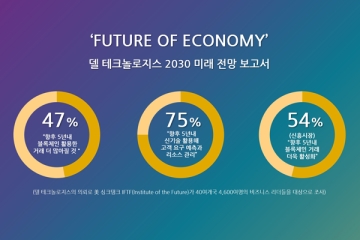
Five new technologies that will change the future economy in 2030! 5·6G, AI, IoT, blockchain, and virtual currency
Dell Technologies has released the Future of Economy report, which provides a forecast of the future economy in light of emerging technologies. The report presents prospects on how the emergence and advancement of new technologies will reshape our economy over the next decade, while providing insights into how businesses and organizations should respond to these changes. The Future of Economy report is part of Dell Technologies' thought leadership campaign that has been ongoing since 2017, and is a follow-up study to the future prediction report Realizing 2030. Conducted through IFTF, a U.S.-based nonprofit think tank, the report contains findings derived from interviews with approximately 4,600 business leaders from over 40 countries worldwide and workshops attended by futurists and experts.
2019.07.04by 이수민 기자

[e4ds Tech Day 2026 ⑨] Sim Sang-gyu, Autocrypt CTO: "In the Physical AI Era, Automotive Security Must Extend Beyond the Vehicle"
At e4ds Tech Day 2026, Sim Sang-gyu, CTO of Autocrypt, explained automotive cybersecurity strategies in the era of Physical AI and SDV (Software-Defined Vehicle). Automobiles are evolving as part of an ecosystem connected to AI, cloud, chargers, IoT, and robots, and he emphasized that the scope of security must expand beyond the vehicle interior to the entire connected environment. In particular, AI model tampering, adversarial attacks, OTA updates, and EV charger hacking were identified as major threats. He explained that response measures require zero trust, AI model integrity protection, intrusion detection, Security by Design and Default, and full lifecycle security management, and that proactive security system establishment beyond regulatory compliance is critical for securing future mobility competitiveness.
2026.10.12by 배종인 기자
NVIDIA to Invest $1 Billion in U.S. Science Over Next Five Years
NVIDIA has announced plans to invest $1 billion over the next five years to strengthen U.S. scientific and technological competitiveness. The company will enhance cutting-edge artificial intelligence research and development capabilities in key areas including quantum computing, healthcare, and energy security, while expanding support for higher education research institutions and cloud service providers. NVIDIA is participating as a major industry partner in the White House Office of Science and Technology Policy's Genesis Mission, and is promoting supercomputer construction in collaboration with national laboratories including Argonne and Los Alamos.
2026.10.12by 배종인 기자











