This page was machine-translated and may differ from the original. View original
KT to Establish External Communications Facility Management System and Center: "We Will Never Repeat the Ahyeon Branch Accident"

KT Establishes OSP Innovation Center in Daejeon
Commercialization of a Big Data-Based OSP Management System
From fire detection to fire suppression with 5G robots
On November 24, 2018, just as 5G commercialization was approaching, smoke began rising from the basement of KT's Ahyeon branch in Seodaemun-gu, Seoul. The flames engulfed numerous communication cables in the building's underground communication tunnels. This event triggered various wired and wireless communication outages in the northern part of Seoul. The National Fire Agency sent safety alert text messages, but KT subscribers were unable to receive them due to network disruption. The damage to the self-employed, in particular, was so severe that KT had to develop various compensation plans.
This was a significant event that reminded us that while providing high-speed service is important, providing stable service is equally crucial. About nine months have passed since the Ahyeon branch fire. On the 4th, KT held a press conference at the Daedeok Research Complex in Yuseong-gu, Daejeon, unveiling the "OSP Innovation Center" and vowing to never repeat the Ahyeon branch fire.

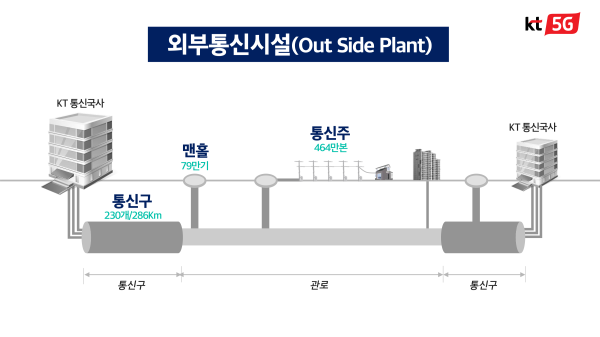
Outside Plant (OSP) refers to basic communication infrastructure such as communication tunnels, communication poles, and manholes in addition to communication equipment such as base stations and servers. Currently, KT operates and manages 230 communication lines (286 km), 4.64 million communication poles, and 790,000 manholes nationwide. Therefore, the efficiency and stability of OSPs are increasingly important.
In May of this year, KT established the "Infrastructure Operation Innovation Lab" in its network division and launched a large-scale inspection and improvement effort for its communications infrastructure. Furthermore, it regularly conducts large-scale emergency communications restoration drills to enhance its capabilities, enabling rapid response in disaster situations.
In July, the KT OSP Innovation Center was established under the Convergence Technology Research Institute to develop next-generation communications infrastructure innovation technologies. Located on approximately 76,000 square meters of land in the Daedeok Research Complex, the OSP Innovation Center is developing technologies for stable and efficient OSP construction and operation, as well as conducting real-world testing.
KT has developed a next-generation OSP management system based on big data to improve the efficiency of communications infrastructure construction and operation. Furthermore, the company plans to utilize 5G and AI-powered robots to manage communication tunnels, manholes, and other facilities more safely and reliably.
Development of Atacama, a big data-based OSP management system
On this day, KT announced that it had developed and commercialized the next-generation OSP management system, 'ATACAMA (Advanced Tunnel And Cable Management Architecture),' which can manage all processes from design to control of communication infrastructure in a single system. Atacama was completed by compiling the know-how of KT's design, operation, control, and failure recovery experts into a database.

Through Atacama, KT explained that the optical cable network design process, which previously took approximately 100 minutes for manual section-by-section design, was shortened to approximately 5 minutes, resulting in a 20-fold increase in productivity. Furthermore, KT emphasized that AI-based automated design enables optimal route design for the entire route, from start to finish, while simultaneously enhancing network reliability and stability by automatically designing dual-route systems.
The existing track opening process, which previously took approximately 50 minutes, has been shortened by a factor of five to approximately 10 minutes. Furthermore, it is expected that network failures will be easier to identify and pinpoint their precise locations, enabling faster troubleshooting.
KT unveiled an innovative OSP management solution that detects and extinguishes fires in communication facilities using robots and manages manholes using AI. This is expected to contribute to solving the inconvenience of existing solutions that can only detect problems in OSP or require individual personnel to be dispatched to the site, as well as improving work efficiency.
From fire detection to extinguishment with 5G robots
Existing fire detectors have limitations, such as taking too long to respond in real-time in emergency situations and being limited to detecting specific locations where the sensors are installed. The power required for sensor operation has also been identified as another potential cause of fires. Furthermore, when a fire breaks out in a communication area, toxic gases can make entry difficult.
KT explained that it will address this issue with its newly developed "fire detection technology (Cable Tunnel Temperature Remote Sensing; CTTRS)" and 5G robots. When CTTRS detects abnormal temperature changes within a communication tunnel, rail-mounted and ground-mounted 5G robots installed within the tunnel assess the situation and extinguish fires early.

The rail-type 5G robot 'Sapphire' moves along rails installed in the communication facility and can remotely monitor and control the communication facility environment through a 5G network. The on-site situation is relayed in real time via 5G using a full HD camera and thermal imaging camera, and fire extinguishing powder is sprayed with an aerosol fire extinguisher to extinguish the fire at an early stage.
Because manholes are located beneath roads, inspecting their interiors requires workers to physically visit the site. KT has developed a manhole management solution that automatically and remotely detects flooding in real time and enables rapid action.
Manhole Flooding Remote Sensing (MFRS) technology uses AI-based distributed sonar to detect flooding in manholes. Once the location of a flooded manhole is identified using MFRS, a 5G-powered robot called "Bingsu" (泵水) travels to the location and performs on-site work. The autonomous robot, Bingsu, explores the manhole environment and performs water pumping.

The shaved ice robot uses a magnet lifter to open the manhole cover, enter, and automatically lift water. It is expected that the ability to check the inside of manholes with a 360-degree camera and hazardous gas sensor will also help prevent safety accidents during manhole work.
Continued OSP innovation for stable 5G services
Telecommunication poles, installed to connect external communication cables, are typically installed at heights of 5 meters or more. Therefore, they can tilt due to various factors, including external impacts and weather. In such cases, maintenance is necessary for safety reasons, so it's crucial to quickly recognize and take action to address any tilting of the pole.
KT has developed a solution that allows for quick and easy remote detection of telecommunications pole tilt. The newly developed "Pole Tilt Remote Sensing (PTRS)" technology can remotely detect the tilt of a telecommunications pole. This remote monitoring of the pole's condition is expected to reduce unnecessary field trips.
KT applies OSP innovation technologies and solutions to sites nationwide after rigorous testing. In addition, we plan to actively utilize ICT convergence to build and operate a safe and stable communications infrastructure.

KT Network Division President Oh Seong-mok said, “In order to enjoy the hyper-connected society that will unfold around 5G, the stability of OSP, the foundation of communications infrastructure, must be improved above all else.” He added, “KT will continue to pursue innovation to elevate the reliability of Korea’s communications infrastructure to the next level, centered around the OSP Innovation Center.”
Commercialization of a Big Data-Based OSP Management System
From fire detection to fire suppression with 5G robots
On November 24, 2018, just as 5G commercialization was approaching, smoke began rising from the basement of KT's Ahyeon branch in Seodaemun-gu, Seoul. The flames engulfed numerous communication cables in the building's underground communication tunnels. This event triggered various wired and wireless communication outages in the northern part of Seoul. The National Fire Agency sent safety alert text messages, but KT subscribers were unable to receive them due to network disruption. The damage to the self-employed, in particular, was so severe that KT had to develop various compensation plans.
This was a significant event that reminded us that while providing high-speed service is important, providing stable service is equally crucial. About nine months have passed since the Ahyeon branch fire. On the 4th, KT held a press conference at the Daedeok Research Complex in Yuseong-gu, Daejeon, unveiling the "OSP Innovation Center" and vowing to never repeat the Ahyeon branch fire.

▲ KT OSP configuration diagram (Image provided by KT)
Outside Plant (OSP) refers to basic communication infrastructure such as communication tunnels, communication poles, and manholes in addition to communication equipment such as base stations and servers. Currently, KT operates and manages 230 communication lines (286 km), 4.64 million communication poles, and 790,000 manholes nationwide. Therefore, the efficiency and stability of OSPs are increasingly important.
In May of this year, KT established the "Infrastructure Operation Innovation Lab" in its network division and launched a large-scale inspection and improvement effort for its communications infrastructure. Furthermore, it regularly conducts large-scale emergency communications restoration drills to enhance its capabilities, enabling rapid response in disaster situations.
In July, the KT OSP Innovation Center was established under the Convergence Technology Research Institute to develop next-generation communications infrastructure innovation technologies. Located on approximately 76,000 square meters of land in the Daedeok Research Complex, the OSP Innovation Center is developing technologies for stable and efficient OSP construction and operation, as well as conducting real-world testing.
KT has developed a next-generation OSP management system based on big data to improve the efficiency of communications infrastructure construction and operation. Furthermore, the company plans to utilize 5G and AI-powered robots to manage communication tunnels, manholes, and other facilities more safely and reliably.
Development of Atacama, a big data-based OSP management system
On this day, KT announced that it had developed and commercialized the next-generation OSP management system, 'ATACAMA (Advanced Tunnel And Cable Management Architecture),' which can manage all processes from design to control of communication infrastructure in a single system. Atacama was completed by compiling the know-how of KT's design, operation, control, and failure recovery experts into a database.

▲ KT Chairman Hwang Chang-gyu's next-generation communications infrastructure innovation technology
Giving a greeting at the meeting (Photo provided by KT)
Through Atacama, KT explained that the optical cable network design process, which previously took approximately 100 minutes for manual section-by-section design, was shortened to approximately 5 minutes, resulting in a 20-fold increase in productivity. Furthermore, KT emphasized that AI-based automated design enables optimal route design for the entire route, from start to finish, while simultaneously enhancing network reliability and stability by automatically designing dual-route systems.
The existing track opening process, which previously took approximately 50 minutes, has been shortened by a factor of five to approximately 10 minutes. Furthermore, it is expected that network failures will be easier to identify and pinpoint their precise locations, enabling faster troubleshooting.
KT unveiled an innovative OSP management solution that detects and extinguishes fires in communication facilities using robots and manages manholes using AI. This is expected to contribute to solving the inconvenience of existing solutions that can only detect problems in OSP or require individual personnel to be dispatched to the site, as well as improving work efficiency.
From fire detection to extinguishment with 5G robots
Existing fire detectors have limitations, such as taking too long to respond in real-time in emergency situations and being limited to detecting specific locations where the sensors are installed. The power required for sensor operation has also been identified as another potential cause of fires. Furthermore, when a fire breaks out in a communication area, toxic gases can make entry difficult.
KT explained that it will address this issue with its newly developed "fire detection technology (Cable Tunnel Temperature Remote Sensing; CTTRS)" and 5G robots. When CTTRS detects abnormal temperature changes within a communication tunnel, rail-mounted and ground-mounted 5G robots installed within the tunnel assess the situation and extinguish fires early.

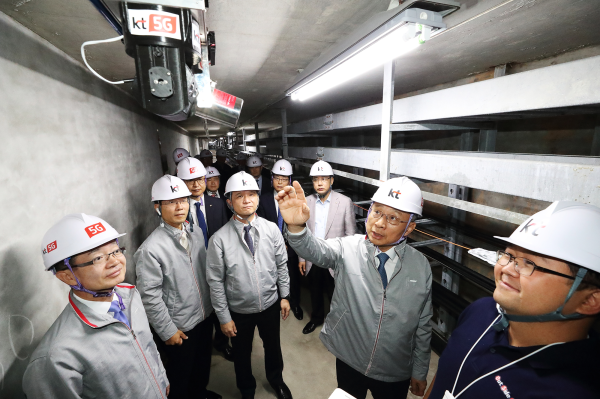
▲ KT Chairman Hwang Chang-gyu examining a sapphire (Photo provided by KT)
The rail-type 5G robot 'Sapphire' moves along rails installed in the communication facility and can remotely monitor and control the communication facility environment through a 5G network. The on-site situation is relayed in real time via 5G using a full HD camera and thermal imaging camera, and fire extinguishing powder is sprayed with an aerosol fire extinguisher to extinguish the fire at an early stage.
Because manholes are located beneath roads, inspecting their interiors requires workers to physically visit the site. KT has developed a manhole management solution that automatically and remotely detects flooding in real time and enables rapid action.
Manhole Flooding Remote Sensing (MFRS) technology uses AI-based distributed sonar to detect flooding in manholes. Once the location of a flooded manhole is identified using MFRS, a 5G-powered robot called "Bingsu" (泵水) travels to the location and performs on-site work. The autonomous robot, Bingsu, explores the manhole environment and performs water pumping.
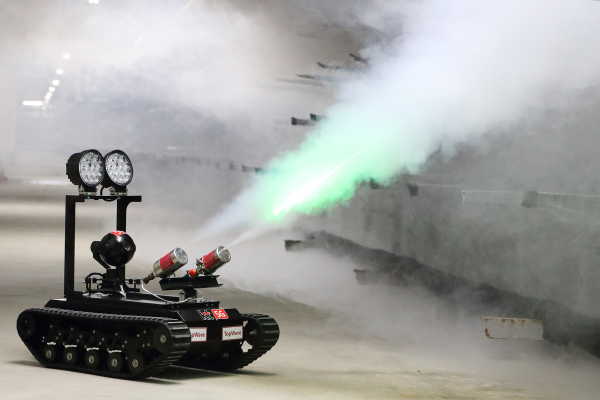
▲ Bingsu sprayed with digestive powder (Photo courtesy of KT)
The shaved ice robot uses a magnet lifter to open the manhole cover, enter, and automatically lift water. It is expected that the ability to check the inside of manholes with a 360-degree camera and hazardous gas sensor will also help prevent safety accidents during manhole work.
Continued OSP innovation for stable 5G services
Telecommunication poles, installed to connect external communication cables, are typically installed at heights of 5 meters or more. Therefore, they can tilt due to various factors, including external impacts and weather. In such cases, maintenance is necessary for safety reasons, so it's crucial to quickly recognize and take action to address any tilting of the pole.
KT has developed a solution that allows for quick and easy remote detection of telecommunications pole tilt. The newly developed "Pole Tilt Remote Sensing (PTRS)" technology can remotely detect the tilt of a telecommunications pole. This remote monitoring of the pole's condition is expected to reduce unnecessary field trips.
KT applies OSP innovation technologies and solutions to sites nationwide after rigorous testing. In addition, we plan to actively utilize ICT convergence to build and operate a safe and stable communications infrastructure.

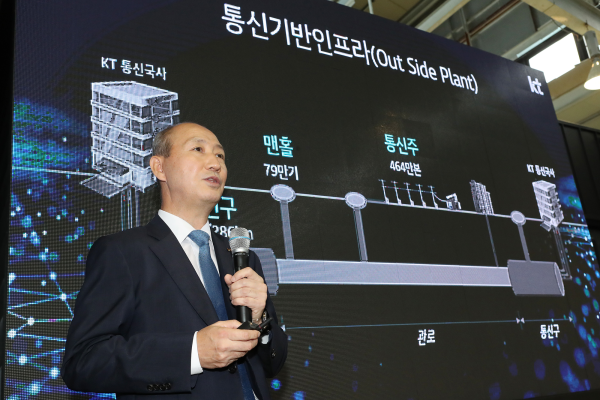
▲ KT Network Division President Oh Seong-mok (Photo provided by KT)
KT Network Division President Oh Seong-mok said, “In order to enjoy the hyper-connected society that will unfold around 5G, the stability of OSP, the foundation of communications infrastructure, must be improved above all else.” He added, “KT will continue to pursue innovation to elevate the reliability of Korea’s communications infrastructure to the next level, centered around the OSP Innovation Center.”
본 기사에 대한 정정·반론·추후보도 청구는 보도 청구 안내를, 그간 게재된 보도문은 정정·반론보도 모아보기를 참고해 주세요.